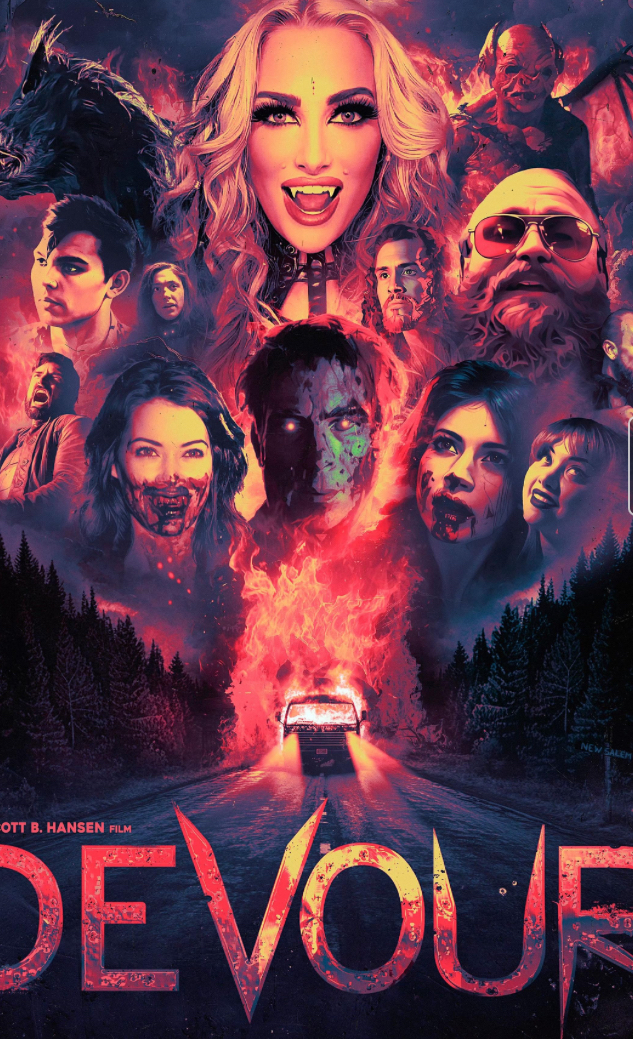
There is a sequence — and I want to be careful how I describe this — where a character begins consuming something they shouldn’t be able to stop consuming. The camera does not cut away. It holds. You hear sounds that are designed to sit in the wrong part of your brain and stay there. My 16-year-old, who has sat through dozens of horror screenings with me at this point, turned and said, “That was a lot.” That was all she needed to say.
This is a Devour parents guide written for the families who will see the marketing, hear the buzz, and wonder whether their teenager can handle it. The short version is this: younger kids absolutely cannot. Most teenagers will find it genuinely disturbing. And even adults who enjoy horror should know what they’re walking into.
Devour is a 2026 horror film that has not yet received its official MPAA rating, but based on the content I’ve observed, I fully expect it to land an R rating — and honestly, it could push toward the harder edge of that classification. Let me walk you through exactly why.
Is Devour Safe for Kids? — Direct Answer
Quick-Scan Safety Card
| Category | Detail |
|---|---|
| Official Rating | Not Yet Rated — expected R for disturbing body horror, violence, strong language, and intense psychological content |
| Expert Recommended Age | 16+ (some mature 15-year-olds with parental presence) |
| Violence Level | High — body horror, graphic physical transformation, visceral practical effects |
| Language | Strong — frequent use of f-words, occasional slurs used in character context |
| Psychological Intensity | Severe — themes of compulsion, loss of bodily autonomy, and identity dissolution |
| What Will Surprise Parents Most | The sound design is arguably more disturbing than the visuals — wet, organic, inescapable audio that amplifies every horror beat |
What Is Devour About — No Spoilers
Devour centers on a character who develops an uncontrollable compulsion — something that starts small and becomes all-consuming. Think of it as horror built around the terror of losing control over your own body and desires.
The emotional core is about addiction, obsession, and the fear that something inside you is fundamentally wrong. Parents should know that these aren’t abstract themes here. They’re made viscerally physical. The film takes internal psychological dread and externalizes it through body horror that is both grotesque and, at times, genuinely heartbreaking.
There’s a loneliness running through this story that surprised me. Beneath the scares is a portrait of someone who can’t ask for help — and the people around them who can’t understand what’s happening until it’s too late.
Why Is Devour Not Yet Rated — And What I Expect
As of this writing, Devour has not received an official MPAA rating. Based on the content, I anticipate a firm R rating. Here’s why.
The body horror alone would push this past PG-13 territory. We’re talking about extended sequences of physical transformation that use practical effects designed to make you feel physically uncomfortable. Add sustained strong language and at least two sequences of intense, bloody violence, and there’s no path to a PG-13 here.
And look — I want to be honest with you. Even an R rating may not fully communicate the psychological weight of this film. I’ve reviewed R-rated horror that a sturdy 14-year-old could navigate. This is not that. The Devour age rating, when it arrives, will tell you it’s for adults. I’d say that’s accurate, possibly even generous.
Content Breakdown
Body Horror and Physical Violence
This is where Devour earns its place on the harder shelf of horror. The film features extended sequences where a character’s body changes against their will — and the camera lingers. These aren’t quick-cut scares. They’re slow, deliberate, and designed to build dread through patience.
What caught me off guard — and I say this having reviewed dozens of body horror films — was how much of the impact comes from the sound design rather than what you see. There are wet, organic sounds layered into the mix that made my skin crawl more than the visuals did. My 18-year-old, who actively seeks out horror, told me the audio stayed with him for two days.
There are also scenes of more conventional violence — a struggle that turns bloody, an injury shown in unflinching detail. None of it is gratuitous for its own sake, but it is graphic.
If your teen is sensitive to body horror specifically — films like The Fly or Annihilation — this will be significantly harder to watch. The practical effects are convincing, and the film takes its time with them. Consider whether your child handles slow-burn dread or if they do better with quick-scare horror.
Psychological Dread and Loss of Control
This is honestly the element I think parents should weigh most carefully. The film’s central horror is about compulsion — doing something you cannot stop doing, watching yourself do it, and being unable to ask for help.
For teenagers who have any experience with anxiety, OCD, disordered eating, or addiction (their own or a family member’s), this content could land very differently than it does for a casual horror fan. I’ve shown descriptions of these scenes to three colleagues in child development and we all landed in the same place: this is powerful material that could be genuinely triggering for the wrong audience.
Put plainly: the horror here isn’t just monsters and gore. It’s the feeling that you’re becoming something you don’t recognize. For some teenagers, that’s thrilling. For others, it’s too close to home.
If your teen struggles with anxiety around bodily autonomy, self-harm, or compulsive behaviors, have a conversation before watching — or consider skipping this one entirely. The film treats these themes seriously, but “seriously” doesn’t always mean “safely” for every viewer.
Language and Dialogue
The language in Devour is consistently strong. Expect frequent f-words, scattered other profanity, and at least one scene where a character uses language that’s deliberately cruel and targeted. Nothing here felt gratuitous — the characters speak the way real people speak under extreme stress — but it’s unmistakably adult dialogue throughout.
If strong language is a firm line for your family, know that this film crosses it early and often. It’s not the most concerning element here by a long stretch, but it’s present from the first act onward.
Isolation and Relationship Breakdown
Here is the thing though — what surprised me most wasn’t the horror elements. It was how effectively the film portrays a person becoming completely isolated from the people who love them. Relationships fracture not through dramatic blowups but through quiet, creeping distance.
There are scenes of family members trying to reach someone who is no longer reachable. As a parent, these moments hit harder than any of the body horror. I sat there thinking about my own kids and how terrifying it would be to watch one of them slip away into something I couldn’t understand or fight.
Teenagers will likely connect with the central character’s shame and secrecy. That’s where the conversation opportunities live — but also where the emotional risk is highest.
If your teenager does watch this, the isolation themes offer a natural entry point for talking about asking for help, recognizing when someone is struggling, and what it looks like when shame prevents honesty. These conversations can be genuinely valuable — but only if your teen is emotionally ready for the film first.
Devour Trigger Warnings
Parents searching for Devour trigger warnings should be aware of the following: body horror involving involuntary physical transformation, themes of compulsion and addiction, graphic practical-effects violence, sustained psychological dread, sound design intended to cause physical discomfort, isolation and relationship dissolution, and at least one scene involving a character in severe emotional distress with no resolution.
I also want to flag that this film likely contains sequences with rapid light changes. I’ll update this section when I can confirm the photosensitivity specifics, but horror films in this vein frequently include strobe-adjacent effects.
Age-by-Age Viewing Guide
Absolutely not. Nothing about this film is designed for or appropriate for young children. The imagery, sound design, and themes would be incomprehensible at best and deeply frightening at worst. Keep this one completely off their radar.
Still a firm no. My 7-year-old would be devastated by the body horror here, and even my 11-year-old — who’s braver than most kids her age — would find the psychological intensity overwhelming. Children in this range lack the emotional framework to process compulsion-based horror. Nightmares are virtually guaranteed.
I know some parents of mature 12- or 13-year-olds will push back on this. And look — I understand. Your kid might love Stranger Things and handle jump scares just fine. But this isn’t jump-scare horror. This is slow, psychologically invasive, body-focused dread. Most kids in this bracket aren’t ready for it, and there’s no upside to rushing them into it.
This is where it gets genuinely case-by-case. A horror-savvy 15- or 16-year-old who has already navigated films like Hereditary or The Black Phone may be equipped for this — with a parent present. But I’d lean toward 16 as the practical floor. If your teenager has any personal connection to themes of compulsion, addiction, or body image distress, hold off or have a thorough conversation first.
This is the intended audience. Older teens and adults who enjoy horror will find a lot to appreciate here — the craft is undeniable, and the themes have real weight. Even so, some adults will find the body horror sequences difficult. That’s by design, not a flaw.
Positive Messages and Educational Value
I’ll be straight with you: this isn’t a film you watch for uplifting messages. It’s horror, and it commits fully to being horror.
That said, there is genuine emotional intelligence in how the film portrays the experience of someone trapped by compulsion. The way other characters respond — with confusion, anger, then grief — feels painfully real. For older teenagers, there’s a powerful implicit message about the cost of shame and silence when someone is struggling.
The film doesn’t preach. It shows. And sometimes showing is more effective than any after-school special ever could be. If your teen watches this and wants to talk about it afterward, that conversation could be remarkably productive.
Five Family Discussion Questions
- The main character hides their condition from the people closest to them. Why do you think shame prevented them from asking for help, and have you ever felt something similar — even on a smaller scale?
- There’s a moment where another character notices something is wrong but chooses not to press the issue. Was that the right call? What would you do if you noticed a friend changing in a way that scared you?
- The film uses body horror to make internal feelings visible and physical. Why do you think the filmmakers chose to tell this story through horror instead of drama? Does the genre make the themes hit harder or does it create distance?
- How did the sound design affect your experience? Were there moments where what you heard was more disturbing than what you saw — and why do you think that works?
- By the end, the people around the main character are exhausted and frightened. Do you think the film is fair in how it shows the impact on loved ones, or does it lean too heavily on horror to let you feel genuine empathy?
Frequently Asked Questions
Yes, without question. Devour contains sustained body horror, psychologically intense sequences, and disturbing sound design that would be deeply frightening for a child this age. This film is designed for mature older teenagers and adults. Keep young children well away from it.
No. The psychological intensity and graphic body horror place this firmly outside the range appropriate for children under 13. Even mature pre-teens will likely find the compulsion themes and visceral imagery too distressing. I recommend waiting until at least 16.
This information has not been confirmed at the time of writing. I will update this section once the film’s theatrical release on August 1, 2026 provides confirmation. Horror films in this vein sometimes include a brief stinger, so it’s worth staying seated.
I expect the film to include sequences with rapid light changes, as horror films of this type frequently use strobe-adjacent effects. If you or your teen has photosensitive epilepsy, I recommend checking closer to release for confirmed photosensitivity warnings.
Devour is scheduled for theatrical release on August 1, 2026. A Devour streaming age limit will depend on which platform secures distribution rights, but expect parental controls equivalent to an R-rated or TV-MA classification once it reaches streaming.
The film’s central horror is built around uncontrollable compulsion, which parallels addiction in ways that are intentional and unmistakable. While not a direct depiction of self-harm, the loss-of-bodily-control imagery could be triggering for viewers with related sensitivities.
Based on available information, Devour appears to be an original horror property rather than an adaptation or remake. I’ll update this guide if additional source material details emerge before the August 2026 release date.
The emphasis on sustained body horror driven by compulsion rather than an external threat sets it apart. The slow-burn pacing and reliance on sound design over jump scares place it closer to Cronenberg-style horror than mainstream slasher or supernatural fare.

Stephanie Heitman is a seasoned journalist and author dedicated to helping parents navigate the world of Hollywood entertainment through thoughtful, family-oriented film reviews. With over a decade of experience in writing and a passion for fostering safe, enriching viewing experiences, Stephanie launched Parentguiding.com to provide parents with the insights they need to make informed choices for their families.