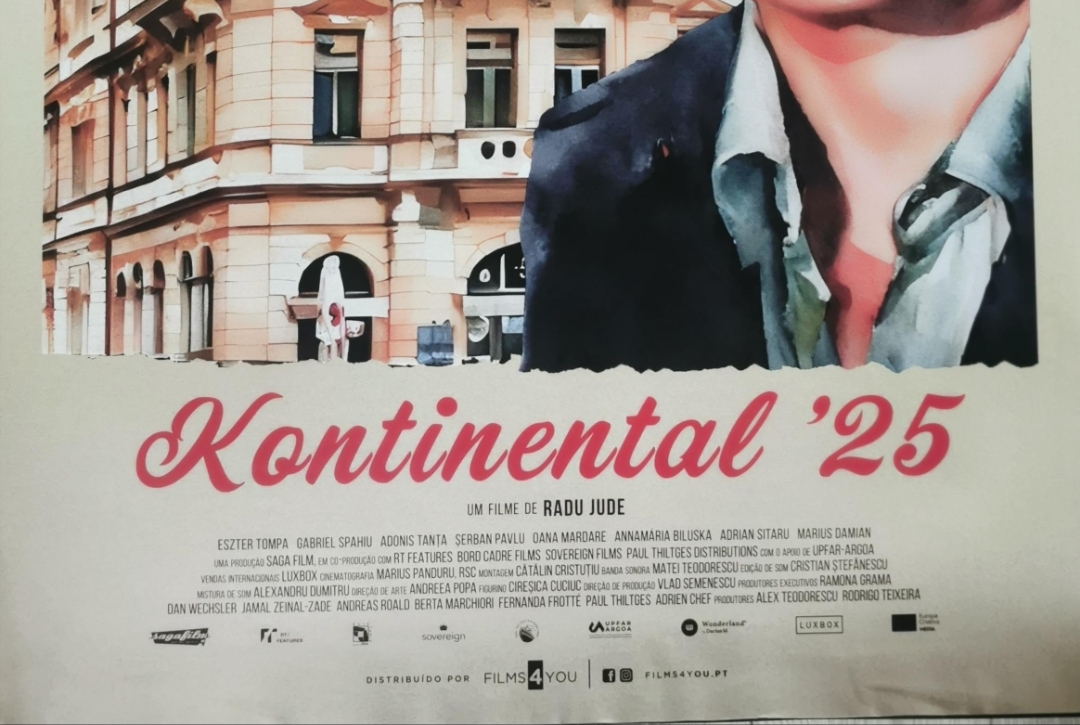
Kontinental '25
Radu Jude's acclaimed Romanian drama is a serious, adult work. Here is everything parents need to know before anyone under 18 gets anywhere near it.
No. Kontinental '25 is not suitable for children, and it is not suitable for most teenagers either. I want to say that plainly in the first paragraph, because it matters. This is a subtitled Romanian arthouse film about a woman whose professional actions lead directly to a man's suicide, and it spends the next eighty minutes sitting inside her guilt without resolution. That is the film. There is no softening of it.
I will say this: it is a genuinely affecting piece of cinema, and I am glad I watched it. But I watched it alone, late at night, and I still thought about the opening scene for days afterward. That is a recommendation for adults who want to be challenged. It is a clear signal for parents that this is not a family film by any stretch.
No — not for children or most teens. Kontinental '25 opens with the depiction of a man's suicide and spends its entire runtime inside the fallout of that event. It contains adult sexual content, heavy drinking, blunt political discussions about antisemitism and nationalism, and unresolved moral darkness. The only appropriate audience is adults, and even then it requires a strong stomach for the subject matter. The Kontinental '25 parental guidance verdict is about as clear as it gets on this site.
Quick-Scan Safety Card
Foreign arthouse films often go unrated in the US. This is not the same as being family-friendly. Based on content, I would place this firmly at R, with a strong argument for the adult-only end of that category.
No caveats. This is adult cinema about adult moral failure. The subject matter — suicide, class guilt, the collapse of social responsibility — requires adult processing.
A homeless man hangs himself after being evicted in the opening act. The event is the entire engine of the film. Its handling is not sensationalised, but it is present and unflinching.
Strong language throughout, in Romanian and Hungarian. Conveyed in English subtitles. Includes profanity, crude expressions, and a notably foul-mouthed priest who delivers his advice in extremely blunt terms.
Sexual activity is part of how Orsolya spends her crisis week. Not graphically depicted, but not glossed over either. A morally charged context around it — she is married.
Drinking features throughout Orsolya's week of moral unravelling. Not depicted as heroic or glamorous — but sustained and central to the character's coping.
Antisemitism, ethno-nationalism, housing policy, capitalism, and post-socialist guilt all come up explicitly in conversation. Not background colour — these are the arguments the film is making.
No physical violence beyond the suicide, which is not shown graphically. The film's damage is entirely psychological and moral.
Unresolved guilt, systemic hopelessness, and a closing montage of urban renewal that several critics described as chilling. There is no catharsis. The film ends, and the world keeps going without having improved.
The film is in Romanian, Hungarian, and German. Viewers must be able to read subtitles throughout. This alone rules it out for younger children practically, quite apart from content concerns.
What Is Kontinental '25 Actually About?
Orsolya works as a bailiff in Cluj, Romania — a city being transformed by foreign investment and gentrification. Her job is to evict people. One day she evicts a man named Ion, a former Olympic athlete now living as a squatter in a condemned basement. Ion takes his own life rather than leave. The rest of the film follows Orsolya across a week as she tries to cope with what she has caused: conversations with her husband, an old friend, a former student, a priest, her mother. None of them help. The film is a slow, cold dissection of liberal middle-class guilt — the kind of guilt that is sincere but ultimately changes nothing, because the system keeps running regardless.
Radu Jude shot the whole film on an iPhone 15, using a fixed camera style that holds scenes at a distance. The visual restraint is deliberate — it is asking you to watch, and to sit with what you are watching. That is a sophisticated ask. It is one that adults who love challenging cinema will welcome. It is not remotely appropriate for children or teenagers.
Why Is Kontinental '25 Unrated — And What Does That Actually Mean?
Foreign films regularly bypass the MPAA rating process in the United States. Not Rated does not mean not mature — it means the filmmakers or distributor chose not to submit the film for classification. This happens constantly with international arthouse releases, and it is worth knowing as a parent because NR films can carry any level of content.
If Kontinental '25 had been submitted to the MPAA, I have no doubt it would have received an R rating. Based on content, I personally think it sits at the harder end of that rating. The suicide that opens the film, the frank sexual content mid-film, the sustained heavy drinking, and the explicit political dialogue about antisemitism would all contribute to that assessment.
The absence of an MPAA rating is not a reassurance for parents — if anything, it is a flag worth paying attention to.
There are no jump scares, no gore, and no traditional action violence. The film's impact is entirely psychological. That makes it harder to scan for at a glance, and it is exactly why this guide exists.
Content Breakdown
The Suicide — What You Need to Know
Ion's suicide by hanging is the inciting event of the film. It occurs in the opening act and is not depicted graphically, but it is not ambiguous either. The film does not romanticise it. It is presented as desperate and real, and the weight of it sits on every subsequent scene. Parents of children or teenagers dealing with suicidal ideation should be aware of this before allowing anyone in that position near this film.
What Jude does — and this is where I found myself genuinely unsettled in a way that speaks to the filmmaking rather than just the content — is position the suicide as an institutional failure rather than an individual tragedy. Ion is not a three-dimensional character we have spent time with. He is a person the system has made invisible, and the film makes you complicit in that invisibility. That is a powerful and unsettling thing to put on screen.
For adults processing themes of housing inequality, social abandonment, or systemic neglect, this is the film's most valuable and challenging contribution. For anyone under 18, this is categorically not a context in which they should be encountering on-screen suicide.
The Drinking and Sexual Content — Context Matters
After Ion's death, Orsolya stays behind while her family goes on holiday. She drinks. She sleeps with someone who is not her husband. These choices are not presented as escapes — they are presented as a person failing to cope, doing the things people do when they are drowning and unable to admit it.
I did not find the sexual content gratuitous. It is brief and serves the character study. But it is adult content, unambiguously, and in the context of marital infidelity during a moral crisis. This is not a film where the characters behave well and we admire them. That is the point. It is also a very specific reason why this material is not appropriate for teenage viewers, who are still forming their frameworks for adult relationships.
The Political Conversations — Heavy and Intentional
Multiple scenes are essentially extended arguments about politics, economics, and history. A conversation with Orsolya's Hungarian mother escalates into a heated row about fascism. A priest character delivers advice in blunt, expletive-laden terms while being, frankly, useless. Discussions about antisemitism, ethnic nationalism, and the social costs of development run through the film.
My 18-year-old, who is studying politics and was curious about this film after I mentioned it, watched it and found the discussions genuinely interesting — though she also found the film slow and demanding. For a teenager that age with that specific interest, it opens real conversations. For anyone younger, or without that contextual scaffolding, the political content will either be indigestible or — worse — will land as raw material without any framing.
The Tone — Absurdist, Cold, and Unresolved
Radu Jude is a filmmaker who belongs to a tradition of Eastern European satire — dark, intellectually demanding, more interested in making you uncomfortable than in reassuring you. This film ends without resolution. Orsolya does not grow. The system does not change. The hotel gets built. The credits roll.
I found that genuinely affecting, in the way that the best socially conscious cinema is. But I also think parents should know that this film offers no emotional exit ramp. There is no moment of grace, no catharsis, no sense that things improve. For adult viewers who can metabolise that, it is a serious and worthwhile film. For younger viewers, it is not just inappropriate — it is the wrong kind of demanding at the wrong developmental stage.
Age-by-Age Viewing Guide
There is genuinely nothing to discuss here. A subtitled foreign film about institutional neglect and suicide has no place in a child this age's viewing life.
Even setting aside the content, the film is nearly two hours of dialogue-driven scenes in Romanian, Hungarian, and German. For this age group, the content concerns are complete — suicide, drinking, sexual infidelity, and political anger are all present. There is nothing here for a child in this range.
Preteens are not equipped to process the film's central event — a suicide framed as systemic failure — in a healthy way. The sexual content alone would make this inappropriate at this age. If your child is dealing with any form of depression or suicidal thinking, this film should absolutely not be on the table.
This is the age group where I get the most parental questions about arthouse cinema, and my answer here is still no. The suicide content, the sexual content, and the deliberately unresolved moral framework are not appropriate for this age group. A curious, politically engaged 16-year-old might be drawn to the premise — but the execution requires adult emotional resources they have not yet developed. Save this one.
A mature, intellectually curious 17 or 18-year-old could engage with this film meaningfully, particularly if they have an interest in political philosophy, Eastern European history, or socially conscious cinema. Watch it with them. Have the conversation about the suicide depiction, about Orsolya's choices, about what the film is actually arguing. Do not hand it over without context. My 18-year-old's reaction was smart and engaged — but she also had me to talk it through with afterward, and that mattered.
What Families Can Take From This Film
I always try to find genuine educational value in the films I review here, and with Kontinental '25 that task is less straightforward than usual — not because the film has no value, but because its value is specifically adult in nature.
For parents watching alone or with a mature older teenager: the film asks serious questions about what we owe to people the system has discarded, and whether good intentions are any kind of substitute for good outcomes. Those are worthwhile questions. The fact that Orsolya is a decent person who does something that destroys another person's life is, in itself, a more honest moral framework than most films offer.
The housing and gentrification material has real educational worth for older students studying economics or politics. And the film's depiction of how guilt functions — not as redemption but as paralysis — is something therapists and social workers have called one of the more honest portrayals in recent cinema.
None of that makes it suitable for children. But it does mean that for the right adult viewer, this is a film worth the discomfort it causes.
Discussion Questions
For adults or older teens who have watched the film:
- 1
Orsolya was following the rules when she evicted Ion — she did not make the system that put him there. Does following the rules make someone responsible for what those rules cause? Where does her guilt end and the system's responsibility begin?
- 2
The film switches its central character from Ion to Orsolya shortly after Ion's death. What does that structural choice say about whose grief and whose experience cinema tends to follow — and whose it leaves behind?
- 3
Orsolya speaks to a priest, a friend, her mother, a former student. None of them help her. What do you think Jude is saying about the institutions — religious, social, familial — that are supposed to provide moral guidance?
- 4
The hotel at the end of the film is called the Kontinental — the title of the film, the thing Ion's death made possible. What was your reaction when you understood that connection fully?
- 5
The film was shot on an iPhone, with a fixed camera, for almost no budget. Did knowing that change how you experienced it? Does the low-budget aesthetic serve what the film is trying to say about the people it is depicting?
Frequently Asked Questions
No. The film opens with a suicide that drives its entire narrative, and also contains adult sexual content, sustained drinking, and blunt political themes including antisemitism. There is no age group under 18 where I would recommend this film without significant caveats.
A man's suicide by hanging is depicted in the opening act. It is not shown in graphic detail, but it is the film's central event and its presence is clear and unambiguous. Parents should be fully aware of this before anyone vulnerable watches this film.
In my view, yes. The combination of the suicide depiction, the sexual content, and the film's deliberately unresolved moral framework makes it more than most 16-year-olds have the emotional scaffolding for. A mature 17 or 18-year-old, watched with a parent and discussed afterward, is a different conversation.
No post-credits scene. The film ends with a montage of urban renewal footage and then stops. There is nothing additional after the credits begin.
No. The film is shot in a deliberately static, low-stimulation style using a fixed camera. There are no strobe effects, no rapid editing, and no visual intensity of the kind that triggers photosensitive conditions.
The film is available on Amazon Prime Video for streaming in the US following its limited theatrical run from March 27, 2026. It is distributed in North America by 1-2 Special. Check your local listings for any remaining theatrical screenings.
No — the film comes with English subtitles. However, it is primarily in Romanian and Hungarian, and requires sustained reading throughout. This practically rules out younger children beyond all the content concerns, and it also makes this a different kind of viewing experience from English-language films.
A confirmed BBFC classification was not publicly listed at the time of this review. Based on content, I would expect a 15 or 18 certificate. UK parents should check the BBFC website directly before screening this film with anyone under 18.

Stephanie Heitman is a seasoned journalist and author dedicated to helping parents navigate the world of Hollywood entertainment through thoughtful, family-oriented film reviews. With over a decade of experience in writing and a passion for fostering safe, enriching viewing experiences, Stephanie launched Parentguiding.com to provide parents with the insights they need to make informed choices for their families.