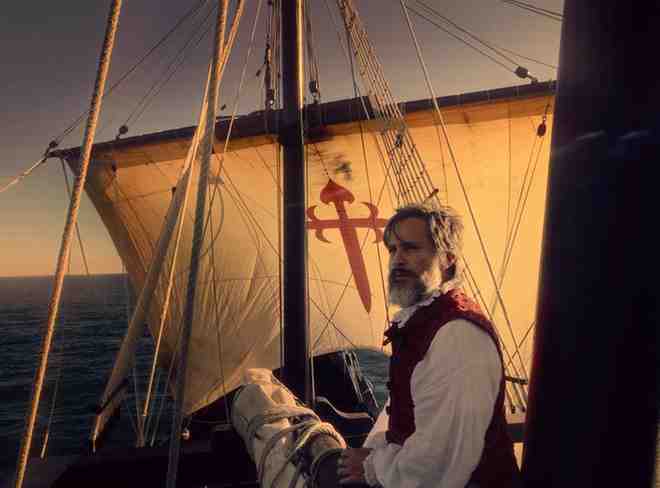
You might dimly recall Ferdinand Magellan as a name pulled from the margins of a high school textbook an explorer, a voyage, a line or two about sailing around the world. Lav Diaz’s Magellan isn’t especially interested in refreshing that memory. In fact, it offers remarkably little historical context at all, choosing instead a stubbornly plain, almost indifferent posture toward the facts. What the film does foreground almost to a confrontational degree is form. If you’ve ever sat through a film theory course and heard the term “static shot” defined with academic precision, you’ll recognize Diaz’s approach immediately. He plants the camera, locks it in place, and lets the world wander in and out of the frame. Then he does it again. And again. For nearly three hours.
It’s a method that feels less like an aesthetic choice than a stress test. Each shot lingers far beyond what contemporary audiences are conditioned to tolerate, daring you to notice the erosion of your own patience. In an era built on fast cuts and algorithm-friendly pacing, Magellan moves with glacial resolve, unmoved by your restlessness. You can feel the film asking something of you attention, endurance, submission but it’s hard not to wonder what you’re meant to receive in return. As an exercise in filmmaking, it’s punishing. As entertainment, it barely registers. And as a history lesson, it leaves you adrift.
Magellan himself, played by Gael García Bernal, is introduced not as a myth but as a functionary. A Portuguese explorer, loyal to crown and church, tasked with extending European dominion across the globe. His expedition becomes a slow march of conquest: lands “discovered,” peoples coerced into Christianity, dissent met with violence. In 1520, he charts what would come to bear his name the strait connecting the Atlantic and Pacific Oceans an achievement that history has polished into heroism.
Highly Recommended: Armageddon Time Parents Guide
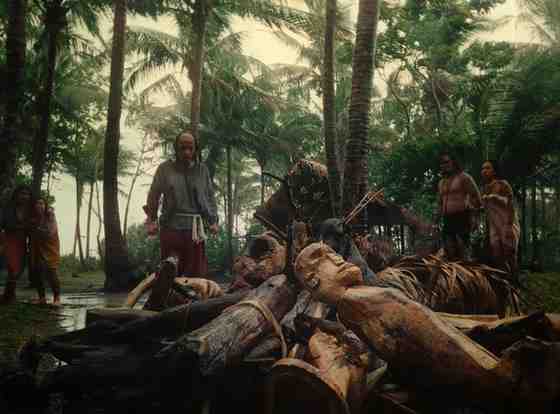
Diaz, to his credit, resists that polish. Magellan operates with unchecked authority, acting as judge, jury, and executioner in the name of God and king. By the time his starving, exhausted crew reaches Cebu in the Philippines, the spell begins to break. The people there don’t see a visionary explorer. They see what he is: a conqueror, and a brittle one at that.
From a purely technical standpoint, Diaz’s accomplishment is undeniable. He shoots exclusively with natural light, relies on ambient sound, and pares editing down to the bare minimum. Static framing demands meticulous blocking and rehearsal; when the camera refuses to move, every entrance, exit, and gesture must be exact. Cinephiles will recognize how much discipline this requires, how carefully the film must be assembled to appear so unadorned. But admiration quickly gives way to fatigue. The rigor Diaz imposes on himself is transferred wholesale to the audience, and not everyone will be willing to shoulder that burden.
Budgetary constraints shape the film in ways that become impossible to ignore. Battles are never shown only their consequences. We hear cannon blasts echo offscreen, because sound is affordable, but the violence itself remains unseen, reduced to bodies scattered across the landscape. Over time, the effect feels less like restraint and more like limitation. The film plays like a historical reenactment staged for the camera rather than cinema that fully inhabits its world. You might find yourself waiting for the images to catch up to the ambition, but they never quite do. Magellan asks for immense patience, and it’s not clear it earns it.
Bernal, an actor of undeniable charisma and intelligence, seems almost swallowed by the film’s conceit. Beneath the heavy beard, the distant framing, and the unyielding visual strategy, his performance struggles to surface. There are moments where you sense what he could bring to this role contradiction, arrogance, spiritual conviction curdling into cruelty but the film’s rigid structure keeps him at arm’s length. Even the most beautifully composed shots, lit with painterly care, can’t compensate for the emotional remove. Eventually, the approach reveals itself less as bold experimentation and more as a limiting gimmick.
Highly Recommended: Alice In Borderland Parents Guide
What lingers after Magellan ends isn’t a renewed fascination with its subject, but a quiet frustration. History, especially the messy, morally fraught kind, often comes alive through interpretation through imagined moments that bridge the gap between fact and feeling. Films that dare to speculate, to dramatize, to lean into the human contradictions of their figures, tend to spark curiosity rather than extinguish it. Diaz’s film refuses that invitation. And while there’s something admirable in its severity, it’s hard not to feel that, in the end, Magellan leaves both history and its audience stranded.
Content Breakdown for Parents

Violence & Intensity: There is no graphic violence, but the film is steeped in the tension of political and personal conflict. Some scenes reference displacement, loss, and the threat of violence connected to historical events. The impact is emotional rather than visual, and younger viewers may sense the heaviness even if they don’t fully understand the context.
Language: Language is generally restrained. There may be occasional strong or emotionally charged dialogue, but profanity is not a defining feature of the film. Tone matters more than words here the heaviness comes from what’s implied rather than what’s spoken.
Sexual Content / Nudity: There is little to no sexual content. Any intimacy is implied, contextual, and handled with restraint. Nothing graphic or exploitative.
Drugs, Alcohol & Smoking: Some brief depictions of smoking or alcohol use, shown as part of everyday adult life rather than glamorized behavior.
Parental Concerns
Parents should know this is not a light or fast-moving film. Its themes may prompt questions about politics, loss, and injustice conversations that may require guidance or context, especially for younger teens. The pacing is deliberate, and kids accustomed to action-driven storytelling may struggle with its quiet intensity.
Recommended Age Range: Best for: Ages 13+, particularly mature teens and adults

Stephanie Heitman is a seasoned journalist and author dedicated to helping parents navigate the world of Hollywood entertainment through thoughtful, family-oriented film reviews. With over a decade of experience in writing and a passion for fostering safe, enriching viewing experiences, Stephanie launched Parentguiding.com to provide parents with the insights they need to make informed choices for their families.