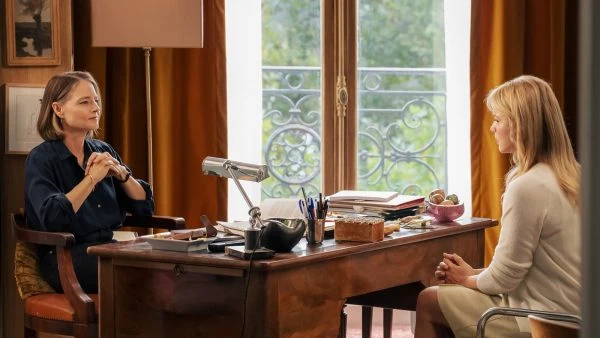
A garnish can elevate a well-cooked dish, adding texture or a flash of brightness, but it’s rarely satisfying when presented as the meal itself. That’s the lingering frustration with Rebecca Zlotowski’s A Private Life, a film that glides along smoothly, even stylishly, yet never quite nourishes. It’s a sleek, faintly mischievous psychological thriller that keeps you company for a while, pleasant enough in the moment, but once it’s over you may find yourself wondering what, exactly, you were meant to take away from it.
The hook is undeniably enticing. Jodie Foster, for the first time in her long and varied career, takes on a leading role in a language that isn’t her own. She plays Lilian, an American psychiatrist who has made a life for herself in Paris, and when we meet her she’s closing out another long day, the kind that feels interchangeable with the one before it. She calls Paula (Virginie Efira), a patient who has skipped three sessions in a row. There’s professional concern in her voice, of course, but also the faintly awkward matter of unpaid appointments. Lilian’s world appears to be built on this gentle hum of repetition listening, note-taking, billing the bureaucratic rhythms of care. Then she learns that Paula is dead, having taken her own life.
Highly Recommended: We Have a Ghost Parents Guide
Unlike surgeons or emergency physicians, psychiatrists live in constant proximity to death without ever touching it. They deal in ideation, impulse, despair but not blood or breath leaving a body. That distance is part of the job’s insulation, and Paula’s suicide punctures it completely. Lilian is shaken, maybe more than she’s prepared to admit. You can almost hear the questions echoing in her head: How did Paula seem the last time she was stretched out on the couch? Were there warning signs? Did she miss something crucial? These are the kinds of questions that have no satisfying answers, and they gnaw at her until she makes an impulsive decision to attend Paula’s funeral.
It’s there that the film tips into something more intriguing. Lilian meets Paula’s family: a daughter who watches her with a mixture of curiosity and openness, and a husband who responds with thinly veiled hostility. He’s sharp, accusatory, eager to push the psychiatrist away, his anger carrying a strange urgency that feels less like grief than concealment. It’s hard not to notice how quickly suspicion takes root in Lilian’s mind and maybe in ours, too.
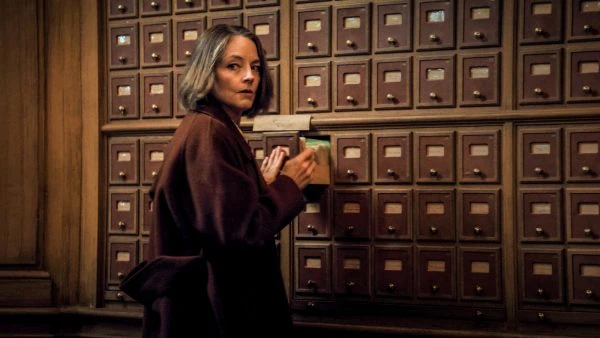
This is where A Private Life is most alive, when it follows Lilian into a slow, Hitchcock-flavored spiral of obsession. Paula didn’t seem suicidal, did she? The husband’s behavior is unsettling. And what about the daughter, heavily pregnant, vibrating with hormonal intensity could there be something darker beneath her anticipation of motherhood? Zlotowski allows these questions to hover without immediately answering them, letting paranoia and intuition bleed into one another. One of the film’s most striking sequences places Lilian under hypnosis, sitting stiffly as a young hypnotist’s long, glittering nails drift through the air in front of her face. Lilian’s skepticism and Foster plays it beautifully is brittle. The rational defenses of a trained mind give way, and suddenly reality fractures. She wanders the corridors of her own consciousness, opening doors to lives that were lived, and others that never came to be. It’s eerie, vulnerable, and unexpectedly tender.
Highly Recommended: Die Hard Parents Guide
Foster’s performance benefits enormously from the friction of working in a second language. There’s a slight stiffness to her speech, an effortfulness that mirrors Lilian’s own destabilization as her carefully maintained routine cracks open. What begins as professional doubt morphs into something more existential. There’s a guilty thrill in abandoning reason, and Lilian leans into it with a kind of delighted recklessness, playing detective with a giddy appetite that also conveniently deflects her sense of culpability. When friends and colleagues express concern, she brushes them off. She knows the difference, she insists, between delusion and choice. You might believe her or at least understand why she needs to.
Strangely, the film falters when it shifts toward family drama. Zlotowski’s previous feature, Other People’s Children, demonstrated an extraordinary sensitivity to emotional gray areas, exploring the fragile bonds between stepparents and children with patience and aching restraint. That film trusted observation over incident. Here, trying to balance crime thriller mechanics, whodunit intrigue, and light dramedy touches, A Private Life starts ricocheting between tones. The result is less contemplative, more distracted, as if the film is too eager to keep moving to sit with its own ideas.
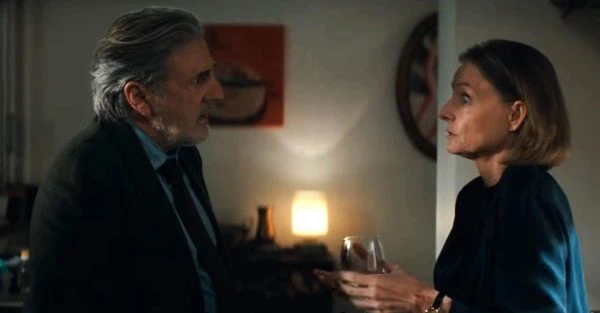
There is, however, one undeniable bright spot on the domestic front: Daniel Auteuil as Gabriel, Lilian’s ex-husband. Paula’s death nudges them back into each other’s orbit, not quite toward reconciliation, but into the easy familiarity of shared history. Auteuil’s warmth and natural charm play beautifully against Foster’s more guarded, deliberate presence. Watching them rediscover each other reminds us of who Lilian used to be and how much she’s shifted.
Highly Recommended: Speak No Evil Parents Guide
Gabriel is an ophthalmologist, a detail that feels pointed. He deals in sight, while Lilian has built her life around listening. At a moment when she fears her work has become passive, that she’s merely absorbing words instead of actively engaging with lives, this contrast lands with quiet force. When the film leans into metaphors like these asking what we owe our patients, our loved ones, ourselves it touches something honest and unsettled. You can feel the pulse of a deeper movie there.
It’s disappointing, then, that Zlotowski doesn’t linger longer on that pulse. She keeps moving, keeps decorating, never quite committing to the rawness she brushes up against. A Private Life remains an agreeable, even pleasurable experience a polished diversion with flashes of insight but one can’t shake the sense that it might have been more than just the garnish. [C+]
Content Breakdown for Parents
Violence & Intensity: There is no traditional action violence in A Private Life. Instead, the intensity is psychological and emotional. The central event is a character’s suicide, which is discussed in detail and serves as the catalyst for the story. While the act itself is not graphically depicted, the emotional fallout is sustained and heavy. The tension comes from obsession, suspicion, and moral unease rather than physical harm. Some scenes may feel unsettling due to their quiet, realistic depiction of grief and mental unraveling.
Language: Moderate adult language appears throughout, mostly in conversational or emotionally charged contexts. Profanity is present but not constant or aggressive. Dialogue reflects adult relationships and stress rather than shock value.
Sexual Content / Nudity: Mild to moderate sexual content. There are sexual references and brief intimate moments, including limited nudity, but nothing prolonged or explicit. The content is treated matter-of-factly and is more reflective of adult relationships than designed to titillate.
Drugs, Alcohol & Smoking: Alcohol consumption is shown occasionally, typically in social or emotionally reflective settings. There is no glamorization of substance abuse. Drug use is not a major focus, though the film does explore altered mental states through therapy and hypnosis, which may feel intense or disorienting.
Scary or Disturbing Scenes: Several moments may be emotionally disturbing rather than frightening. Themes of suicide, guilt, psychological instability, and obsession are central. Hypnosis sequences and scenes of mental dissociation may be unsettling, especially for viewers sensitive to mental health struggles. The film’s quiet tone can make these moments feel more invasive and personal.
Parental Concerns
The primary concern is thematic, not visual. The film’s focus on suicide, mental health, emotional obsession, and existential guilt makes it unsuitable for children or teens. While it lacks graphic violence or explicit sexuality, its emotional weight and adult subject matter are best suited for mature viewers comfortable with introspective, psychologically heavy storytelling.

Stephanie Heitman is a seasoned journalist and author dedicated to helping parents navigate the world of Hollywood entertainment through thoughtful, family-oriented film reviews. With over a decade of experience in writing and a passion for fostering safe, enriching viewing experiences, Stephanie launched Parentguiding.com to provide parents with the insights they need to make informed choices for their families.