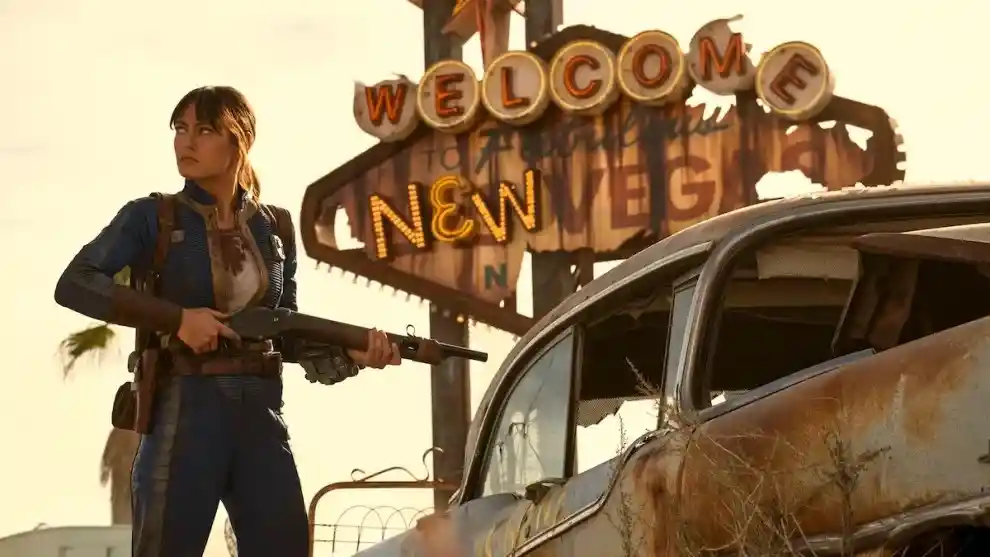
‘Fallout’ Season 2 is rated TV-MA (Mature Audiences Only) This rating is fully earned. The show contains intense violence, graphic imagery, strong language, and disturbing themes. Comparable to The Last of Us or Westworld in tone and content.
“The house always wins.” It’s a phrase worn smooth by repetition, usually muttered under the low hum of slot machines, a reminder that casinos are built to outlast the players inside them. The saying carries an implied shrug one person can’t dent a system designed to grind forward without them. It turns out to be an uncannily apt lens for Season 2 of Prime Video’s Fallout, which leans into that fatalistic wisdom and lets it seep into every corner of its irradiated world.
More than a year and a half after its first season arrived a minor miracle in the modern streaming churn, especially for a show this elaborate Fallout returns with another confidently staged blend of brutality, absurd humor, and battered heroism at the literal end of civilization. Season 1 invited us into the Wasteland through the wide, untested eyes of Lucy MacLean (Ella Purnell), a lifelong Vault 33 resident raised in a carefully controlled underground paradise. When her father, Hank (Kyle MacLachlan), vanished, Lucy stepped into a world she’d only been taught about through propaganda and platitudes. Along the way, she crossed paths with Cooper Howard (Walton Goggins), once a movie star, now a centuries-old, radiation-scarred bounty hunter known simply as the Ghoul, and Maximus (Aaron Moten), a young squire bound to the rigid, quasi-religious Brotherhood of Steel.
Highly Recommended: Moonfall Parents Guide
Season 2 picks up with noticeably heavier shadows. The story resumes in the immediate aftermath of the finale: Lucy and the Ghoul are tracking Hank, who has escaped to the remains of Las Vegas for reasons that remain deliberately opaque. But traveling together doesn’t mean moving in step. Their philosophies about survival, morality, and compromise still scrape against one another at every turn. Elsewhere, Maximus has returned to the Brotherhood of Steel, now wielding more authority and, with it, deeper unease. He begins to question whether this particular incarnation of the Brotherhood is truly interested in preserving humanity, or merely in controlling its ruins. And in the past, as Cooper Howard grapples with the horrifying realization of the role his wife may play in triggering the apocalypse, the enigmatic billionaire Robert House (Justin Theroux) quietly lays the groundwork for his own endgame as the world edges closer to collapse.
Showrunners Geneva Robertson-Dworet and Graham Wagner resist the urge to rush viewers back into the chaos. Instead, they let Season 2 unfurl deliberately, building toward a thematic argument that grows clearer with each episode. An early argument between Lucy and the Ghoul, for instance, might initially feel like familiar ground another round of the same ideological sparring that defined much of Season 1. But repetition is the point. Their bickering mirrors a larger pattern of self-defeating division: Caesar’s Legion versus the New California Republic, Vault 33 residents turning on one another over dwindling resources, factions too busy fighting among themselves to imagine something better. Tribalism may keep people alive, the show suggests, but it won’t help them actually live. And in a world this unforgiving, even the impulse to try can feel like a luxury. If the house always wins, why step back up to the table at all?
Highly Recommended: Girl, Interrupted Parents Guide
It’s a bleak, almost nihilistic idea to plant at the heart of a series that still finds room for outrageous jokes about cousin inbreeding and gunfights that end in grotesquely comic explosions of blood. You can feel the tonal friction early on. The season’s opening stretch moves more slowly than the breathless momentum that closed out Season 1, occasionally weighed down by the need to articulate its central conflict. But once that groundwork is firmly in place, Fallout regains its rhythm. Howard Cummings’ production design continues to be a quiet marvel, making the Wasteland feel lived-in and tactile, especially when the story finally reaches New Vegas a setting that expands the show’s already ambitious scale without losing its sense of texture and decay.
At the center of it all, the chemistry between Walton Goggins and Ella Purnell remains electric. Their relationship is the series’ emotional engine, and the show practically hums whenever they share the frame. What once felt like a strange, uneasy parental bond Season 1’s dynamic of a grizzled survivor guiding a wide-eyed innocent now resembles the stormier years of adolescence. Lucy pushes back at every rule, every compromise, every cynical assumption the Ghoul takes for granted. Watching them shape each other, sometimes for the better and sometimes very much not, becomes one of Season 2’s most consistent pleasures.
Aaron Moten’s Maximus quietly delivers the season’s most surprising arc. His performance captures the tension of someone who wants to be righteous while trapped inside an institution that mistakes obedience for virtue. Moten leans heavily on physical performance posture, hesitation, the way his body stiffens or slackens under pressure to communicate Maximus’ internal struggle. The decision to give him a largely separate journey in the six episodes provided to critics proves wise, allowing both Maximus and Lucy to develop as individuals rather than orbiting the same storyline.
Highly Recommended: Violent Night Parents Guide
The most conspicuous newcomer is Justin Theroux as Robert House, a figure modeled loosely after Howard Hughes and played with unmistakable relish. Theroux seems delighted by House’s arrogance and ambition, and that energy carries through every scene. The specifics of how House and Cooper Howard first cross paths are under embargo, but their eventual collision is both one of the season’s standout moments and uncannily relevant. The uneasy overlap between Hollywood mythmaking and tech-fueled power grabs feels ripped from today’s headlines. House’s presence looms as one of Season 2’s great unanswered questions, particularly for fans of Fallout: New Vegas, which serves as the season’s narrative backbone.
Vegas, after all, has always been about risk. Sometimes you walk away flush; other times you’re cleaned out before you know what hit you. Fallout Season 2 stumbles a bit out of the gate, like a gambler warming up at the table. But by the time it hits its back half, the series finds its stride and starts stacking wins. When the night is over, it’s hard to argue that the bet wasn’t worth placing.
Detailed Content Breakdown for Parents
Violence & Intensity: Very strong and frequent. Gunfights, explosions, executions, and close-quarters combat are common. Violence is often sudden and brutal, with visible blood, dismemberment, and graphic injuries. Some scenes play violence for dark humor, while others linger on its consequences. Younger viewers may find the unpredictability especially unsettling.
Language: Heavy use of profanity throughout, including repeated uses of the F-word and other strong language. The tone is often sarcastic, angry, or cynical, reflecting the harshness of the world.
Sexual Content / Nudity: Limited but present. Some sexual references, innuendo, and implied encounters. Brief nudity may appear in non-sexualized but adult contexts. Nothing constant, but enough to warrant caution.
Drugs, Alcohol & Smoking: Alcohol use is frequent and normalized, especially among Wasteland survivors. Characters also use fictional drugs and substances tied to the Fallout universe. Substance use is portrayed as coping rather than glamour.
Very much so. Mutated creatures, radiation victims, moral cruelty, executions, and scenes of human desperation can be disturbing not just visually, but emotionally. The show doesn’t flinch from showing how ugly survival can be.
Parental Concerns: Parents should be aware that Fallout Season 2 is darker and heavier than Season 1. The humor is sharper, the violence more explicit, and the themes more nihilistic. Some scenes involving cruelty, executions, or moral collapse may linger emotionally, especially for teens who are sensitive to bleak storytelling.

Stephanie Heitman is a seasoned journalist and author dedicated to helping parents navigate the world of Hollywood entertainment through thoughtful, family-oriented film reviews. With over a decade of experience in writing and a passion for fostering safe, enriching viewing experiences, Stephanie launched Parentguiding.com to provide parents with the insights they need to make informed choices for their families.