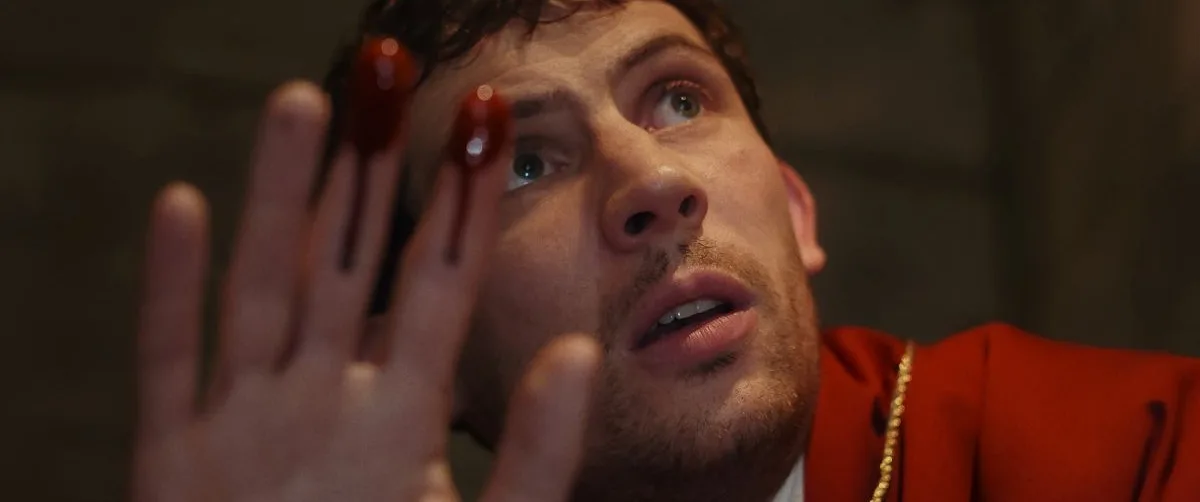
Wake Up Dead Man: A Knives Out Mystery is Rated PG-13 by Motion Picture Rating (MPA) for violent content, bloody images, strong language, some crude sexual material, and smoking.
If “Glass Onion” felt like a breezy vacation in the world of Rian Johnson’s increasingly sprawling franchise, then “Wake Up Dead Man” is a return to something colder, sharper, and more urgent. The film doesn’t bask in playful puzzles or tropical whimsy; it’s windy, overcast, and at times nearly bitter but within that chill, there’s a warmth that sneaks up on you, a light for every shadow. You can feel Johnson consciously steering away from levity toward something weightier, and the shift is exhilarating.
“Wake Up Dead Man” is a love letter to the locked-room mysteries of old, drawing inspiration from works like The Hollow Man and The Murders in the Rue Morgue. Daniel Craig’s Benoit Blanc returns, but the story’s heartbeat belongs elsewhere: a seemingly impossible case becomes a canvas for Johnson to explore profound themes faith against reason, greed against sacrifice, and the human craving for stories that help us navigate our lives, whether spiritual, secular, or cinematic. The film feels like part of a subtle movement among contemporary writers, who don’t confront the tumult of the 2020s head-on, but angle around it, weaving its anxieties into timeless frameworks. It’s ambitious, dense, and yet surprisingly generous: a movie that refuses to separate the faithful from the heretic, reminding both that their deepest needs often overlap.
Highly Recommended: Murder Mystery 2 Parents Guide
In one of the film’s boldest gambits, Blanc steps aside as the narrative’s focal point. The story centers on Reverend Jud Dupenticy, played with quiet intensity by Josh O’Connor a young priest sent to a troubled New York parish after a violent altercation with a deacon. Jud is immediately set in opposition to the formidable Monsignor Jefferson Wicks (Josh Brolin at his most imposing), a man whose authority is wielded through fear, anger, and relentless control. Wicks’ pulpit is a platform of intimidation: shame, guilt, and rhetoric designed to dominate. He sees faith under siege and believes survival demands aggression. Jud, in contrast, preaches tenderness and connection, hugs over fists a dichotomy that forms the moral core of the film. Through their conflict, Johnson isn’t just exploring divisions within a church; he’s holding up a mirror to a fractured society. In this world, loyalty to a tribe is no salvation only openness and the courage to welcome outsiders can prevent moral collapse.
The Monsignor’s inner circle is as complicated as it is intriguing, and naturally, they all become suspects in this twisty, engrossing mystery. Glenn Close plays Martha Delacroix, Wicks’ lifelong right-hand, a figure whose loyalty is forged over decades of service. Thomas Haden Church’s Samson Holt is a quiet, devoted man whose allegiance stems from both love and gratitude, having been rescued from alcoholism by Wicks’ intervention. Jeremy Renner’s Dr. Nat Sharp carries the weight of personal loss and misplaced longing; Andrew Scott’s Lee Ross, a former hit writer, is consumed by internet conspiracies. Cailee Spaeny’s Simone believes Wicks can cure her chronic pain, while Kerry Washington’s Vera Draven wrestles with resentment toward her troublesome half-brother Cy (Daryl McCormack), who wields social media as a weaponized pulpit for his political ambitions. The ensemble is rounded out with Jeffrey Wright, Mila Kunis, and a wonderfully effective Bridget Everett, all adding texture, humor, and menace. It’s the kind of cast that makes you hang on every glance, every twitch, every barely-contained fury.
Highly Recommended: We Have a Ghost Parents Guide
Though the first two films leaned heavily on Craig’s Benoit Blanc to carry the narrative, here O’Connor’s Jud provides the emotional compass. He’s a character marked by past violence he once killed a man in the boxing ring and by his subsequent quest for atonement and understanding. Anger, in its many forms, pulses through the film: Jud’s own guilt, Wicks’ oppressive wrath, Martha’s rigid judgment, Cy’s opportunism, Nat’s bitterness. Johnson has always had a knack for marrying personal dynamics to larger societal commentary, and in “Wake Up Dead Man,” that skill reaches a peak. Yet despite its dark threads, the film is quietly, insistently optimistic. It champions empathy over conflict, understanding over tribalism, but without tipping into sentimentality or preachiness. The script is razor-sharp some of Johnson’s finest work and the film’s emotional intelligence is hard to overstate.
And then there’s the craft itself. We often talk about Johnson as a storyteller, but his mastery of cinematic form continues to evolve. “Wake Up Dead Man” is primarily destined for home screens, yet it is unmistakably a film. Steven Yedlin’s cinematography balances the cool, almost austere light of an old New York church with bursts of sunlight that feel like revelations. Every frame is considered, every shadow meaningful. Bob Ducsay’s editing, precise and rhythmically alive, keeps the labyrinthine plot coherent and tense, a feat in a movie this densely plotted.
The case at the heart of the film is, admittedly, a little too intricate to solve on your first watch. That’s intentional. Like all the “Knives Out” mysteries, the puzzle itself is secondary; the real intrigue is in the why, the human psychology, the ethical and emotional currents beneath the crime. At times, the film even edges into buddy-comedy territory, as Jud’s faith-driven perspective clashes and collides with Benoit Blanc’s logic-centered reasoning. But the true genius lies in how it suggests that, despite differences, people have more in common than they suspect. And perhaps only when we recognize that shared humanity can we truly wake up.
Highly Recommended: The Secret Agent (2025) Parents Guide
“Wake Up Dead Man” is, in the end, a film that wears its intelligence lightly but feels profoundly alive. It’s morally complex, visually stunning, narratively playful, and emotionally generous a rare gem in contemporary mystery cinema. You leave it thinking about choices, anger, forgiveness, and the strange, miraculous ways that stories whether told from a pulpit, a page, or a screen shape the way we live.
Content Breakdown (For Parents)
Violence & Intensity: The central plot involves a murder and the investigation of a violent death. There are “bloody images,” likely including the aftermath of the murder. Expect tension, psychological unease, and scenes inside a church, graveyards, and possibly cryptic settings the atmosphere is gothic and heavy, with a persistent sense of gloom or foreboding.
Language: The “strong language” mention in the rating suggests there will be profanity and potentially aggressive or emotionally charged dialogue. Given the themes (religion, guilt, power), there may also be harsh moral judgment or intense confrontations among characters.
Sexual Content / Nudity: There is a mention of “some crude sexual material,” but nothing that screams graphic or explicit. It suggests perhaps some references or mild suggestiveness.
Drugs, Alcohol & Smoking: The rating includes “Smoking” so expect some characters to smoke. I saw no specific notes about drugs or heavy substance abuse, though characters may have troubled pasts (grief, addiction, or trauma) but nothing indicates a focus on drug culture.
Parental Concerns / What Might Surprise Parents
The themes are dark, heavy, and mature guilt, manipulation, power, religion, death not light entertainment for kids.
Scenes of violence (including a murder and possible bloody images) could upset younger or more sensitive viewers.
Moral ambiguity: there are no purely “good vs evil” stereotypes characters may be flawed, and the film doesn’t neatly reward “good behavior.” The complexity may require emotional maturity to appreciate.
Religious themes are central some families might find certain depictions or conflicts challenging (e.g. abuse of power, faith under question, institutional hypocrisy).
I’d recommend teenagers (14+) and adults for this one.
Release Date: Theatrical (limited) release beginning November 26, 2025; streaming on Netflix starting December 12, 2025

Matthew Creith is a movie and TV critic based in Denver, Colorado. He’s a member of the Critics Choice Association and GALECA: The Society of LGBTQ Entertainment Critics. He can be found on Twitter: @matthew_creith or Instagram: matineewithmatt. He graduated with a BA in Media, Theory and Criticism from California State University, Northridge. Since then, he’s covered a wide range of movies and TV shows, as well as film festivals like SXSW and TIFF.