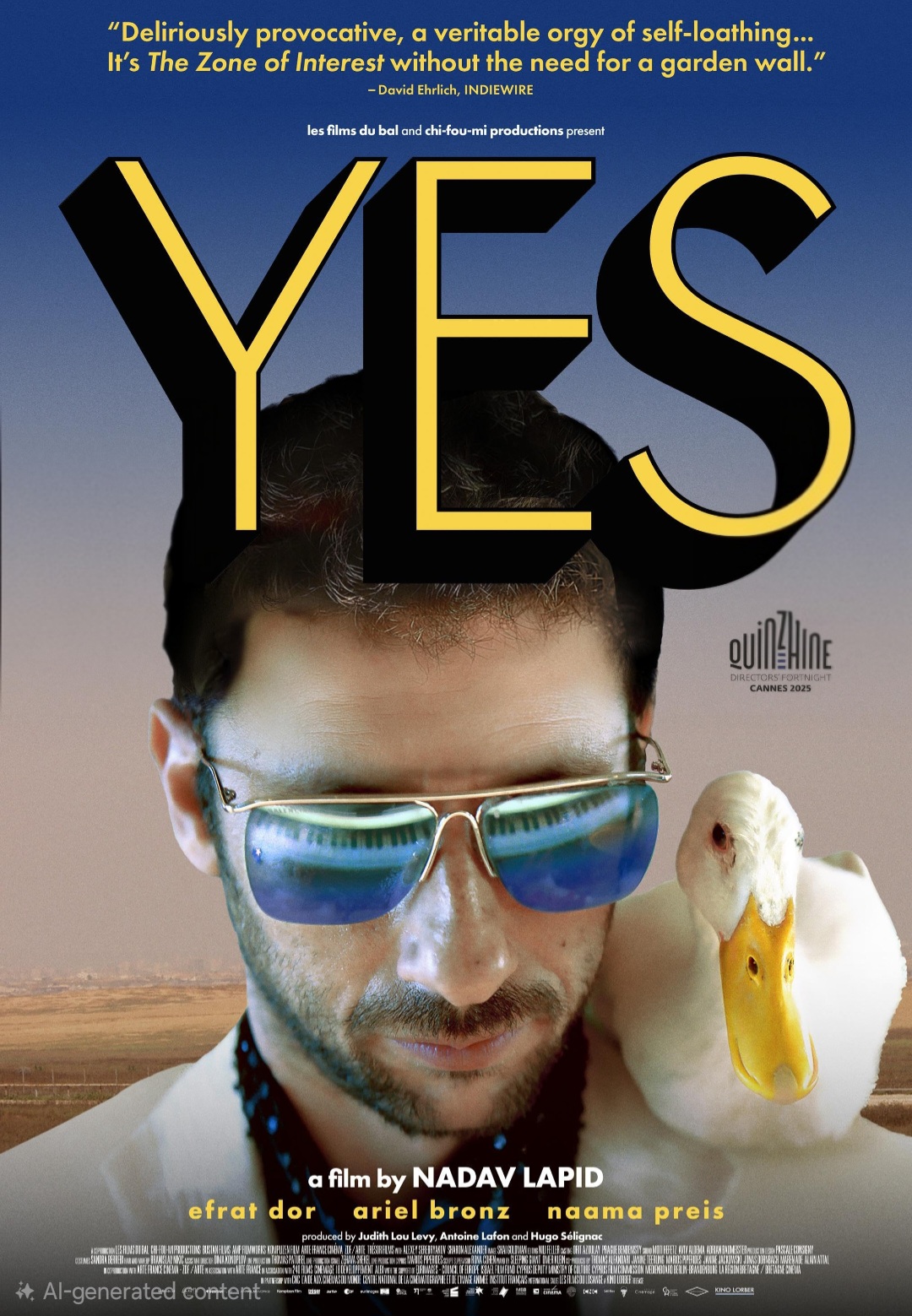
Is Yes (2025) Suitable for kids?
I want to be clear about something before we go any further: this is one of the most difficult films I have had to guide parents through in recent memory — not because it is gratuitously violent or sexually explicit in the way that triggers easy warning flags, but because its assault on the viewer is relentless, deliberate, and deeply political. The content concerns here are real, they are layered, and they require more than a quick scan of a safety table.
Yes (2025) is Nadav Lapid's fifth feature film. It is a raw, maximalist, sometimes genuinely exhausting political satire set in Israel in the aftermath of October 7, 2023. This is not — by any measure — a family film, a teen film, or even a film most adults will find comfortable. And I say that as someone who has spent 22 years navigating difficult content on behalf of parents: this one requires a warning that goes beyond what the Kino Lorber distribution page will tell you.
What This Film Is About
In the weeks after October 7, 2023, Y. a jazz musician and his wife Yasmin, a dancer, decide to say yes to everything. Facing financial pressure and moral exhaustion, they begin performing for Israel's wealthy, powerful elite, offering their art and themselves as a kind of surrendered service. The logic they adopt is that submission itself is a form of resistance or maybe survival. That contradiction sits at the heart of the film and never resolves.
When Y. is commissioned to write the music for a new Israeli national anthem, the collaboration pushes both of them to the edge of their identity, their marriage, and their sanity. The film is saturated with guilt, grief, and a deep anger at the gap between what artists say they believe and what they actually do.
Trigger areas to be aware of: war trauma, references to October 7 atrocities, sexual humiliation, identity crisis, moral collapse, and sustained psychological distress.
Content Breakdown
Sexual Content and the Submission Premise
This is probably the content area that will most surprise parents who read a brief plot description. The film's central conceit two artists who sell their art and their bodies to the elite is not a metaphor the film leaves safely abstract. There are scenes involving humiliation, physical servitude, and sexual submission that are depicted with deliberate discomfort. They are not pornographic, but they are explicit in theme and sustained in tone.
I want to be careful how I say this: the film is making a point about compliance and corruption, and the sexual dimension is part of that argument. Lapid is drawing a direct line between physical submission and political submission. That does not make it easier to watch it makes it more disturbing. For younger viewers, this framework is simply too sophisticated and too raw to process productively.
War Imagery and October 7 Content
One of the most striking scenes in the film places Y. on a hill near Gaza a location called, with terrible irony, "the hill of love" filmed at a distance that echoes a Caspar David Friedrich painting, except what he overlooks is not a romantic landscape but a war zone shaking with explosions. It is a genuinely extraordinary cinematic image. It is also genuinely upsetting.
The October 7 attacks are not a backdrop here they are a wound the film keeps pressing. Leah, Y.'s ex-girlfriend, works for Israeli PR and has access to documentation of the atrocities that the public has not seen. That documentation is referenced and partially described in what critics have called one of the film's most harrowing extended monologues. Parents should know this material is treated with real weight, not sensationally but it is still confronting.
Political Intensity – What This Film Actually Is
Put plainly: Yes is a work of furious political art from a filmmaker who is deeply, personally opposed to the Israeli government and its conduct in Gaza. Lapid has said as much publicly for years. This film is not an attempt to present multiple perspectives — it is a directed polemic, a formal act of outrage, and it expects the viewer to sit inside that outrage for two and a half hours.
For families with strong views on the Israel-Palestine conflict on any side this film will feel charged. Teenagers who engage with Middle Eastern politics will have strong reactions to it. That is not in itself a reason to avoid it, but it is a reason to watch it together, if you watch it at all, and to have significant conversation before and after.
Formal Style as a Content Concern
Something parents don't often hear discussed but genuinely matters: the way this film is made will affect sensitive viewers before the content does. Lapid's camera moves fast, constantly, and with what feels like controlled desperation. The colour contrast is extreme. The sound design is loud and intentionally abrasive. Multiple critics have described the experience as "torturous" in the technical, filmmaking sense the form itself is an assault.
For viewers with anxiety disorders, sensory sensitivities, or trauma responses to overstimulation, this is worth knowing ahead of time. My 16-year-old watched the first twenty minutes with me before I paused it not because of the content but because of the intensity of the formal experience. She said, accurately, that it felt like being in an argument whether you wanted to be or not.
Moral Ambiguity and the Absence of Resolution
There is no hero in this film. There is no moment where Y. makes the right choice and is rewarded for it. The film ends, as one critic accurately put it, in sublime, absurd chaos. Y.'s moral compromises accumulate without consequence, and the film resists the satisfaction of judgment in any direction.
For teenagers who are used to narratives with moral clarity — or for younger viewers who need stories to resolve this is going to be actively frustrating or distressing. That is not a flaw in the film. It is the point. But it requires a level of intellectual and emotional maturity that most under-17s are still developing.
Age Guide
This film would be incomprehensible and distressing in equal measure. The formal style alone is overwhelming for children, before the political and sexual content enters the picture. Not under any circumstances.
Even curious, mature 13 to 15-year-olds do not yet have the context historical, political, or emotional to process what this film is doing. The sexual submission framework and the October 7 material both require life experience this age group doesn't have.
There is a narrow window here for very mature 16 and 17-year-olds who are already engaged with Middle Eastern politics and can handle challenging, unresolved art. This is not a film to leave them with alone. It needs an adult present and a long conversation after. Even then, it's a judgment call I'd make cautiously.
Genuinely important cinema — and genuinely difficult cinema. Adults with an interest in political art, Israeli society, or the intersection of art and complicity will find something here that few films offer. But go in knowing it is not a comfortable watch and was not designed to be.
If You Watch This With an Older Teen
These are the questions worth sitting with after the credits roll:
- When Y. stands on the hill overlooking Gaza and chooses to keep looking rather than leave — what do you think Lapid is saying about the act of witnessing? Is watching the same as endorsing?
- The film uses the word "yes" as both surrender and defiance. Did you find yourself reading Y.'s constant agreement as cowardice, survival, or something else entirely by the end?
- Y. knows exactly what the national anthem will be used for, and he composes it anyway. Where is the line between an artist's work and an artist's responsibility for how that work is used?
- Did the film's formal style the aggressive camera movement, the sound design, the saturated colour affect how you felt about its political argument? Does the way a film feels change what it means?
- Leah's monologue about the October 7 documentation is one of the most disturbing sequences in the film. Why do you think Lapid chose to deliver that information through a character who works in government PR rather than a survivor or journalist?
FAQ
No. Not remotely. This is a film for adults specifically adults with an appetite for challenging political art. The sexual content, war imagery, and formal intensity put it well beyond anything appropriate for children or most teenagers.
The US release carries no official MPAA rating (NR — Not Rated), which is common for arthouse distributors like Kino Lorber. In practice, the content warrants a hard R at minimum. My professional assessment is 18+, and I rarely apply that threshold to films that haven't earned it.
Not as direct footage, but the attacks are central to the film's emotional reality. A key character has access to undisclosed government documentation of the atrocities, and this is described in a prolonged and deeply distressing monologue. Parents should take this seriously as a trigger warning for anyone with personal connection to those events.
More than a standard R-rated film, though not in the explicit sense of graphic nudity. The sexual content here is thematic and sustained — the protagonists are essentially performing acts of submission and humiliation for political elites. This is depicted with discomfort and is central to the film's argument. It is not gratuitous in intent but is difficult in execution.
As of early 2026, the film is distributed by Kino Lorber in the US and played the arthouse circuit. Streaming availability may follow. Any platform carrying it should flag it NR/18+. Given the content, parents should treat it as restricted regardless of how a platform categorises it.
Sexual humiliation and submission; references to and partial depiction of October 7 atrocities; war imagery including active conflict zones; intense formal filmmaking that may cause sensory distress; sustained moral ambiguity without resolution; political content about the Israel-Gaza conflict from a strongly critical perspective.

Matthew Creith is a movie and TV critic based in Denver, Colorado. He’s a member of the Critics Choice Association and GALECA: The Society of LGBTQ Entertainment Critics. He can be found on Twitter: @matthew_creith or Instagram: matineewithmatt. He graduated with a BA in Media, Theory and Criticism from California State University, Northridge. Since then, he’s covered a wide range of movies and TV shows, as well as film festivals like SXSW and TIFF.