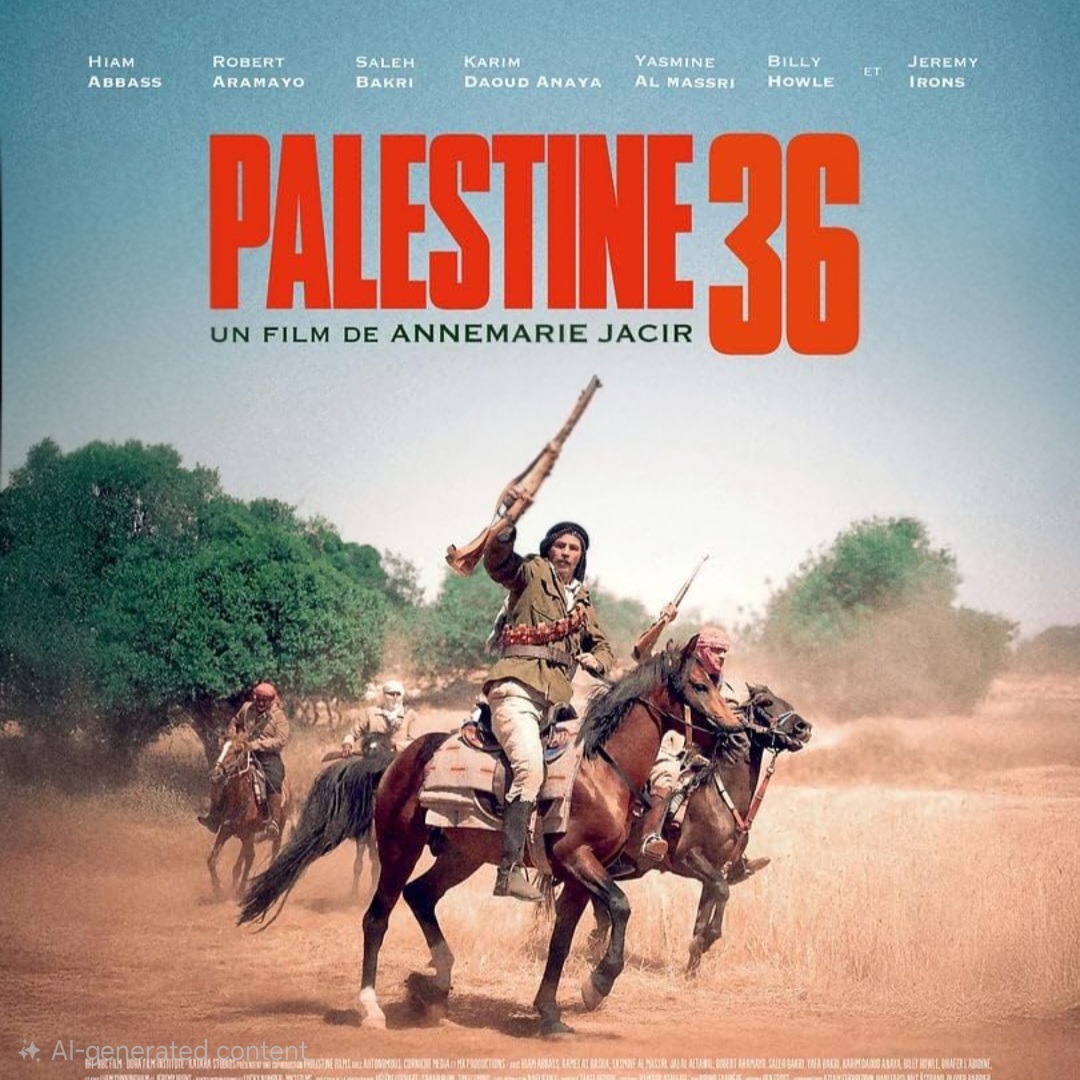
Expert Parent's Guide & Safety Review · 2025 / 2026
Palestine 36 (2025) Parents Guide:
Is It Kid-Friendly?
⚠ Direct Answer
With Caution — for ages 13 and above. Palestine 36 is a powerful, Oscar-shortlisted historical drama depicting the 1936 Arab Revolt against British colonial rule in Palestine. It is not a children's film — colonial violence, shootings, dead bodies, and distressing scenes of oppression make it unsuitable for under-13s. However, for teens and adults, it is an extraordinarily important piece of cinema that functions as genuine parental guidance-worthy educational viewing, provided parents engage with the material alongside their children and are prepared for its significant emotional and political weight.
US Age Rating
IFCO Rating (Ireland)
Expert Rec. Age
Violence
Language
Sex / Nudity
Substance Use
Emotional Themes
Positive Role Models
Critical Reception
| Category | Rating | Details |
|---|---|---|
| US Age Rating | PG-13 / Unrated | No MPAA rating confirmed for US release. Content benchmarks align squarely with PG-13 for thematic violence, disturbing content, and infrequent strong language. |
| IFCO (Ireland) | 12A | Certified 12A for moderate violence, cruelty, some distressing scenes, and infrequent strong language. Children under 12 require adult accompaniment in Ireland. |
| Expert Rec. Age | 13+ | Our recommendation. Mature 13+ viewers with active parental engagement. The historical and political weight demands adult context-setting and follow-up conversation. |
| Violence | Moderate | Shootings, explosions, physical attacks, dead bodies shown, funeral processions, leg wound injury detail. Historically grounded and purposeful rather than gratuitous. |
| Language | Moderate | Confirmed by Common Sense Media: "f---ing," "bastard," "damn," "hell," "bloody," "lowlife." "Christ" and "God" used as exclamations. Infrequent overall. |
| Sex / Nudity | Minimal | A married couple flirts fondly — the only flagged content. No nudity, no sexual scenes, no suggestive dialogue. Not a parental guidance concern. |
| Substance Use | Low | Characters smoke cigarettes and an argila (water pipe). Alcohol consumed socially — spirits, wine, champagne — but nobody is depicted drunk. Historically contextual. |
| Emotional Themes | Heavy | Colonial oppression, displacement, civilian persecution, land confiscation, community fracture. Deeply distressing for sensitive viewers. Requires parental preparation. |
| Positive Role Models | 5 / 5 | Exceptional positive modelling: loyalty, integrity, courage, solidarity, resistance to injustice. Women portrayed in equally strong roles throughout. |
| Critical Standing | 97% RT | 97% Rotten Tomatoes · Best Film Tokyo IFF 2025 · Palestine's Official Oscar Submission · 20-min TIFF standing ovation · IMDB 7.6/10 |
What Is Palestine 36 About? (No Spoilers)
Set in 1936 Mandatory Palestine, the film follows Yusuf (Karim Daoud Anaya), a young Palestinian man who moves between his rural village of al-Bassa and the charged political atmosphere of Jerusalem, where he works as a domestic servant for a publisher whose wife secretly writes articles about Palestinian freedom. As the 1936–39 Arab Revolt against British colonial rule ignites around him, Yusuf is drawn increasingly into the orbit of the uprising.
The Palestine 36 parents guide must foreground the film's emotional texture clearly: this is a story about loss of land, loss of safety, and the fracturing of a community under the pressure of colonial occupation. Parents should be prepared for emotional triggers including forced displacement of civilian families, the collective punishment of entire villages by soldiers, the detention and threatened killing of civilians, death of community members, and a young man's radicalization from hope to armed resistance.
Crucially, the film uses colourised archival footage woven into the dramatic narrative — giving the historical events an immediate, documentary-adjacent reality. This makes the film's distressing content feel more viscerally real than a purely fictional period drama would. Families watching together should be prepared for that emotional proximity. [Link to: Best Historical Drama Films for Families — Rated & Reviewed]
Why Is Palestine 36 Rated 12A / PG-13?
The IFCO's 12A certification — and its alignment with PG-13 content benchmarks — is accurately applied and, if anything, generously permissive for a film of this emotional weight. The IFCO specifically flags moderate violence, cruelty, distressing scenes, and infrequent strong language. The violence is not graphic in a horror or action-film sense, but it is historically credible and emotionally devastating in its context — soldiers shooting civilians, villages being collectively punished, and families being displaced from their homes.
The Palestine 36 age rating places it in the same general tier as films like Schindler's List or Hotel Rwanda in terms of its emotional demand on young viewers — not graphically gory, but profoundly disturbing in its subject matter. The IFCO's decision to permit 12-year-olds with adult accompaniment is defensible, but our expert recommendation of 13+ with active parental discussion reflects the film's sustained emotional intensity and its significant contemporary political resonance.
Detailed Content Breakdown
Violence & Gore
Violence in Palestine 36 is moderate, historically grounded, and purposeful — never gratuitous, but never sanitised either. Confirmed content from Common Sense Media includes: shootings with characters killed; explosions during uprising sequences; physical attacks and beatings of Palestinian civilians by soldiers; dead bodies visible on screen; funeral processions and characters digging graves; and a leg wound shown with injury detail — the one instance of visible gore flagged by multiple content reviewers.
Particularly notable for parents is the collective punishment sequences — British soldiers threatening and rounding up civilian villagers, including women and the elderly — which are among the film's most distressing and effective scenes. A settler guard shoots an unarmed Arab villager from a watchtower in one pivotal scene. The Palestine 36 violence content is consistently tied to the film's historical argument — it is never decorative, but it is sustained and emotionally demanding.
Profanity & Language
Language is infrequent but present, confirmed in granular detail by Common Sense Media. Specific words used include: "f---ing" (one confirmed use, likely in a British military context); "bastard," "damn," "hell," "bloody," and "lowlife." Additionally, "Christ" and "God" are used as exclamations. The IFCO describes the language as "infrequent strong language" — this is not a film defined by its profanity, but parents of children under 12 who are sensitive to any strong language should note these instances.
The film's dialogue is in both Arabic and English, with English subtitles. The Arabic-language sequences carry no equivalent profanity concerns flagged by any reviewer.
Sexual Content & Nudity
Virtually absent. The only flagged romantic content is a married couple flirting fondly — tender and age-appropriate. No nudity, no sexual scenes, no suggestive dialogue beyond this single instance. Common Sense Media, the IFCO, and all audience reports confirm this is a complete non-issue for parents assessing the Palestine 36 safe for kids question. The film's entire emotional energy is directed toward its historical and political subject matter.
Substance Use
Substance use is present but contextual and not a concern. Characters smoke cigarettes on numerous occasions, and tobacco is smoked through an argila (water pipe) — a culturally specific detail reflecting 1930s Palestinian social life. Alcohol is consumed — spirits, wine, and champagne at homes and parties — but nobody is depicted as drunk. Common Sense Media specifically notes this is "in keeping with the location and time period." No drug use of any kind is present or implied. [Link to: How to Talk to Teenagers About Historical Films — A Parent's Resource]
Emotional & Thematic Triggers
The film's primary content challenge for younger viewers is not physical violence but sustained emotional and thematic weight. Key themes — colonial oppression, the confiscation of ancestral land, civilian persecution, community fracture, and the radicalisation of a young man driven to violence by injustice — require significant emotional and cognitive maturity to process constructively.
Compounding this is the film's direct contemporary resonance. Multiple critics, reviewers, and audience members have noted the unavoidable parallel between the 1936 events depicted and the ongoing conflict in Gaza. For many viewers — particularly families with Palestinian, Arab, or Jewish heritage — this film will land not as history but as living memory and present grief. Parents should be explicitly prepared for this dimension before viewing with any child under 16.
Age-by-Age Viewing Guide
Toddlers & Preschoolers · 0–5
✖ Absolutely Not
Gunfire, explosions, dead bodies, and the general atmosphere of colonial threat and civilian suffering make this completely inappropriate for this age group in every respect.
Elementary · 6–10
✖ Not Appropriate
The scare factor from civilian shootings, displacement sequences, and collective punishment scenes places this firmly off-limits. The film's thematic complexity adds a further developmental bar. Not safe for kids this age.
Tweens · 11–13
⚠ With Strong Guidance
The IFCO permits 12-year-olds with adult accompaniment. Mature, emotionally confident 12–13 year olds can engage with this material, but parents must watch alongside and lead discussion before and after. Not suitable for unsupervised streaming.
Early Teens · 14–15
✔ Recommended with Discussion
This is an ideal film for 14–15 year olds studying history, colonialism, or current affairs. The emotional intensity is entirely appropriate for this age with parental context. A genuinely educational experience for this age group.
Older Teens & Adults · 16+
✔ Strongly Recommended
A masterwork of world cinema. 97% on Rotten Tomatoes. A 20-minute standing ovation at TIFF. Palestine's official Oscar submission. Every adult and mature teen with an interest in history, justice, or world cinema should see this film.
Positive Messages & Educational Value
What Families Can Learn from Palestine 36
- Overlooked History of the Middle East Conflict: The 1936–39 Arab Revolt is rarely covered in Western curricula. This film provides an essential, accessible entry point for understanding how the modern Israeli-Palestinian conflict was shaped. The Palestine 36 educational value for students of history and current affairs is exceptional.
- Colonial History & Its Modern Legacy: The film demonstrates in vivid human terms how British colonial policies — land allocation, divide-and-rule tactics, biased employment — created conditions of injustice whose consequences persist today. A history lesson that resonates far beyond the Middle East.
- The Power of Archival Memory: Director Jacir's innovative use of colourised archival footage teaches viewers to think critically about how history is preserved, who gets to tell it, and how visual evidence shapes our understanding of the past.
- Women's Voices in History: The film's female characters — particularly Yasmine Al Massri's clandestine journalist — offer a compelling portrait of women's role in resistance movements. Common Sense Media specifically notes women are portrayed in equally strong roles as men throughout.
- Loyalty and Integrity Under Pressure: Common Sense Media identifies these as the film's core positive messages. Yusuf's journey — from aspiring civilian to committed participant in his community's struggle — models a form of moral seriousness and communal loyalty that is genuinely admirable in its context.
- Critical Media Literacy: The film's contested historical reception — praised by most critics, challenged by others on grounds of balance — makes it an ideal vehicle for teaching older teens about perspective, bias, and how to engage critically with historical narratives in cinema.
5 Discussion Questions for Families
- The film is told entirely from a Palestinian point of view. How does knowing that shape the way you watch it? Does every historical film have a perspective — and is that a problem, or just honest?
- Yusuf starts the film hoping for a normal life and ends it as a participant in armed revolt. At what point do you think his choice became understandable — and where, if anywhere, do you think he crossed a line?
- The British officials in the film believe they are managing a difficult situation fairly. How is it possible for people to participate in a system of injustice and genuinely believe they are doing the right thing?
- The film was made partly to be shown now, during an ongoing conflict. Do you think art about historical injustice can change how people respond to present-day injustice — or does it mostly preach to people who already agree?
- The colourised archive footage makes the 1936 events feel immediate and real. Did that change how you felt watching the film compared to black-and-white archival footage? Why do you think the director made that choice?
Common Questions About Palestine 36 (2025)
Is Palestine 36 too scary for children under 12?
Yes — for most children under 12. Colonial violence, shootings, dead bodies, and sustained scenes of civilian persecution create real distress. The IFCO requires adult accompaniment under 12 in Ireland. Our expert recommendation for the Palestine 36 streaming age limit is 13+.
Does Palestine 36 have a post-credits scene?
No post-credits scene has been reported from any screening, including TIFF, BFI London, or the Tokyo International Film Festival. Palestine 36 is a standalone historical drama, not a franchise film. The film ends decisively without a tease. [Link to: Is Palestine 36 Streaming? Where to Watch Guide]
Are there any strobe light or photosensitivity warnings for Palestine 36?
No official photosensitivity warning has been issued. The film's visual style — combining drama with colourised archival footage — is unlikely to contain rapid flashing sequences. Parents of photosensitive children should confirm with their local cinema or streaming platform before viewing.
Is Palestine 36 appropriate for classroom use with high school students?
Yes — for students aged 14 and above with appropriate teacher-led context. The film's historical subject matter, positive messages about resistance and integrity, and its Oscar-shortlisted quality make it an exceptional classroom resource for history, politics, and film studies. Parental consent letters are recommended for under-16s.
Where can I watch Palestine 36 — and what is the streaming age limit?
Palestine 36 is available in UK cinemas via Curzon Film (released October 31, 2025). US theatrical release via Watermelon Pictures is underway in 2026. Streaming platform details are unconfirmed at publication. When streaming becomes available, apply a 12+ or PG-13 parental control filter as the appropriate streaming age limit. [Link to: Palestine 36 Streaming Release Date — Updated Guide]
Is Palestine 36 politically biased — and should that affect my parental guidance decision?
The film has a declared Palestinian perspective, which some critics have praised as honest and others have critiqued for omitting Jewish voices. This does not change the content safety profile for children — violence and language levels remain moderate. Parents should plan for post-viewing discussion about perspective in historical storytelling. This is an asset, not a reason to avoid the film.
My child of Palestinian or Arab heritage wants to watch Palestine 36 — any specific guidance?
Children from Palestinian, Arab, or Middle Eastern families may find this film lands with profound personal resonance — or reactivates difficult emotions related to family history or current news. Watching together as a family, with space for emotional processing before and after, is strongly recommended. Do not let children aged under 13 watch this unsupervised regardless of heritage.

I am a journalist with 10+ years of experience, specializing in family-friendly film reviews.