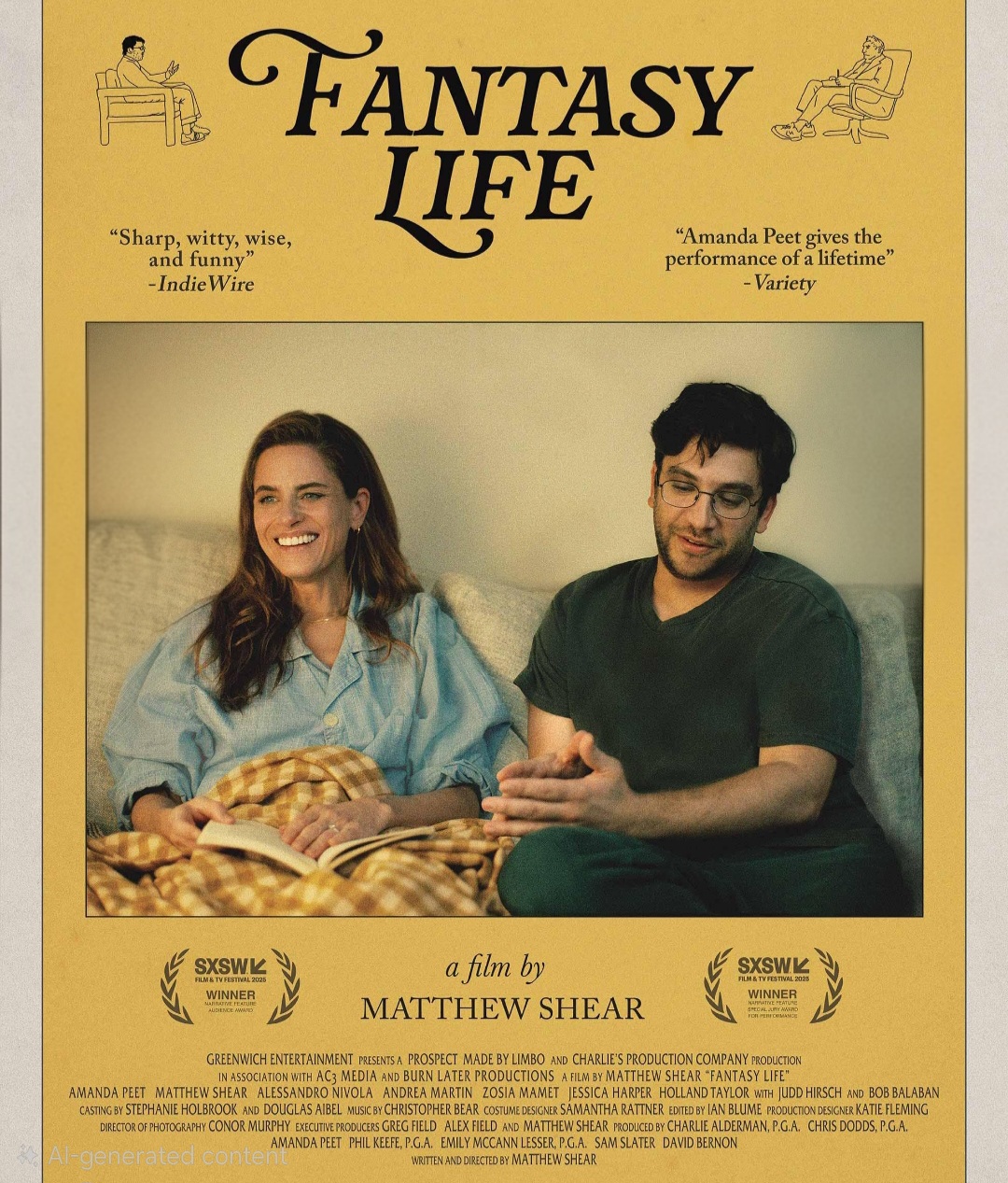
Fantasy Life (2025)
There is a scene in the third act of Fantasy Life — not fully shown on screen, as it happens — where Sam, the film's hapless man-child protagonist, has a panic attack while he is supposed to be watching three young girls. We learn about it the way the children's mother learns about it: after the fact, in fragments, through other people's retelling. What the camera does show us is the fallout. Amanda Peet's Dianne — controlled, measured, exhausted for most of the film — unravels completely.
I watched that scene and thought, immediately, about parents in the audience who live with anxiety disorders themselves, or who are raising children alongside a partner who does. There is something in this film that will land very differently depending on where you are sitting in life.
That scene is also why I want to talk carefully about who this film is for — because the R rating, somewhat unhelpfully, tells you almost nothing useful.
What It's About
Sam Stein loses his paralegal job and promptly has a panic attack in a coffee shop. His therapist's wife — in the waiting room, immediately after his session — offers him babysitting work for her son's three young daughters. Sam takes it. The girls' mother, Dianne, is a former actress in a crumbling marriage to a touring musician who is almost never home. The film follows Sam and Dianne's deepening connection across a year, including a summer on Martha's Vineyard where two families, all four grandparents, and a great deal of unspoken need converge in close quarters. Mental illness, professional failure, the quiet grief of a marriage dying in slow motion — all of it handled without melodrama, and mostly without resolution.
Quick-Scan Safety Card
Adult language throughout, consistent with an R-rated indie drama. Not relentless, but present. Includes strong profanity in the explosive argument scene.
Panic attacks depicted realistically and recurrently. Anxiety, depression, and therapy are central to both lead characters. Medication is referenced matter-of-factly.
A marriage visibly disintegrating across the runtime. Not violent, but emotionally raw. Children are present in the household throughout this breakdown.
A married woman and the family's babysitter develop romantic feelings. Nothing explicit. The tension is emotional, not physical.
No physical violence of any kind.
No sexual content. The film is entirely chaste in this regard.
Social drinking among adults at family gatherings. Nothing that centres substance use.
Antisemitism and ageism surface as background details. Neither is dramatised at length, but both are present.
Bittersweet rather than bleak. The film sits in discomfort without turning dark. A low-key, autumnal mood for most of its runtime.
Content Breakdown
The Panic Attack Scenes — What You Actually See
This is the part most parents will want to know about before deciding whether to watch this alongside a younger teenager — or before deciding whether it is appropriate for a child who already deals with anxiety personally.
Sam's first panic attack happens early, in a coffee shop. It is filmed close and uncomfortable. He cannot speak properly, people stare, he stumbles out. It is not played for drama — it is played for embarrassment and confusion, which is, honestly, more accurate to what panic attacks feel like from the inside. I've talked to child psychologists who think that kind of portrayal does more good than harm for anxious teens who have never seen their own experience reflected back accurately.
I've reviewed dozens of films that reference anxiety as character flavouring. This one treats it as a condition — which, for families navigating this personally, makes it feel like a different category of film entirely.
The later panic attack — the one that happens off-screen while Sam is minding the three girls — is handled differently. We do not see it. We see its consequences: a frightened child, a phone call, a mother whose carefully maintained composure finally gives way. That choice to keep the actual episode off-camera is interesting. It means the film lands harder on the parenting anxiety of leaving your children with someone who cannot fully look after himself.
The Marriage — What Children in the Film Witness, and What Younger Viewers Will Absorb
The relationship between Dianne and her husband David is where I think this film becomes a more complicated watch than its breezy rom-com marketing suggests. David is not a villain. He is not cruel. He is simply absent — choosing tour dates over his children, allowing an emotional distance between himself and Dianne to calcify into something permanent.
Younger viewers from stable family backgrounds will likely read this as adult drama that doesn't concern them. But here is the thing — teenagers who have lived through or are currently living through parental separation may recognise something in the particular texture of this marriage. The way Dianne and David talk around things. The way the children are maintained as a reason to keep showing up. It is written with a specificity that mirrors real relationship breakdown, not cinematic divorce.
There is one extended confrontation scene. It is not shouting for the sake of it — but it is raw, and Peet earns every second of it. I would not hesitate to call it the most emotionally intense scene in the film.
The Romantic Tension — Honest Assessment
Sam falls for a married woman. The film does not pretend otherwise, and it does not punish him excessively for it either. I want to be careful how I say this: the film has a moral ambiguity around this that I actually think is handled more responsibly than the setup suggests. Sam does not act on his feelings in any way that crosses a line. Dianne does not betray her marriage. The film sits in the tension of a connection that cannot go anywhere — and is, ultimately, a story about two lonely people who need a friend more than they need a romance.
That said, the dynamic is adult enough that I would not want to watch this with my 11-year-old without being prepared for questions. My 16-year-old is another matter entirely — this is exactly the kind of film that rewards older teens who are starting to understand that adult relationships are complicated.
Mental Health as Subject Matter, Not Backdrop
What sets Fantasy Life apart from the majority of films I cover on this site is that its treatment of mental illness feels lived-in rather than decorative. Both Sam and Dianne have histories with depression and anxiety. Both are in therapy. Medication is mentioned without drama or stigma.
For families dealing with these things personally, that normalisation is actually meaningful. I've shown excerpts of Sam's early therapy scene to colleagues in child development — the way Judd Hirsch's Fred navigates a patient who is deflecting while clearly struggling — and the consensus was that it is one of the more honest portrayals of therapy dynamics in recent mainstream film. Not a therapy advertisement. Not a mockery. Just two people sitting in a room trying to talk.
My Rating vs. the MPAA
The R rating is almost certainly driven by language. As far as I can determine, there is no sexual content, no violence, and no substance misuse at R-rated levels. By content alone, this is a soft R — closer to PG-13 in terms of actual risk. The emotional material, however, deserves a rating of its own. For families in the middle of parental separation, or for children managing anxiety disorders, some of this will hit harder than any amount of profanity.
Age Guide
The language alone rules this out for most under-13s, but more than that — the emotional subject matter simply isn't calibrated for younger children. There is nothing frightening, but there is a great deal that will either confuse or land in unintended ways for this age group.
Teens this age can handle the content, but the marriage breakdown and panic attack sequences are worth talking through. Particularly worth screening ahead of time if your child is managing anxiety personally — this could be a genuinely useful film, or it could trigger something. Know your kid.
This is the sweet spot for teenage viewers. Old enough to appreciate what the film is actually doing with mental health and relationships, emotionally literate enough to sit with its ambiguity. My own 16-year-old found it more interesting than she expected.
Adults — particularly those in their late twenties and beyond who recognise Sam's particular flavour of failure anxiety — will find this sharply observed and quietly affecting. A small film that earns its warmth.
Discussion Questions for Families
For parents watching with older teenagers:
- When Sam has his panic attack in the coffee shop, people around him do not know how to react. Have you ever witnessed someone having a panic attack — or experienced one yourself? What would have actually helped in that moment, and what do you think people usually get wrong?
- David keeps choosing his tour over his family, and the film never really condemns him for it outright. Do you think the film is asking us to sympathise with him, judge him, or something more complicated than either of those things?
- Dianne's therapist tells her, at one point, that being privileged doesn't make you undeserving of help. Do you agree with that? Have you ever dismissed your own problems because someone else seemed to have it worse?
- Sam never tells Dianne how he feels. By the end of the film, do you think that was the right choice — and what do you think happens between them after the credits roll?
- The three girls in this film are very much in the background of a story that's happening around them. How do you think they experienced the summer differently to the adults? What do you think they understood — and what do you think they didn't?
Frequently Asked Questions
Not for young children. The R rating and the film's central themes — panic attacks, a failing marriage, adult loneliness — make it an adults-and-older-teens watch. There is nothing graphic, but the emotional material is squarely aimed at grown-up audiences.
Almost certainly for language. There is no sexual content, no violence, and no heavy substance use. The R rating feels like a soft one — the content is far closer to PG-13 in most categories — but the adult emotional themes make the rating appropriate regardless of the reason for it.
Yes. Panic attacks are depicted on screen more than once, including in a coffee shop setting early in the film. For viewers who deal with anxiety disorders personally, these scenes are realistic rather than sensationalised. They are not gratuitous, but they are not easy either.
No. The film is entirely chaste. There is romantic tension between a man and a married woman, but nothing is acted on and nothing explicit occurs.
As of its US release on March 27, 2026, Fantasy Life is a theatrical release via Greenwich Entertainment. Streaming availability had not been confirmed at the time of this review. Check Fandango at Home and major streaming platforms for updates.
No relation whatsoever. Fantasy Life the film is an indie romantic drama set in New York and Martha's Vineyard. Fantasy Life the video game is a family-friendly life-simulation RPG. Different titles, completely different content.
Final Verdict
Fantasy Life won the Audience Award at SXSW 2025 for reasons you can feel while watching it — it is warm, it is specific, and it trusts its audience to sit with things that don't resolve neatly. Amanda Peet gives the kind of performance that makes you wonder where she has been, and the answer the film offers is: the same place Dianne has been, just doing her best.
As a parents guide, my honest take is this: the official R rating slightly misrepresents the nature of the content risk. You will not be blindsided by sex or violence. You might be blindsided by how accurately it captures the emotional texture of adult life going quietly wrong. That is worth knowing before you press play.
For parents watching with older teenagers — particularly those navigating questions about mental health, ambition, or what it actually means when adults in their lives seem to be struggling — this is a small film that punches above its weight as a conversation starter. I would watch it with my 16-year-old again.

Matthew Creith is a movie and TV critic based in Denver, Colorado. He’s a member of the Critics Choice Association and GALECA: The Society of LGBTQ Entertainment Critics. He can be found on Twitter: @matthew_creith or Instagram: matineewithmatt. He graduated with a BA in Media, Theory and Criticism from California State University, Northridge. Since then, he’s covered a wide range of movies and TV shows, as well as film festivals like SXSW and TIFF.