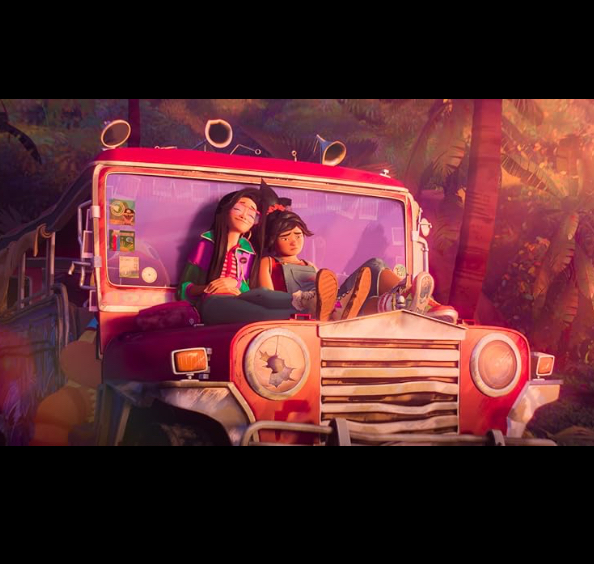
My youngest sat perfectly still for the first forty minutes. That almost never happens. Then there’s a scene near the second act where a child character is separated from their group, alone in a collapsing underground space, and I watched my daughter’s hands grip the armrest so tight her knuckles went white. She’s nine. She didn’t cry, but she turned to me and whispered, “Is she going to be okay?” That moment told me everything I needed to know about where this Forgotten Island parents guide needed to start.
Because the trailers sell this as a sun-drenched island adventure. And it is — partially. But there’s an emotional weight here that caught me off guard, a thread of loss and isolation that runs beneath the adventure set pieces like an undertow.
Is Forgotten Island Safe for Kids? The Direct Answer
Quick-Scan Safety Card
| Category | Detail |
|---|---|
| Official Rating | Not Yet Rated — likely PG or PG-13 based on content |
| Expert Recommended Age | 10+ (8-9 with a parent present) |
| Violence Level | Moderate — perilous action sequences, environmental dangers, no graphic bloodshed |
| Language Level | Mild — occasional “damn” and “hell,” no strong profanity |
| Emotional Intensity | High — themes of abandonment, grief, and prolonged isolation hit harder than expected |
| What Will Surprise Parents Most | The emotional weight. This is not a breezy adventure — the grief subplot is front and centre by the midpoint |
What Is Forgotten Island About — No Spoilers
A group of young characters find themselves stranded on an island that doesn’t appear on any map. What starts as a survival adventure shifts into something more personal — each character is carrying a loss they haven’t processed.
The island itself seems to respond to their emotional states, which creates some genuinely unsettling sequences. Think less “tropical holiday gone wrong” and more “what happens when you’re forced to face the things you’ve been running from.”
If your child has experienced loss — a grandparent, a pet, a family separation — this film will absolutely touch those nerves. That’s not necessarily a bad thing, but you should know it going in. The adventure elements are thrilling and well-crafted. The emotional core is what will stay with your family afterward.
Why Is It Rated Not Yet Rated?
As of my screening, Forgotten Island hasn’t received its official classification in Australia. Based on what I saw, I’d expect it to land somewhere around a PG rating, possibly M, depending on how the classification board weighs the emotional intensity against the lack of graphic content.
Here’s where my honest assessment diverges from what I expect the official Forgotten Island age rating to be. A PG rating suggests parental guidance for younger viewers but generally signals “most kids will be fine.” I’m not sure most kids under 10 will be fine here. The peril sequences are sustained. The emotional beats are heavy. There’s a difference between content that’s technically mild and content that hits hard — and this film hits hard.
If it receives a PG, I’d argue that undersells what parents actually need to prepare for. The Forgotten Island parental guidance conversation needs to happen before you press play, not during the car ride home.
Content Breakdown
Violence and Perilous Sequences
No one gets punched in this film. No weapons, no blood. But the danger feels visceral because of how the island’s environment is used. Collapsing cave systems, rising floodwaters, unstable cliff edges — these aren’t quick-cut action beats.
One sequence involving a character trapped in an underground passage goes on for what felt like a full five minutes. The sound design is claustrophobic and oppressive. My middle child (he’s twelve) said afterward, “That was more stressful than any horror movie,” which I thought was a pretty sharp observation for a kid who wasn’t supposed to be watching horror movies.
If your child has a fear of enclosed spaces or drowning, preview the cave sequence before family viewing. It’s the most intense sustained peril in the film and could be genuinely distressing for anxious children.
Emotional Content and Grief Themes
This is where the Forgotten Island content warning really matters. Each young character on the island is dealing with a different form of loss. One has lost a parent. Another is coping with a family that fractured after a move. A third is grieving a friendship that ended badly.
The film doesn’t treat these lightly. There’s a scene where a character finds what appears to be a memory of their deceased parent, recreated by the island, and has to choose whether to stay in that illusion or leave. I had a lump in my throat. Honestly, I teared up. And I knew it was coming.
For kids who’ve experienced similar losses, this could be cathartic or triggering — and I genuinely can’t tell you which it’ll be for your child. That depends entirely on where they are in processing their own experiences.
The parent-loss subplot peaks around the two-thirds mark. If you’re watching with a child who has lost a parent or close family member, be ready for an emotional response. Consider having a conversation beforehand about what they might see.
Frightening and Intense Imagery
The island shifts and changes in ways that border on surreal. There are sequences where familiar landscapes warp into something disorienting — trees bending at wrong angles, the sky changing colour rapidly, shadows that move independently. None of it is graphic or gory. All of it is deeply unsettling.
One nighttime sequence, where the island seems to “breathe” around the characters, genuinely made me uneasy. It’s the kind of atmospheric dread that doesn’t show up in a trailer but lingers.
Children who are sensitive to surreal or “reality-bending” imagery may find several sequences disturbing. The fear here isn’t monster-based — it’s existential and atmospheric, which can be harder for younger kids to shake off at bedtime.
Language
Fairly mild across the board. A handful of uses of “damn” and “hell,” typically in moments of extreme stress. No sexual language. No slurs. Nothing that would raise eyebrows in most households.
If the rest of the content were as mild as the language, I’d have no hesitation recommending this for younger audiences. But language is really the least of your concerns here.
Language is a non-issue in this film. Focus your pre-viewing conversation on the emotional and peril-based content instead.
Substance Use and Mature Themes
No substance use, no romantic content beyond fleeting hints of a pre-teen crush, nothing sexual. The mature themes are entirely emotional — loss, abandonment, the fear of being forgotten. The title isn’t just about geography. It’s about people.
The “mature” content here is all psychological and emotional. There’s nothing to worry about in terms of substances, romance, or age-inappropriate physical content.
Forgotten Island Age-by-Age Viewing Guide
Not a chance. The sustained peril sequences are long and loud, the atmospheric shifts will confuse and frighten very young viewers, and the emotional themes are well beyond what a preschooler can process. Even the adventure elements move at a pace designed for older audiences. Skip this one entirely for your littlest ones.
This is the age range where I’d be most cautious. The adventure elements will absolutely appeal to 7- and 8-year-olds, and the trailer will make them beg to watch it. But the cave sequence alone would have been too much for two of my three kids at that age. The grief themes require emotional maturity that most kids in this bracket haven’t developed yet. A very mature 9-year-old watching with a parent who’s ready to pause and talk? Maybe. But I’d lean toward waiting.
This is the sweet spot, but with caveats. Most 11- to 13-year-olds will handle the peril sequences well and might even find them thrilling rather than frightening. The emotional content is where you’ll want to gauge your own child’s readiness. Kids in this range who’ve dealt with loss may need a parent nearby. Kids who haven’t will likely find the story moving without being overwhelming. My 12-year-old processed it beautifully and wanted to talk about it for days.
Teenagers will handle all of this content without issue and will likely connect deeply with the emotional themes. The character dynamics feel authentic to this age group. This is honestly a strong film for teens who are beginning to grapple with big feelings and don’t always have the language for them. It gives them a framework.
Fully appropriate and genuinely rewarding. The themes of unprocessed grief and the courage it takes to face what you’ve been avoiding will land differently for older teens and adults than for younger viewers. I found it more emotionally affecting as a parent than I expected going in. Bring tissues if you’re the type. I apparently am.
Positive Messages and Educational Value
I’ll be straightforward — this isn’t an educational film in any traditional sense. You won’t learn survival skills or island ecology. What it does offer is something harder to quantify but genuinely valuable: a framework for talking about grief with children.
The film presents loss not as something to “get over” but as something to face and carry forward. That’s a nuanced message, and it’s delivered without being preachy. The characters model vulnerability, asking for help, and supporting each other through fear — all things I want my kids to see normalised on screen.
There’s also a quiet but consistent message about the danger of running from painful emotions. The island quite literally won’t let these characters escape until they’ve confronted what they’re carrying. It’s not subtle, but it works.
Five Family Discussion Questions
- When one character discovers the island has recreated a memory of their lost parent, they have to decide whether to stay or leave. What would you have done in their position, and why?
- The island seems to change based on what the characters are feeling inside. Can you think of a time when your emotions changed how you experienced a place — like a school or a friend’s house feeling different when you were sad?
- One character keeps their grief completely hidden from the group until it becomes impossible to hide. Why do you think people sometimes try to carry hard feelings alone, and what happened when that character finally opened up?
- The film suggests that being “forgotten” is one of the scariest things a person can experience. Do you agree? What does it feel like to worry that someone might forget you?
- At the end, the characters leave the island changed. If you had to describe what each character gained and what they left behind, what would you say?
Frequently Asked Questions
For most 7-year-olds, yes. The cave collapse sequence and surreal island transformations are sustained and intense rather than quick scares. Combined with heavy emotional themes around loss, this is likely too much for children under 10 without parental support.
Based on my screening, there is a brief moment after the initial credits roll — a short, quiet scene rather than a sequel tease. It’s emotional rather than action-based. Worth staying for, but not essential to understanding the story.
There are sequences with rapid light changes during the island’s surreal transformation scenes. While I’m not certain they’d meet clinical thresholds for photosensitivity warnings, families affected by epilepsy or light sensitivity should exercise caution and preview first.
Forgotten Island is set for release on 17 September 2026 in Australia. Streaming platform details haven’t been confirmed at time of writing. Check back closer to release for updated Forgotten Island streaming age limit and platform information.
Without spoiling specifics, the film deals heavily with past deaths that occurred before the story begins. No main character dies on screen during the film’s events, though there are moments of intense peril where it feels like they might.
This is genuinely case-by-case. The film handles grief with care and could open valuable conversations. But it could also reopen wounds unexpectedly. If your child has experienced recent loss, watch it yourself first or be prepared to pause and talk.
Key Forgotten Island trigger warnings include parental death (discussed, not shown), prolonged claustrophobic peril, child separation and isolation, surreal/disorienting imagery, and intense themes of abandonment and grief throughout the second and third acts.

Stephanie Heitman is a seasoned journalist and author dedicated to helping parents navigate the world of Hollywood entertainment through thoughtful, family-oriented film reviews. With over a decade of experience in writing and a passion for fostering safe, enriching viewing experiences, Stephanie launched Parentguiding.com to provide parents with the insights they need to make informed choices for their families.