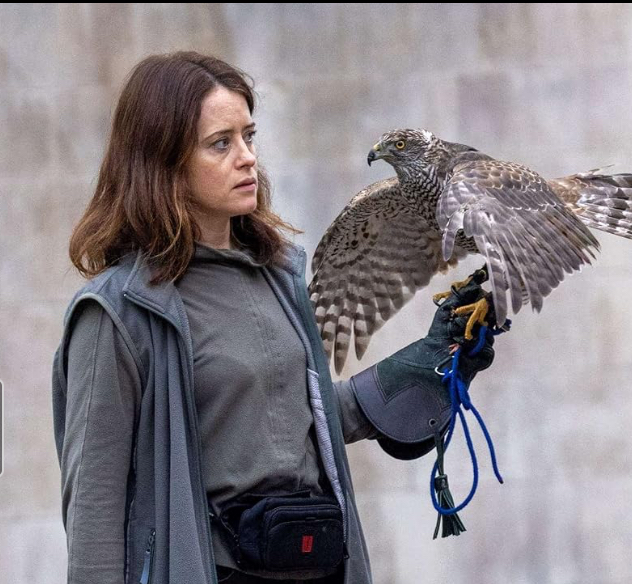
There is a scene roughly midway through H Is for Hawk where a goshawk tears apart a rabbit in close-up — feathers blooded, talons clenched, the camera absolutely refusing to look away. It lasts maybe fifteen seconds. My 11-year-old turned to me with wide eyes and said, “That’s real, isn’t it?” I didn’t have a good answer, because the filmmaking is so precise it blurs every line between nature documentary rawness and dramatic storytelling. That single moment crystallised what this H Is for Hawk parents guide needs to communicate: this is a quiet, literary film that carries sudden visceral punches most families will not anticipate from the marketing.
Based on Helen Macdonald’s acclaimed memoir, this 2026 adaptation is not an action film. It’s not a thriller. But it contains some of the most emotionally lacerating scenes about grief, loss, and the wildness of the natural world that I’ve encountered in recent years. If you’re asking whether H Is for Hawk is safe for kids, the answer depends far less on what happens on screen and far more on where your child is emotionally.
Is H Is for Hawk Safe for Kids? — Direct Answer
Quick-Scan Safety Card
| Category | Detail |
|---|---|
| Official Rating | Not Yet Rated — likely PG-13 equivalent for thematic intensity and brief animal violence |
| Expert Recommended Age | 12+ (10+ for mature, emotionally resilient children with parental discussion) |
| Violence Level | Moderate — graphic depictions of raptor hunting prey; no human-on-human violence |
| Language Level | Mild — occasional mild profanity (“damn,” “bloody”); British dialogue throughout |
| Grief & Loss | Heavy — the death of a parent is central; prolonged depictions of mourning and emotional breakdown |
| Animal Content | Intense — realistic falconry, prey animals killed on screen, emotionally complex human-animal bond |
| What Will Surprise Parents Most | How raw and unrelenting the grief is — this is not a comforting “healing” narrative for long stretches |
What Is H Is for Hawk About — No Spoilers
A woman loses her father suddenly and unexpectedly. In the suffocating fog of grief that follows, she makes an impulsive decision: she will train a goshawk — one of the most notoriously difficult and wild birds of prey in falconry. The hawk becomes both her lifeline and her mirror.
The film interweaves her story with that of T.H. White, author of The Once and Future King, who attempted the same task decades earlier with very different results. Expect sustained emotional intensity, the rawness of bereavement, isolation, and moments of ferocious natural beauty that land somewhere between awe and discomfort.
Why Is It Rated Not Yet Rated?
As of writing, H Is for Hawk has not received an official classification in Australia or from the MPAA. Here is where I’ll be honest with you: I expect this lands somewhere around PG-13 in the US or M in Australia.
And look — I think that rating, when it comes, will technically be accurate but will tell parents almost nothing useful. The content that makes this challenging isn’t profanity or explicit violence in the traditional sense. It’s emotional devastation sustained across a full runtime. A PG-13 tag doesn’t communicate that your child will watch a woman come apart with grief for ninety minutes.
The H Is for Hawk age rating conversation is really about emotional readiness, not content checklists. I’ve reviewed films rated R that are less emotionally demanding than what I anticipate here.
Content Breakdown
Grief and Bereavement
This is the backbone of the film and the primary reason for this H Is for Hawk parental guidance advisory. The protagonist’s father dies early in the narrative. What follows is not a neat arc from sadness to healing. It is messy, obsessive, sometimes frightening grief.
I want to be careful how I say this. The film depicts grief as it actually feels — not as we wish it felt. There are scenes of the protagonist unable to function, withdrawn from friends and family, engaging in behaviour that borders on self-destructive. For children who have lost a grandparent or a parent, this material could be triggering. For children who haven’t experienced loss, it may simply be confusing and distressing.
If your child has recently experienced a significant loss, preview this film yourself before sharing it. The grief depiction is unflinching and could be either cathartic or deeply upsetting depending on where they are in their own process.
Animal Violence and Predation
Goshawks kill things. That’s what they do. The film does not sanitise this reality. Expect scenes of the hawk hunting rabbits, pheasants, and possibly other small animals, with blood and the physical mechanics of predation shown in some detail.
What caught me off guard — and I say this having reviewed dozens of nature-adjacent dramas — is how the camera treats these kills with neither triumph nor horror. They simply happen, as they do in nature. My 16-year-old found this matter-of-fact approach more unsettling than any stylised movie violence. “It doesn’t tell you how to feel about it,” she said. She was right.
If your child is sensitive about animals, especially small prey animals like rabbits, this will be difficult viewing. These scenes are integral to the story and cannot easily be skipped without losing narrative context.
Isolation and Mental Health
The protagonist deliberately withdraws from human contact for extended periods. She sleeps in unusual conditions, neglects self-care, and becomes so consumed by the hawk-training process that it functions as an avoidance mechanism rather than genuine healing for much of the film.
Honestly, this aspect surprised me more than the animal content. The film sits in that uncomfortable space between showing self-destructive behaviour and implicitly endorsing it — at least until the final act offers perspective. For teenagers, particularly those who may already be dealing with anxiety or depression, this warrants a conversation beforehand.
Frame this before viewing: coping mechanisms can be both helpful and harmful. The protagonist’s relationship with the hawk serves as both — and recognising that duality is part of the film’s purpose.
Language
The language concern here is minimal. Expect British mild profanity — “bloody,” “damn,” perhaps an occasional stronger word. Nothing that would register as a concern for most families. The dialogue is literary and often quietly beautiful.
T.H. White Parallel Narrative
The sections dealing with T.H. White introduce themes of repressed identity, loneliness, and the cruelty of mid-20th century English boarding school culture. White’s story carries implications of self-loathing connected to his sexuality, though the source material handles this with restraint. I expect the film will follow suit, but parents should be aware this thread exists.
I’ve shown the source material passages to colleagues, and we agree: this adds important thematic depth but requires a viewer mature enough to hold two timelines and two emotional registers simultaneously. Most children under 12 will simply lose the thread rather than be disturbed by it.
The T.H. White sections may prompt questions about historical attitudes toward sexuality. Having a brief, honest answer prepared is wise — even if the film handles this subtly.
Age-by-Age Viewing Guide
No part of this film is designed for very young children. The pacing alone — slow, meditative, long scenes of silent observation — would lose them completely. The animal violence and raw grief would be frightening without any emotional framework to process it. Keep this one well out of reach.
Even for bird-obsessed kids in this age range — and I know they exist because my youngest went through a raptor phase at eight — this is not the right film yet. The grief content is too sustained and too adult. A child this age is likely to feel confused, bored, or distressed, possibly all three. Nature documentaries about hawks will scratch this itch far better.
This is the dividing line, and it depends entirely on your child. A mature, emotionally secure 12 or 13-year-old who reads widely and has some framework for understanding death could find this deeply affecting in a positive way. A sensitive 11-year-old is more likely to find it overwhelming. You know your child. Watch it yourself first if you’re unsure.
This is the sweet spot. Teens in this range are old enough to sit with difficult emotions and young enough for the film to genuinely expand their emotional vocabulary. My 16-year-old called it “the saddest film that isn’t actually sad” — which I think captures something true about its tone. Strong recommendation for this group, especially for families comfortable talking about grief openly.
Fully appropriate. Young adults and older teens will likely connect with the themes of identity, loss, and the search for meaning. If your older teen or young adult is heading off to university, this could actually spark a surprisingly good conversation about how people cope when the structures of their life change suddenly.
Positive Messages and Educational Value
Put plainly: the educational value here is real but it’s not the kind you can measure with a quiz. The film teaches children — if they’re old enough for it — that grief is not linear, that healing sometimes looks like breaking down first, and that our relationship with the natural world can be both profoundly comforting and completely untameable.
There’s genuine learning about falconry, raptor behaviour, and the English countryside. The T.H. White thread offers a window into literary history that curious teens may actually follow up on. I wouldn’t call this film fun. But it is genuinely enriching for the right viewer at the right age.
What I appreciated most was the film’s refusal to offer easy answers. Life hurts sometimes, and the only way through is through. That’s a message worth sitting with.
Five Family Discussion Questions
- When the protagonist chooses to train a goshawk instead of leaning on friends or family after her father’s death, do you think that was a brave choice or a way of avoiding her feelings? Can it be both?
- The hawk kills prey animals throughout the film, and the camera doesn’t look away. Why do you think the filmmakers chose to show this so directly? How did it make you feel?
- T.H. White tried to train a hawk too, but his experience was very different. What do you think the film is saying by putting these two stories side by side?
- Have you ever thrown yourself into a hobby or activity to avoid thinking about something painful? What happened when you finally stopped?
- The protagonist says at one point that the hawk doesn’t care about her grief — it just wants to fly and hunt. Is there something comforting about that, or something frightening? Why?
Frequently Asked Questions
Yes. The animal predation scenes are graphic and realistic, and the heavy grief themes will confuse or frighten most children this young. The film’s slow pace and adult emotional register make it unsuitable for this age group entirely. Wait several years.
Based on the film’s genre and tone as a literary drama adaptation, a post-credits scene is extremely unlikely. This is not a franchise film. You can leave when the credits roll without missing additional content.
Given the naturalistic, outdoor-focused cinematography typical of this kind of British drama, significant strobe effects are not expected. However, official photosensitivity warnings have not yet been released. Check closer to the Australian release date for confirmation.
H Is for Hawk is scheduled for release on 13 August 2026. Theatrical release details for Australia should be confirmed closer to date. Streaming availability and the H Is for Hawk streaming age limit will depend on the platform — check back here for updates.
It depends on the child’s age and sensitivity. Animal-loving teens aged 12 and up may find the falconry content fascinating. But younger animal lovers could be upset by realistic hunting and prey kills. The film portrays nature honestly, not sentimentally.
Yes. The protagonist’s father dies early in the story — this is the central event of the narrative. His death is not shown graphically, but the grief that follows is depicted in sustained, emotionally intense detail throughout the film.
Yes. It’s adapted from Helen Macdonald’s bestselling 2014 memoir of the same name. Macdonald trained a goshawk named Mabel after her father’s death. The book won the Samuel Johnson Prize and Costa Book Award.
Key H Is for Hawk trigger warnings include: parental death, intense grief and bereavement, realistic animal predation with blood, social isolation, and depictions of mental health struggles. The emotional content is more challenging than any visual content.

Stephanie Heitman is a seasoned journalist and author dedicated to helping parents navigate the world of Hollywood entertainment through thoughtful, family-oriented film reviews. With over a decade of experience in writing and a passion for fostering safe, enriching viewing experiences, Stephanie launched Parentguiding.com to provide parents with the insights they need to make informed choices for their families.