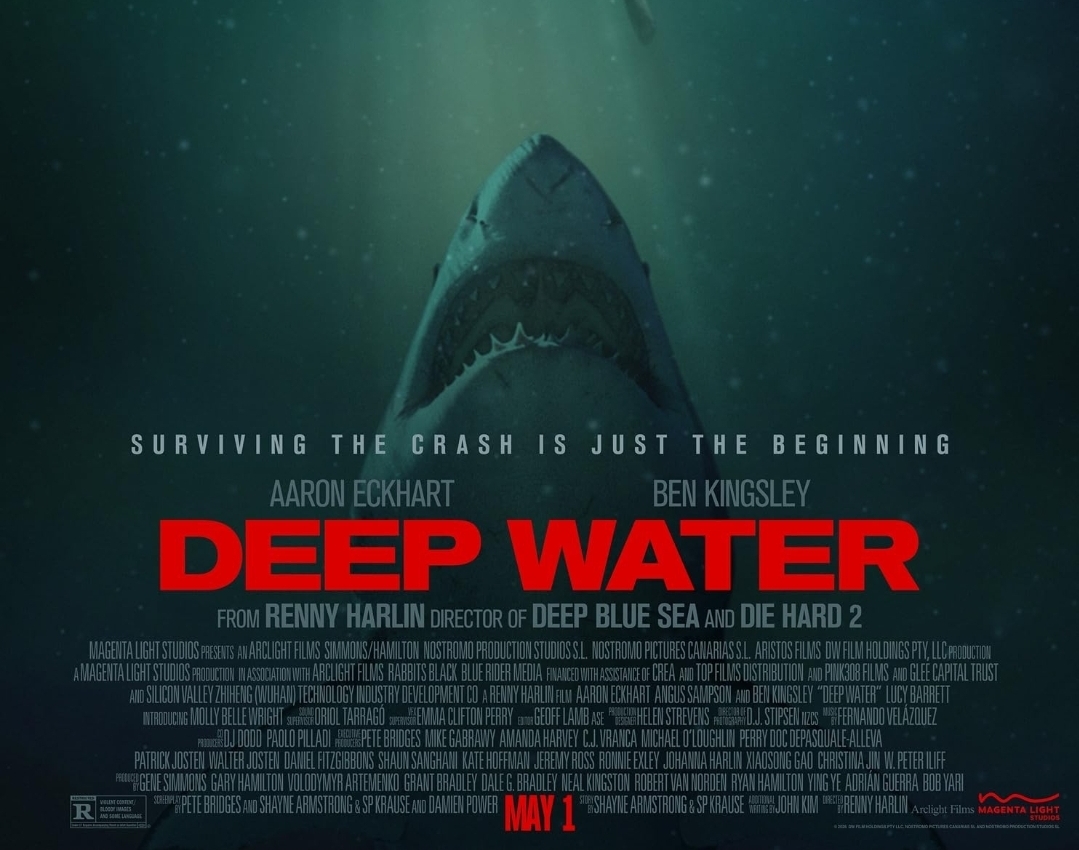
There is a sequence roughly forty minutes into Deep Water where a character — already exhausted, already terrified — realizes the thing beneath them is not leaving. The camera does not cut away. It holds. The water darkens. And what follows is sustained in a way that I genuinely did not expect from a film whose marketing leaned so heavily on atmosphere over gore. I stopped scribbling notes and just watched. Not because it was enjoyable. Because it demanded that kind of attention.
That scene is the clearest signal a parent will get about what Deep Water actually is — and what this Deep Water parents guide is here to unpack properly.
This is a survival horror film that earns its R rating in the old-fashioned way: through sustained psychological dread, graphic threat, and content that accumulates rather than spikes. By the time the third act arrives, the film has built something genuinely oppressive. That is a craft achievement. It is also a content concern for a very wide age range.
With Caution — but realistically, No for most families. Deep Water is a relentlessly tense survival horror aimed squarely at adult audiences. The R rating is accurate, possibly even slightly generous. Mature teens 17 and above may handle it; anyone younger is likely to find this genuinely distressing rather than excitingly scary.
Quick-Scan Safety Card
R — for sustained terror, graphic threat, disturbing imagery, and strong language
17+ (my assessment runs older than the rating implies)
High — creature attacks, drowning sequences, bodily injury shown with detail
Strong — multiple uses of f-word, s-word, and blasphemy under extreme stress
Very High — sustained, claustrophobic dread with few relief moments
Yes — approximately 8 to 10 hard jumpscares, some paired with loud audio stingers
Multiple character deaths, some graphic; grief shown in raw, unfiltered terms
The emotional toll — this is less monster movie and more slow psychological dismantling of its characters
Drowning, claustrophobia, bodily horror, separation from loved ones, hopelessness
| Category | Detail |
|---|---|
| Official Rating | R — for sustained terror, graphic threat, disturbing imagery, and strong language |
| Expert Recommended Age | 17+ (my assessment runs older than the rating implies) |
| Violence Level | High — creature attacks, drowning sequences, bodily injury shown with detail |
| Language | Strong — multiple uses of f-word, s-word, and blasphemy under extreme stress |
| Fear Factor | Very High — sustained, claustrophobic dread with few relief moments |
| Jumpscares | Yes — approximately 8 to 10 hard jumpscares, some paired with loud audio stingers |
| Death & Loss | Multiple character deaths, some graphic; grief shown in raw, unfiltered terms |
| Biggest Surprise for Parents | The emotional toll — this is less monster movie and more slow psychological dismantling of its characters |
| Trigger Warnings | Drowning, claustrophobia, bodily horror, separation from loved ones, hopelessness |
What Is Deep Water About?
A small group of survivors find themselves stranded in open water after a catastrophic accident cuts them off from rescue. What they face is not only the ocean itself — the cold, the exhaustion, the slow erosion of hope — but something that is actively hunting them from below.
At its core, this film is about what fear does to people over time. It raises questions about loyalty under pressure, the instinct to protect others even at personal cost, and what happens when rational thinking collapses under sustained terror. Parents searching for Deep Water trigger warnings should know that themes of helplessness and hopelessness run throughout, and the film does not soften them.
There is no tidy resolution. The emotional weight is real and it lingers.
Why Is Deep Water Rated R?
The official R rating cites sustained terror, disturbing imagery, and strong language. All of that is accurate. Here is the thing though — I think the rating, on its own, slightly undersells what a parent actually needs to prepare for.
R can mean a lot of things. In this case it means graphic creature violence including wounds shown in close detail, multiple deaths that are neither quick nor clean, and a psychological intensity that does not relent for most of the runtime. The language is consistent and strong, not incidental.
What the rating does not tell you is that this film is engineered to make you feel trapped. The sound design alone — low-frequency rumbles, sudden silences followed by hard audio hits — is calibrated to keep an audience in a state of physiological stress. I have reviewed dozens of horror films across my career, and the craft here is genuinely effective. That is also precisely why it belongs well out of reach for younger viewers.
Do not let the R rating alone be your guide here. Some R-rated films are softer than their label. Deep Water is not one of them. If your teenager is sensitive to themes of drowning, claustrophobia, or prolonged hopelessness, that matters more than their age in deciding whether this is appropriate.
Content Breakdown
Violence and Creature Horror
The violence in Deep Water is not decorative. The creature attacks are shot close, often partially obscured by churning water, which somehow makes them worse rather than better. The film understands that suggestion and partial visibility are more disturbing than full clarity — and it uses that knowledge consistently.
At least three sequences involve characters sustaining injuries that are shown in enough detail to be medically specific. One attack in the second act is graphic enough that I noted it in my screening log as genuinely hard to watch — not for shock value but because of how prolonged it is.
The violence here is less about gore and more about duration. Single scenes of threat are extended to the point where the audience’s own stress response becomes part of the experience. That is a meaningful distinction for sensitive viewers of any age.
Psychological Dread and Claustrophobia
This is, honestly, the section I feel most strongly about. The creature is terrifying. The dread is worse.
Deep Water builds a particular kind of horror — the kind where characters know what is coming and cannot stop it. The film spends real time inside that space, with characters who are exhausted and grieving and still making decisions under conditions that would break most people. My 16-year-old watched the first act with me and found it genuinely unsettling in a way she described as “it gets inside you.” That is a precise description.
For children and younger teens with any tendency toward anxiety, separation fears, or water-related phobias, this film is likely to cause real distress rather than the enjoyable version of fear that some horror offers.
If your child has any existing anxiety around water, open spaces, or being separated from safety, this film will likely amplify those feelings rather than provide a safe container for them. That is worth weighing seriously before you hit play.
Character Deaths and Grief
Multiple named characters die in Deep Water. Not all of them die quickly, and the film asks the surviving characters — and the audience — to sit with those losses. There is no musical swell to tell you how to feel. The grief is shown functionally and without comfort.
One death in the third act involves a character who has been established with enough care that their loss lands hard. I want to be careful not to spoil it, but the way the film handles the immediate aftermath is strikingly realistic and emotionally demanding. It is one of the better pieces of filmmaking in the movie. It is also, for that reason, among the most difficult to sit with.
If your family has experienced recent loss, the film’s unflinching treatment of grief and death without resolution may be particularly hard to process. This is not the film that offers comfort — it is the film that asks you to feel the weight and carry it.
Language
Strong language is present throughout, mostly used under extreme duress in ways that feel contextually honest rather than gratuitous. The f-word appears more than a dozen times. The s-word is frequent. There is some blasphemy. None of it feels inserted for effect — these are people in genuine terror, and the script reflects that.
For parents where language is a primary concern, this is the film’s most consistent content category. It does not let up.
Hopelessness and Moral Pressure
Put plainly: this film does not believe in easy answers. Characters are forced into situations where every choice involves harm — to themselves or to others. The film does not punish selfish choices in a tidy moralistic way, and it does not always reward sacrifice. That moral ambiguity is one of the film’s genuine strengths as adult drama.
It is also something younger viewers are unlikely to have the emotional framework to process productively. There is a difference between a film that challenges your values and a film that leaves you in a state of unresolved distress. Deep Water sits closer to the second category for most audiences under 16.
Age-by-Age Viewing Guide
Not Appropriate
Absolutely not. This film would be genuinely traumatic for young children, not mildly frightening. There is no version of this that ends well for a child this age in the room. Keep it off entirely.
Not Appropriate
The sustained dread, creature violence, and death content make this completely wrong for primary school-age children. My 7-year-old would not last ten minutes before being in genuine distress — and I do not mean that as a compliment to the film’s effectiveness. I mean it as a clear limit.
Not Appropriate
My 11-year-old is a capable, emotionally mature kid who has watched some PG-13 content with me. This is not the same category. The psychological weight of Deep Water is built for adult processing. Even confident pre-teens are likely to find this more disturbing than entertaining.
With Caution
Honestly this one depends so much on your specific child. A 16-year-old who actively enjoys horror and has the emotional resilience for sustained dread may engage with this as serious genre filmmaking. A 14-year-old who struggles with anxiety or has water-related fears has no business watching it without real parental consideration first. My 16-year-old handled it — but she also tapped out of the third act and I did not push her to return.
Appropriate
This is the intended audience, and the film respects them. Older teens and adults who enjoy intelligent survival horror will find a lot to engage with here — not just the scares but the character work underneath them. My eldest watched it without any concerns, and the discussion afterward was genuinely interesting. That is, honestly, the best endorsement I can give it at this age level.
Positive Messages and Educational Value
I want to be honest here rather than reach for positives that are not quite there. Deep Water is not designed to leave you with uplift. It is designed to leave you with something harder — a recognition of what human beings look like under real pressure.
There are moments of genuine courage shown without fanfare. Characters make sacrifices that are not celebrated by the narrative, which is actually more interesting than films that reward heroism tidily. And the way the film treats its characters — all of them, not just the leads — as people worth caring about is something worth noting.
As a discussion starter for older teens and adults, the film opens real territory around decision-making in crisis, the psychology of fear, and what loyalty actually costs. Those are rich conversations. Just go in knowing the film itself will not guide you to them — it leaves that work to the audience.
Five Family Discussion Questions
- When the group realizes that staying together puts everyone at greater risk, different characters make different choices. Which character’s decision felt most honest to you — and which felt hardest to watch?
- There is a moment in the second half where a character chooses not to tell the others something they know. Do you think that silence was protective or selfish — and does the film seem to have an opinion either way?
- The film does not give most of its deaths meaning in the traditional storytelling sense. How did that affect how you experienced those losses — and why do you think the filmmakers made that choice?
- Fear changes how people treat each other in this film — sometimes for the worse, but occasionally in ways that are surprisingly generous. Can you think of a real situation where fear brought out something unexpected in yourself or someone you know?
- The ending does not resolve everything cleanly. What do you think happens next — and what does the film seem to be saying by refusing to wrap it up neatly?
Frequently Asked Questions
No — not for children, and not for most younger teens either. The sustained horror, graphic creature violence, multiple character deaths, and relentless psychological dread make this firmly adult content. The R rating is accurate, and my expert recommendation sits at 17 and above.
Yes, significantly so. This is not the kind of scary that is fun or manageable for that age group. The dread is sustained and designed to create genuine physiological stress in the viewer. Children this age are very likely to experience it as distressing rather than entertaining.
Drowning and near-drowning sequences, claustrophobia, open-water fear, bodily horror, graphic creature attacks, multiple deaths including prolonged ones, grief without resolution, and sustained feelings of helplessness and hopelessness. The film is particularly intense for anyone with water-related phobias or anxiety disorders.
There is a brief sequence that plays partway through the credits — not a full scene but enough to be worth staying for if you want complete closure on one particular plot thread. Nothing plays after the full credits roll. You do not need to sit through the entire credit sequence.
Yes. Several underwater sequences use flickering light effects, and at least two above-water scenes involve strobing emergency lighting during attack sequences. Viewers with photosensitive epilepsy or migraine triggers should be aware of these before watching. The scenes are relatively brief but intense.
Deep Water is a 2026 release — streaming availability will depend on distribution deals finalised closer to or after theatrical release. Most platforms apply R-rated content to parental controls requiring PIN access or age verification. Check your streaming service’s parental control settings to restrict access before it becomes available.
Language is strong and consistent throughout. The f-word appears more than a dozen times, the s-word is frequent, and there is some blasphemy. It is used contextually — characters in genuine terror — but it is not incidental or occasional. Parents where language is a firm boundary should consider this a hard no.
Even horror-experienced younger teens should approach this with caution. There is a real difference between enjoying PG-13 horror and being emotionally equipped for what Deep Water delivers. The psychological pressure is adult-grade. Being a horror fan does not automatically mean this content is age-appropriate for them.

Matthew Creith is a movie and TV critic based in Denver, Colorado. He’s a member of the Critics Choice Association and GALECA: The Society of LGBTQ Entertainment Critics. He can be found on Twitter: @matthew_creith or Instagram: matineewithmatt. He graduated with a BA in Media, Theory and Criticism from California State University, Northridge. Since then, he’s covered a wide range of movies and TV shows, as well as film festivals like SXSW and TIFF.