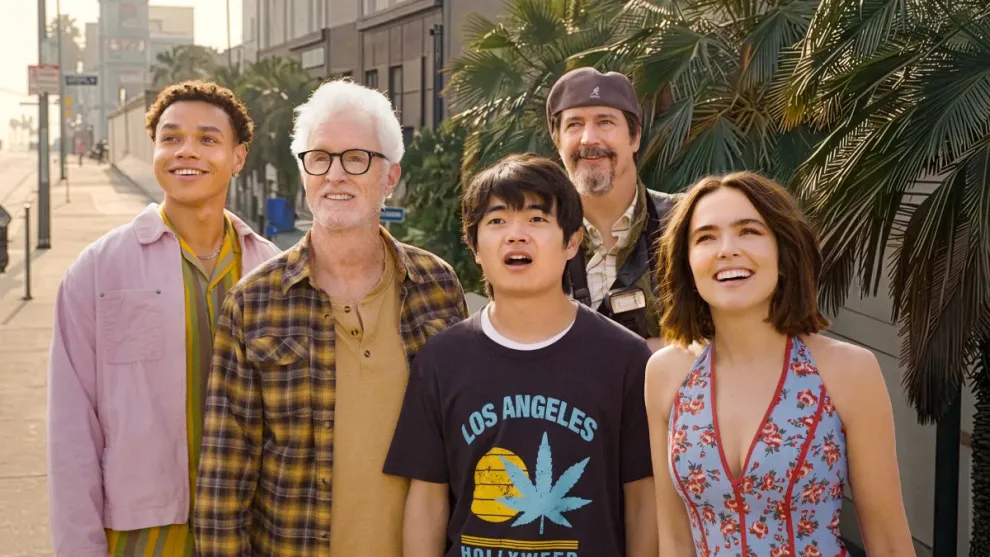
A David Wain film has never been for the timid, and “Gail Daughtry and the Celebrity Sex Pass” continues that proud, peculiar tradition. This time, Wain and co-writer Ken Marino take a premise so ludicrous it feels almost daring: imagine “The Wizard of Oz,” relocated to Southern California, filtered through a marital crisis, and driven by the question of whether sleeping with a celebrity might somehow save a relationship. It sounds like the sort of pitch you’d expect to die in a development meeting. Somehow, against all logic, it survives and even flourishes.
The movie is gloriously unhinged, the kind of goofy, off-kilter comedy Hollywood rarely seems brave enough to make anymore. Nothing about it should click into place. The tone wobbles. The jokes are aggressively silly. The premise is ridiculous on its face. And yet, in a landscape crowded with flat, committee-designed comedies, this one feels like oxygen. Wain and Marino drag us down into their unapologetically corny worldview and dare us to laugh, and if you surrender to the rhythm, you probably will.
Zoey Deutch plays Gail Daughtry, an eternally sunny suburban sweetheart who orbits entirely around her devoted fiancé, portrayed by Michael Cassidy. During a playful conversation about hypothetical celebrity “hall passes,” Gail treats the topic as harmless fantasy. Then she discovers too late that her fiancé took the idea seriously and acted on it. The betrayal lands hard. In response, she packs up with her hair-salon confidante Otto (Miles Gutierrez-Riley) and heads for Los Angeles, determined to even the emotional ledger by pursuing her own celebrity exception.
It’s petty. It’s impulsive. It’s, in the film’s own warped logic, perfectly reasonable. An eye for an eye, as the movie suggests, becomes something more like a hookup for a hookup.
Recommended: The Rip (2026) Parents Guide
True to Wain’s sensibility, the film exists in a heightened, almost cartoonish universe. Gail’s relentless optimism shapes the entire atmosphere, giving the movie a surprisingly bright, candy-colored tone that recalls Dorothy’s trip to the Emerald City. Rather than wallowing in crude raunch, Wain borrows the visual and emotional language of classic Hollywood fantasy particularly Victor Fleming’s 1939 musical about brains, courage, and heart only to twist it toward far more mischievous ends. This yellow brick road leads not to moral enlightenment but to romantic revenge, with a surreal parade of detours along the way, including an abundance of gun-wielding Weird Al Yankovic appearances that feel like they wandered in from another dimension.
Deutch proves to be the film’s secret weapon. She plays Gail as a wide-eyed Midwestern transplant who is utterly enchanted by the most banal aspects of Los Angeles culture. The movie leans heavily on her ability to discuss her fantasies with total earnestness, charging forward with the sincerity of someone who doesn’t realize how absurd she sounds. She’s bubbly, naive, relentlessly wholesome a Dorothy figure in sparkling red shoes and that contrast is exactly what makes the comedy work. Watching such a guileless character navigate such a ridiculous quest gives the film its strange, offbeat charm. Plenty of actors could deliver these jokes; very few could elevate them the way Deutch does.
The supporting cast leans fully into the madness, each member functioning like a warped counterpart to Oz’s companions. Ben Wang lampoons talent-agency culture as Caleb, a send-up of the CAA archetype. Ken Marino appears as Vincent, a pointed jab at paparazzi opportunists. John Slattery plays an exaggerated, pumped-up version of himself, all swagger and self-mythology. Alongside Gutierrez-Riley’s perpetually skeptical sidekick energy, this ragtag ensemble becomes a parade of Los Angeles caricatures lovingly vicious, if not always subtle. You can feel that everyone involved is enjoying themselves, especially when familiar faces from Wain’s extended creative family (“The State,” “Wet Hot American Summer”) pop up for cameos that feel like inside jokes shared with the audience.
Highly Recommended: Night Patrol (2025) Parents Guide
You’ll know almost immediately whether this movie is for you. The opening scene features Fred Melamed’s mailman stepping forward as an overly verbose narrator, setting the tone with a surreal flourish that announces, plainly, that realism will not be on the menu. This kind of absurdist comedy has largely vanished from mainstream releases, and its return here feels oddly refreshing. Wain and Marino rely on visual gags, exaggerated physical comedy, and deliberately dumb choices the kind where every character seems committed to the worst possible decision at any given moment. Notably, they avoid the easy trap of leaning solely on shock value. There’s very little of the lazy gross-out humor that infects so many modern comedies that mistake provocation for wit. The result is more niche than Wain’s more accessible efforts like “Role Models” or “They Came Together,” but there’s an undeniable sweetness in the low-stakes parody and featherlight tone.
That said, the film’s commitment to weirdness can sometimes work against it. The exaggerated physical jokes don’t always land. The barrage of celebrity cameos occasionally feels more indulgent than inspired. Comedy will always be divisive, and this one seems destined to generate strong reactions in both directions. If you’re not attuned to the film’s sensibility or its specific cultural targets it might feel like an alien transmission. And if you’re not familiar with Los Angeles, some of the satire may fly right past you.
Recommended: Killer Whale (2026) Parents Guide
For Angelenos, though, the jokes often hit with laser precision. The heavy presence of the Chateau Marmont, the exaggerated reverence for CAA, the skewering of industry behavior all of it is unmistakably coded to local experience. Gail’s outsider perspective, marveling at things residents have long since normalized, becomes one of the film’s richest comedic veins. Still, these references are unapologetically tailored to a specific crowd, which may leave others feeling like they’ve walked into a party where half the punchlines are inside jokes.
And yet, Wain’s unpredictability remains the film’s greatest asset. The humor doesn’t rely solely on Deutch’s “good girl gone rogue” arc. Slattery’s self-parody, playing a post “Mad Men” version of himself clinging to relevance with exaggerated bravado, is a particular highlight. Wang brings surprising nuance to what could have been a one-note role, capturing the anxious overconfidence of an aspiring power broker. The movie keeps escalating its own strangeness, doubling down on the absurdity until the laughter becomes almost involuntary even if it sometimes feels like you might be the only one in the theater chuckling as a security guard repeatedly slams a heavy wooden door on Slattery’s unfortunate foot.
Calling “Gail Daughtry and the Celebrity Sex Pass” dumb fun might sound dismissive, but here it feels like genuine praise. Wain and Marino tap into the spirit of the best 1980s spoof comedies, where stupidity was not a lack of intelligence but a deliberate, carefully calibrated aesthetic. Beneath the ridiculous title and the implausible rom-com engine, there’s even a sly commentary on filmmaking itself, layering self-aware jokes into the narrative without suffocating it. The movie delivers exactly what its outrageous premise promises and then pushes beyond it. In the realm of contemporary studio comedy, we truly aren’t in Kansas anymore. And in this case, that disorientation feels like a victory.
Gail Daughtry and the Celebrity Sex Pass (2026) Parents Guide
Not Rated R by the Motion Picture Association (MPA)
Violence & Intensity: Despite its chaotic energy, this is not a violent film in any conventional sense. The intensity comes from absurdity rather than danger. There are moments of cartoonish physical comedy doors slammed on feet, exaggerated pratfalls, over-the-top scuffles played strictly for laughs. No blood, no real menace, and no scenes designed to frighten. The tone stays buoyant and surreal, closer to Looney Tunes logic than anything grounded in reality. You can feel that the film wants to amuse, not unsettle.
Language: Expect frequent mild-to-moderate profanity, sexual slang, and sarcastic banter. The tone is irreverent rather than aggressive; insults tend to be playful or self-parodic. There are no sustained hateful slurs, but the dialogue isn’t sanitized either. It’s the kind of language you’d expect from adults behaving foolishly, not from characters meant to be role models.
Sexual Content / Nudity: The entire premise revolves around “hall passes,” sexual fantasy, and the idea of pursuing a celebrity hookup. Characters openly discuss sex, desires, and attraction in explicit but comedic terms. There are suggestive situations, sexual humor, and implied encounters, though the film generally avoids graphic depiction. Nudity, if present, is brief and played for joke rather than titillation. Still, the subject matter is mature, and the humor assumes an adult understanding of relationships and sexuality.
Drugs, Alcohol & Smoking: Alcohol appears socially cocktails at parties, drinks in upscale LA settings but not glamorized to excess. There may be brief references to recreational drug use, again treated as background texture rather than a focal point. Smoking is minimal. These elements exist because the film is satirizing adult social environments, not because it’s trying to promote that behavior.
Age Recommendations: The sexual themes, mature dialogue, and layered satire make it unsuitable for children and most younger teens. Older teens (16–17) with a strong grasp of satire and mature themes may handle it, but parents should know this isn’t a quirky family comedy it’s an offbeat, adult-skewing farce.

Stephanie Heitman is a seasoned journalist and author dedicated to helping parents navigate the world of Hollywood entertainment through thoughtful, family-oriented film reviews. With over a decade of experience in writing and a passion for fostering safe, enriching viewing experiences, Stephanie launched Parentguiding.com to provide parents with the insights they need to make informed choices for their families.