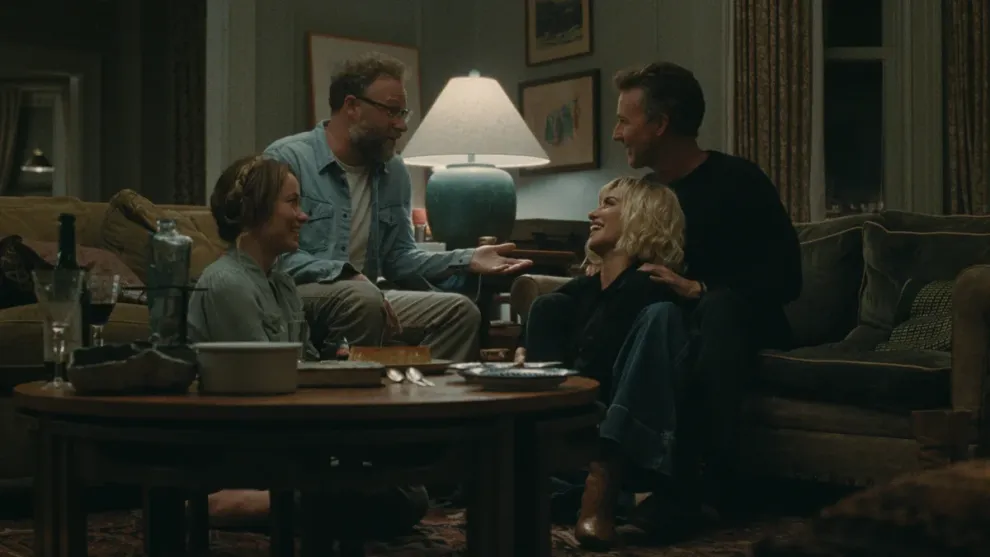
The Invite is not rated by the Motion Picture Association (MPA). What it offers instead is a deeply adult, emotionally candid portrait of marriage, sexuality, and midlife dissatisfaction.
At its world premiere at the 2026 Sundance Film Festival, the Eccles Theatre audience responded with a kind of emotional volatility that felt less like polite festival appreciation and more like collective surrender. People weren’t just laughing; they were howling, losing entire lines of dialogue in the process. But the laughter didn’t stay dominant. It tightened into silence when the film demanded it, and by the end, tears were everywhere. That trajectory from hilarity to stillness to catharsis mirrors the movie’s internal rhythm with uncanny precision.
Wilde, who first announced her directorial voice with the sharp-edged warmth of Booksmart and then tested her ambition with the more divisive Don’t Worry Darling, here opts for something smaller, riskier, and arguably more revealing. The Invite confines itself to a single apartment over the course of one night, tracking the emotional implosion of two couples with the kind of intensity that recalls the long lineage of domestic battle films. It feels like a distant, contemporary relative of Who’s Afraid of Virginia Woolf? not in imitation, but in spirit: a story where conversation becomes combat, and politeness is just a temporary disguise.
Wilde and Seth Rogen play Angela and Joe, a married couple with a teenage daughter and a relationship that has quietly, steadily eroded. They don’t fight in explosive bursts so much as in corrosive drips. Almost every exchange contains a barb. Even their jokes feel weaponized. There’s a weary familiarity in the way they speak to each other, the sense that they’ve rehearsed these conflicts too many times to count.
Highly Recommended: Ha-Chan, Shake Your Booty (2026) Parents Guide
Angela’s decision to invite their upstairs neighbors to dinner feels, on the surface, like a harmless social gesture. Underneath, it carries the weight of something more desperate—a bid for disruption, for validation, maybe even for escape. Joe is caught off guard by the idea, and you can see the discomfort settle into him before the guests even arrive.
Hawk (Edward Norton) and Pina (Penélope Cruz) enter the apartment like an alternate version of adulthood. They are polished, self-possessed, openly affectionate. Their sex life, already a subject of irritation for Joe thanks to the thin ceiling above, becomes an awkward icebreaker almost immediately. From that point forward, the evening becomes a slow unspooling of masks, manners, and self-deceptions.
What unfolds is a chamber piece that’s both meticulously engineered and emotionally volatile. It’s funny in ways that catch you off guard, moving in ways that feel earned, and constructed with a confidence that marks this as Wilde’s most fully realized work to date. This is the film where her instincts as a director her control of tone, her attention to behavior, her understanding of actors seem to click into place all at once.
The script, adapted from a Spanish play and film by Cesc Gay and written by Rashida Jones and Will McCormack, is built on dialogue that crackles with intelligence and danger. The tension doesn’t simply rise; it pulses. It expands, releases, then tightens again, over and over, like a living thing. Watching these four characters circle each other feels less like observing a plot and more like witnessing chemistry in action. The rhythms are so precise, the exchanges so alive, that it’s easy to imagine this exact cast commanding a stage just as effectively.
But The Invite never feels trapped by its theatrical roots, and that’s one of Wilde’s quiet triumphs. Films like this often end up visually inert, content to document performances rather than interpret them. Wilde refuses that limitation. Alongside cinematographer Adam Newport-Berra, she uses framing and movement to express what the characters cannot. Power shifts are embedded in camera angles. Emotional vulnerability is emphasized or denied through the strategic absence of close-ups. Mirrors become recurring tools, reflecting not just faces but self-perception. The apartment doesn’t feel like a static set; it feels like a psychological landscape.
The performances meet that directorial precision with extraordinary responsiveness. Wilde fills the film with meaningful glances, half-finished gestures, tiny pauses that speak volumes. You’re constantly aware of two conversations happening at once: the one spoken aloud, and the deeper, more dangerous one unfolding silently between and within the couples.
Rogen gets some of the film’s biggest laughs as Joe, leaning into the character’s bitterness without losing his humanity. His hostility toward Hawk is often hilarious, but it’s also transparently rooted in insecurity, and Rogen allows that discomfort to show. Norton plays Hawk with an initially smooth charm that gradually fractures, revealing unexpected complexity beneath. When he delivers a third-act monologue that strips away the character’s composure, the effect is electric; you can feel the audience leaning in, breath held. Cruz, too, complicates what could have been a one-note role. Pina’s sensual confidence gradually gives way to something more vulnerable, more conflicted, more real.
Highly Recommended: Mother of Flies (2025) Parents Guide
And then there’s Wilde herself, delivering what feels unmistakably like a career-best performance. Her Angela is funny in ways that hurt, wounded in ways that resonate. Wilde navigates physical comedy with precision, then pivots into emotional devastation without a visible seam. She allows Angela to be flawed, insecure, occasionally maddening but always recognizably human. At the heart of the performance is a quiet, aching desire to be acknowledged, to be understood, to be seen, and Wilde honors that need without softening it.
At its core, The Invite is about relationships, but it’s also about everything that collects around them over time: resentment, longing, routine, jealousy, desire, depression, the quiet panic of realizing you might be disappearing inside your own life. What’s striking is how often the film seems poised to fall into familiar patterns—and how consistently it avoids them. Just when you expect a scene to resolve itself neatly, Wilde steers it toward something messier and more honest.
That honesty is what gives the film its peculiar blend of comedy and discomfort. It’s not just that the jokes land (they do, spectacularly); it’s that they land because they’re rooted in recognition. You laugh because you’ve had that argument. You laugh because you’ve felt that insecurity. You laugh because you recognize the self-protective lies. The humor isn’t distancing it’s exposing.
By the time the night in that apartment draws to a close, The Invite has managed to feel both deeply specific and unnervingly universal. It lingers not because it delivers easy answers, but because it refuses to. And in doing so, Wilde confirms something that’s been building across her work: she’s not just interested in entertaining you. She’s interested in seeing you.
The Invite (2026) Parents Guide
Violence & Intensity: There is no physical violence in the traditional sense no fighting, no weapons, no blood. But the emotional intensity is real and, at times, bruising. The characters wound each other with words, with silences, with truths revealed too late. Arguments escalate. Confessions land like small detonations. If you’ve ever been in the room when a dinner conversation suddenly turns raw and personal, you’ll recognize the atmosphere immediately.
Language: Expect regular use of strong language, including repeated uses of the f-word and other explicit terms. The tone of the language is often sarcastic, bitter, or emotionally charged rather than playful. There are no prominent hate slurs, but the speech reflects how real adults speak when they are no longer censoring themselves.
Sexual Content / Nudity: The neighboring couple’s loud sex life becomes an early subject of discussion, and sexuality continues to surface in dialogue, confessions, and emotional revelations. There is sexual talk that is frank and explicit in meaning, though not pornographic in detail. Some sexual references are intense and emotionally loaded. There is minimal to no explicit nudity, but the subject matter is clearly adult and not appropriate for younger viewers.
Drugs, Alcohol & Smoking: Alcohol is present throughout the evening, as the characters drink during dinner and conversation. The drinking is realistic and social, but it does contribute to lowered inhibitions and emotional volatility. There is no significant depiction of drug use. Smoking, if present, is minimal and not glamorized.
Age Recommendations: This is best suited for adults 17+, and realistically more appropriate for mature adults 18+ who can engage with its themes. The content isn’t inappropriate because of shock value, but because of emotional complexity: marital resentment, sexual dissatisfaction, identity crises, and psychological vulnerability are the core of the film.
Highly Recommended: Mercy (2026) Parents Guide

Stephanie Heitman is a seasoned journalist and author dedicated to helping parents navigate the world of Hollywood entertainment through thoughtful, family-oriented film reviews. With over a decade of experience in writing and a passion for fostering safe, enriching viewing experiences, Stephanie launched Parentguiding.com to provide parents with the insights they need to make informed choices for their families.