In Cold Light is rated R by the Motion Picture Association (MPA) for violence/bloody images, language, and some drug material.
The film opens in motion, a woman sprinting for her life, and it barely allows her or us to slow down after that. But beneath the velocity runs something deeper: a steady undercurrent of sorrow, fatigue, and quiet yearning. Maxime Giroux directs with a pulse for tension, yes, but also with an unusually attentive eye for interior lives. This isn’t just about what happens. It’s about how it feels while it’s happening.
We first meet Ava (Maika Monroe) mid-escape, launching herself out of a second-floor window of a drug house just as police crash in behind her. It’s a jolt of an introduction, but what’s striking is how composed she seems. No wide-eyed panic. No fumbling innocence. Ava knows this world. She and her twin brother Tom (Jessie Irving) run a modest, duct-taped-together drug operation nothing glamorous, nothing sustainable, but apparently the only structure they have. These are kids who never really got to be kids. Their mother died when they were young, leaving them to cling to each other for stability. Their father, Will (Troy Kotsur), is a former bull rider who carries his own damage like a permanent scowl. He’s harsh, distant, and particularly closed off from Ava. Tom, at least, has started to build something resembling a future: a girlfriend, a newborn baby, fragile signs of continuity that matter more than they initially seem.
Highly Recommended: Ella McCay (2025) Parents Guide
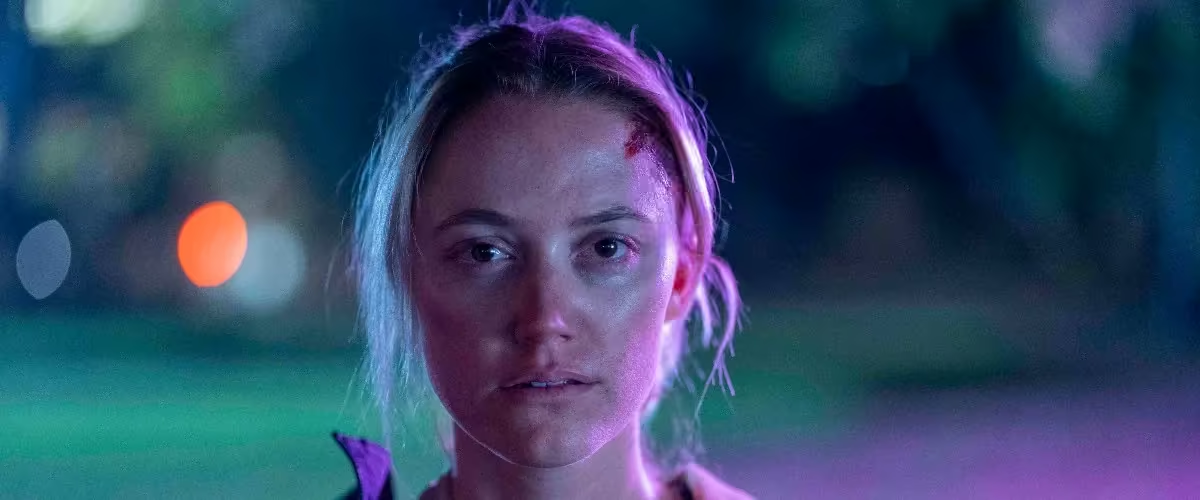
Ava, by contrast, floats untethered. After serving time for the bust, she lands a job at the rodeo. It’s work, not purpose. When her parole officer asks what she wants from life, her answer “To be free. To be alone.” lands with a dull, devastating honesty. You don’t doubt her for a second. Monroe plays Ava as someone who has retreated so far inward that solitude feels less like a choice than a survival mechanism. Then comes a sudden, brutal eruption of violence that sends her running once more, locked again in a state of perpetual near-capture, always a step or two ahead of whoever’s hunting her.
Patrick Whistler’s screenplay brushes against familiar genre territory, but it’s smart about where it leans into cliché and where it refuses to. The dialogue is sparse, and often the most meaningful things happen in the silences. There’s an astute pattern here: the characters who talk the most fluently are usually the ones with something to hide. Helen Hunt appears as one such figure, in a role that could have amounted to little more than a decorative cameo. Instead, she gives it density and unease, reminding you how much authority she still carries on screen when she chooses to use it.
The emotional heart of the film inevitably circles back to Ava and her father. Their long-simmering conflict finally explodes not inside a living room, not in some theatrically staged showdown, but outside his house, conducted entirely in sign language. (Kotsur, who won an Oscar for CODA, brings the same grounded, unshowy truth here.) Giroux stages the scene with a detail that feels both practical and poetic: a motion-sensitive light keeps switching off when neither of them is moving, forcing Ava or Will to flail an arm mid-argument just to bring the illumination back. It’s such a specific, human touch awkward, faintly absurd, deeply intimate and the film is full of moments like this, little behavioral truths that make the world feel lived-in rather than designed.
Highly Recommended: Wake Up Dead Man: A Knives Out Mystery Parents Guide
Giroux’s fascination with environment is especially vivid in the rodeo sequences. Working with cinematographer Sara Mishara, he doesn’t treat the setting as mere backdrop. The rodeo becomes its own ecosystem: the narrow tunnels leading to locker rooms and offices, the echo of boots on concrete, the low hum of machinery, the towering lights bleeding into the blue-black night. You can almost feel the dust in your throat. There’s both romance and roughness here, a tactile sense of place that recalls Giroux’s earlier work like Felix and Meira and The Demons, films equally attuned to how landscapes urban or rural shape the people trapped within them.
The film’s emotional gravity rests most heavily on Monroe’s shoulders, and she carries it with remarkable control. The story operates on life-or-death stakes, as thrillers do, but it’s Monroe’s face guarded, bruised by memory, flickering with feelings she rarely allows to surface that convinces you those stakes matter. She’s been building toward roles like this for years, sometimes underestimated, often underused. You might remember her from the unnerving precision of It Follows, the recent dread-soaked Longlegs, or the unjustly overlooked Watcher, where she proved how commanding she can be when given space. Here, she’s finally given the room to inhabit the center of the frame fully. The film tosses in a couple of flashbacks to explain Ava’s childhood trauma, but they feel almost redundant. Monroe communicates everything essential through stillness alone.
So many thrillers are expertly engineered and emotionally hollow slick machines designed to keep your pulse up and your heart untouched. In Cold Light manages something rarer. It’s tense, yes, but it’s also heavy with feeling, attentive to mood, to damage, to the strange ways people keep going when there’s very little left to hold onto. You don’t just watch Ava run. You feel the exhaustion in her limbs, the loneliness behind her eyes. And when the film finally fades out, that melancholy atmosphere lingers with you, like the echo of hoofbeats long after the arena has gone quiet.
In Cold Light Parents Guide
Violence & Intensity: Violence is present from the opening moments and hangs over the film like a low storm cloud. There are chases, physical confrontations, and a sudden, shocking act of violence that becomes the story’s turning point. The film includes moments with blood and injury, though it’s more grounded than gratuitous. What may affect viewers most isn’t just what happens, but how it feels there’s a sustained atmosphere of dread, grief, and emotional pressure. You can feel the characters living in survival mode. The intensity is psychological as much as physical, which may be unsettling for sensitive viewers.
Language: Strong language appears throughout, consistent with the rough environments the characters inhabit. Profanity is used naturally rather than excessively, but it is present, and the tone can be harsh, bitter, and emotionally raw. The dialogue reflects damaged relationships and lived-in frustration rather than shock-for-shock’s-sake.
Sexual Content / Nudity: Sexual content is minimal. There is no explicit nudity described, and the film does not focus on sexuality as spectacle. Romantic or intimate elements are subdued and treated more as part of character background than as attention-grabbing scenes.
Drugs, Alcohol & Smoking: Drug use and drug dealing are central to the story’s setup. The protagonists are involved in a small drug operation, and the consequences of this lifestyle are a major narrative engine. Viewers will see references to drugs, drug houses, and the fallout from substance-related environments. The film treats this world seriously and without glamor, but the material is still mature. Some alcohol use may be present in the rodeo environment, though it is not the focus.
Age Recommendations: This is firmly for adults and older teens only, and even then, best suited for ages 17+.
Highly Recommended: Cold Copy Parents Guide

Matthew Creith is a movie and TV critic based in Denver, Colorado. He’s a member of the Critics Choice Association and GALECA: The Society of LGBTQ Entertainment Critics. He can be found on Twitter: @matthew_creith or Instagram: matineewithmatt. He graduated with a BA in Media, Theory and Criticism from California State University, Northridge. Since then, he’s covered a wide range of movies and TV shows, as well as film festivals like SXSW and TIFF.