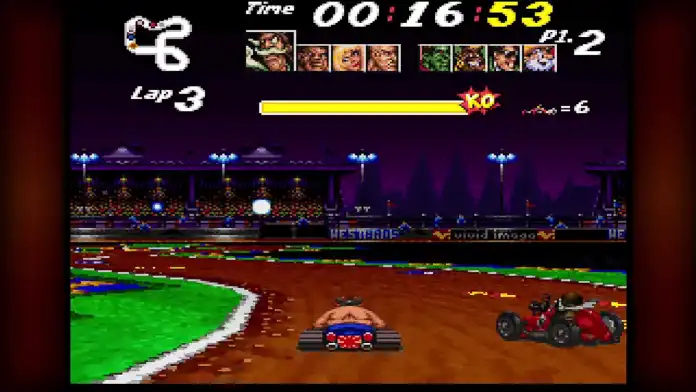
The Street Racer Collection (QUByte Classics) feels like nostalgia given physical form — a bundle of games so firmly rooted in their era that simply booting them up feels like opening an old drawer of childhood memories. That alone brought me a genuine smile. And yet, the longer I stayed with it, the more that warmth was undercut by the friction of playing these games in 2026. The interface is clumsy, the loading times verge on painful, and there were moments where the collection actively tests your patience. Still, I’ll admit it: I have a soft spot for this kind of old-school design, and more often than not, I found myself forgiving flaws I probably shouldn’t.
Developed and published by QUByte Interactive, this collection revolves around an idea that still feels charming : arcade racing spliced with the chaotic energy of a brawler. It’s fast, ridiculous, competitive, and strangely compulsive. There’s something about the blunt, arcade-first mindset here the immediacy of it, the lack of friction between “start race” and “things are already going wrong” that makes it dangerously easy to keep playing. I told myself I’d dip in for a few races. Hours disappeared instead.
What you’re actually getting here are four distinct versions of Street Racer: the SNES, Mega Drive, MS-DOS, and Game Boy editions. For anyone who cares about preservation, that’s genuinely valuable. Each version is faithful to its original platform, which means you’re not getting modernized interpretations you’re getting the games as they were, quirks and all. They all hinge on the same core mechanics and design philosophy, and yes, that means they feel unapologetically dated. For me, that was part of the appeal. For others, it’s going to be the wall they bounce off almost immediately.
There’s a surprising amount of variety in the modes on offer. Practice, Championship, Head-to-Head, Rumble, Soccer it’s a lineup that feels more playful than you might expect from a retro racing collection. I appreciated that it didn’t just rely on pure racing to carry the experience. Even if I was spectacularly bad at Rumble and Soccer, those modes still felt like welcome palate cleansers, little reminders that this series was always more interested in chaos than clean lap times.
Time, however, has not been kind to how any of this feels to play. By modern standards, everything is a bit sluggish. The cars don’t glide, they sort of trudge. The animation is stiff. The overall flow lacks the responsiveness we now take for granted. Longtime fans will likely shrug and accept this as part of the package. Newcomers, on the other hand, will probably struggle to understand why these games ever earned devotion in the first place. Even as someone who likes this series, I had to admit that taken on their own terms, without nostalgia doing some of the heavy lifting, these games don’t always hold attention the way other classics from the same era still can. There were stretches where I felt my focus slipping after only a handful of races, and I found that the best way to enjoy the collection was in short, casual sessions rather than long marathons.
To QUByte’s credit, the curation itself feels careful. Each version is presented as a faithful reflection of its original hardware. That authenticity comes with trade-offs. The MS-DOS version, for example, felt awkward and uncomfortable when stretched across a large modern screen, but suddenly made much more sense on a smaller display. As you move through the versions toward the more recent platforms, things generally behave better on Xbox Series X, but “better” is relative. Performance is serviceable, but the visuals are aggressively pixelated, loud in their color choices, and at times genuinely uncomfortable to stare at for extended periods. It’s authentic, yes, but it’s also undeniably rough.
The audio leans hard into crunchy synth melodies and piercing sound effects, recreating the original soundscapes with impressive fidelity. That fidelity cuts both ways. Some players will find it shrill, maybe even grating. Personally, I found it endearing another layer of that time-capsule quality that makes the whole collection feel like a trip backward rather than a modern product wearing retro skin.
The controls, unfortunately, are where that time travel becomes most painful. They’re twitchy, overly sensitive, and often feel like they’re working against you. Once you acclimate to their particular logic, there is fun to be found the racing can feel satisfying when everything clicks. But the game asks you to unlearn decades of modern control conventions if you want to truly succeed, and that’s a big ask. It’s not just challenging; it’s archaic in a way that borders on hostile.
That feeds directly into the collection’s biggest limitation: its audience is narrow. Replay value is going to be highly dependent on how deeply you already care about this series or this era of racing games. If you’re a hardcore fan, there’s a lot here to revisit and appreciate. If you’re not, you’ll likely treat it as a novelty you return to briefly before moving on. I fall somewhere in the middle. I don’t regret my time with it, and I can absolutely see myself dipping back in when I’m craving something old-fashioned and uncomplicated.
Street Racer Collection never really threatens to amaze. I enjoyed it, genuinely, but I also spent much of that time wishing it had been handled with more care, more quality-of-life consideration, more sensitivity to what modern players need. The visuals are rough, the controls are messy, and the appeal is undeniably niche. And yet, despite all of that, it still ends up being easy to recommen not as a must-play, but as a sincere, imperfect preservation of something that mattered to a certain corner of gaming history. If you’re willing to learn its rhythms, memorize its circuits, and meet it on its own stubborn terms, there’s satisfaction to be found in mastering it.
Pros
- Strong retro visual identity
- Faithful, synth-heavy audio
- Genuinely enjoyable if you already love the originals
Cons
- Overly sensitive, awkward controls
- Very limited appeal outside its niche
Rating info: PEGI 7 (Mild Violence)
Release date: 27/11/2025
Price: £16.74
Street Racer Collection Parent’s Guide
Street Racer Collection is a retro racing compilation that leans heavily on arcade chaos, cartoonish aggression, and nostalgic presentation. Nothing here feels modern in tone or realism; instead, it reflects the exaggerated style of 90s-era game design. That context matters, especially when evaluating content for younger players.
Violence & Intensity: While the game technically includes “violence,” it’s best understood as slapstick chaos rather than harm. Characters use exaggerated attacks during races bumping rivals, striking opponents, and engaging in over-the-top brawling mechanics. There’s no blood, no injury detail, and no sense of real-world consequence. It plays more like Looney Tunes energy than anything grounded or disturbing.
Still, the intensity can spike. The fast pace, flashing visuals, and sudden collisions may feel overwhelming for very young children. The frustration caused by sensitive controls can also lead to heightened emotions during play, especially for kids who aren’t used to retro difficulty.
Language: There is no noticeable spoken dialogue, and no significant use of profanity or offensive language in the gameplay experience. Text elements are minimal and functional, mostly limited to menus and mode labels.
Tonally, the game feels mischievous rather than aggressive. It has that cheeky, competitive arcade vibe, but not a hostile or mean-spirited one.
Sexual Content / Nudity: There is no nudity and no explicit sexual content. Character designs reflect older arcade aesthetics and exaggerated cartoon styling, but nothing crosses into sexualized territory.
Drugs, Alcohol & Smoking: There are no references to drugs, alcohol, or smoking in gameplay, visuals, or themes.
Age Recommendation: While officially rated PEGI 7 (Mild Violence), the real consideration for parents is not content but playability.
Recommended age: Suitable for ages 7+
Experience-wise: Best for ages 10–12+, depending on patience and skill
Street Racer Collection — Software & Hardware Requirements
Platforms Available
- Xbox Series X
- Xbox One
- PlayStation 5
- PlayStation 4
- Nintendo Switch
- PC (Steam)
Console Requirements
There are no special hardware demands. The collection runs comfortably on:
- Xbox Series X / Xbox One
- PlayStation 4 / PlayStation 5
- Nintendo Switch (handheld mode may actually feel better for certain versions, such as MS-DOS)
Storage requirements are modest due to the retro nature of the games.
Minimum (Estimated)
- OS: Windows 10
- Processor: Intel i3 or equivalent
- Memory: 4 GB RAM
- Graphics: Integrated graphics (Intel HD or similar)
- Storage: Under 2 GB available space
Recommended
- Any modern CPU
- 8 GB RAM
- Dedicated GPU not required
This is a technically light game — performance issues stem more from design and presentation than from hardware strain.
Full disclosure: This review is based on a copy of the game provided by the publisher/developer.

Stephanie Heitman is a seasoned journalist and author dedicated to helping parents navigate the world of Hollywood entertainment through thoughtful, family-oriented film reviews. With over a decade of experience in writing and a passion for fostering safe, enriching viewing experiences, Stephanie launched Parentguiding.com to provide parents with the insights they need to make informed choices for their families.