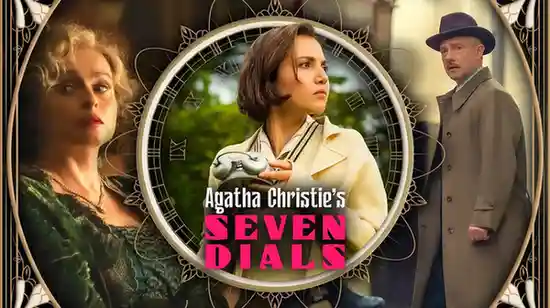
Netflix’s Seven Dials arrives with the kind of pedigree that practically dares you to expect elegance: Agatha Christie source material, prestige casting, lush production design. What you actually get is something more uneven and more interesting than that promise suggests a murder mystery that wants to be emotionally rich, occasionally gets there, and just as often trips over its own devotion to the mechanics of the plot.
Christie’s original novel, The Seven Dials Mystery, has never been considered one of her crown jewels. Even devoted readers will admit it’s more curious than classic. What endures from the book is not the puzzle itself but the relationship between the impulsive, bright-eyed Lady Eileen “Bundle” Brent and the immovable Superintendent Battle. That dynamic youthful recklessness colliding with institutional patience has always been the real engine of the story. Chris Chibnall’s adaptation seems to understand this instinctively, because once again, the characters carry far more weight than the mystery ever does.
Highly Recommended: Hijack Season 2 Parents Guide
The series opens with a brand-new prologue that feels designed to announce its ambitions. A man, later revealed to be Bundle’s father (Iain Glen, squandered in a role that cries out for more screen time), is killed in a grotesque, almost operatic accident involving a Spanish bull. Beside his body: a dusty card bearing a clock face. It’s the first of many symbolic images the show leans on too many, honestly, until the motif starts to feel less like atmosphere and more like overemphasis. You can almost hear the series insisting that this matters deeply, even when it hasn’t yet earned that gravity.
Five years later, we find Bundle (played with luminous energy by Mia McKenna-Bruce) attending a lavish masquerade at her family estate with her mother, Lady Caterham (Helena Bonham Carter). The twist is that this estate is no longer really theirs they’ve been forced to rent it out just to stay afloat. It’s a clever emotional setup: aristocratic opulence on the surface, quiet humiliation underneath. Visually, the sequence delivers everything fans of Christie adaptations expect sumptuous costumes, champagne sparkle, stylized 1920s excess, a parade of posh caricatures who look like they wandered in from every British period drama you’ve ever seen. It’s intoxicating, and also slightly hollow, which may be the point.
The most significant deviation from Christie’s novel arrives here, and it’s one of the adaptation’s smartest decisions. In the book, Bundle more or less stumbles into the mystery. In the series, she’s grieving. She had a real emotional bond with the first victim, Gerry Wade (Corey Mylchreest), and his death is not just a plot catalyst but a personal wound.
This choice gives the story an emotional core it badly needs. You can feel what the show is reaching for: grief as fuel, justice as obsession. The problem is that Chibnall seems simultaneously committed to recreating some of the novel’s more outlandish plot beats, and that loyalty undercuts the very emotional depth he’s trying to build. There’s only so much room for genuine mourning when the narrative keeps rushing off to stage the next Christie esque contrivance.
Highly Recommended: A Knight of the Seven Kingdoms (2026) Parents Guide
So the tone wobbles. One moment the show wants to be reflective and intimate, the next it’s playing dress-up with secret societies and theatrical clues. The result is a series that never quite settles into itself. And yet annoyingly, perhaps it remains highly watchable. It’s the kind of show you breeze through in an evening, enjoy while it’s on, and then feel slipping away from your memory almost immediately afterward.
If Seven Dials works at all, it’s because of Mia McKenna-Bruce. Without her, the whole enterprise would collapse under the weight of its own uncertainty. She brings Bundle to life with warmth, intelligence, and a magnetic sense of purpose. Yes, she’s charming, but that’s not the point. What really anchors the performance is the sadness underneath, the grief that the script sometimes forgets but McKenna-Bruce never does. Her Bundle isn’t chasing clues out of idle curiosity. She’s chasing closure. She’s chasing meaning. She’s chasing something that feels like justice, even when she’s not sure what shape that justice might take.
There are countless amateur sleuths scattered across fiction, but Bundle stands out not because the writing makes her exceptional, but because the performance does. Even when she’s sharing scenes with established names like Helena Bonham Carter (reliably sharp, if occasionally underused here) and Martin Freeman as Superintendent Battle, McKenna-Bruce holds the frame. Freeman, in particular, could easily have anchored the show himself; his Battle is controlled, thoughtful, and quietly compelling. But the series belongs to Bundle, and McKenna-Bruce makes sure you never forget that.
It helps that these three performers seem genuinely invested in the material, because many of their co-stars are given frustratingly little to work with. Corey Mylchreest—so striking in Queen Charlotte shares real chemistry with McKenna-Bruce, but his role barely survives long enough to capitalize on it. Nabhaan Rizwan’s Ronnie Devereux vanishes almost as soon as he arrives. Hughie O’Donnell’s Bill Eversleigh is pleasant enough, amiable but unremarkable. Edward Bluemel, as Jimmy Thesiger, brings his usual charisma and becomes a credible investigative partner for Bundle, which is one of the few secondary relationships the show allows to develop with any texture.
Beyond that small circle, the ensemble blurs together. Apart from Nyasha Hatendi’s Dr. Cyril Matip who at least feels emotionally grounded and narratively essential the supporting cast becomes a fog of interchangeable upper-class figures. They’re all immaculately dressed, uniformly wealthy, and written with dialogue that sounds like it was assembled from a greatest-hits reel of 1920s period drama clichés. You can feel the artificiality. You can hear the writers reaching for “posh” rather than character.
Highly Recommended: Star Trek: Starfleet Academy (2026) Parents Guide
Structurally, the show also stumbles. The first two episodes are dense with exposition, so much so that the story feels like it’s constantly explaining itself instead of letting scenes breathe. It isn’t until the third episode, tellingly titled “The Finger Points,” that the series finally finds momentum. Here, the conspiracy unravels sooner than expected midway through the episode rather than at the end and the shift in setting to a moving train injects real urgency. The confined space, the sense of motion, the danger of confrontation: suddenly, the show feels alive in a way it often didn’t before.
The adaptation also improves on the novel by giving Bundle a more active role in the final reveal. It’s an obvious fix, but an essential one. In Christie’s book, her agency in the climax is frustratingly limited. Here, she’s allowed to step fully into the narrative’s center, and the series is better for it.
The most emotionally resonant moment of the entire season arrives not with a twist or a revelation, but with a conversation. Bundle and Lady Caterham sit down for a quiet, aching exchange that finally clarifies why the show chose to gender-swap her surviving parent. These aren’t just a mother and daughter navigating grief. They’re two intelligent women constrained by expectations, by politics, by history women who might have changed the world together if they’d only known how to stand side by side sooner. It’s moving, understated, and painfully brief. You feel the lost potential not just within their relationship, but within the show itself.
Because that’s the larger tragedy of Seven Dials. It’s so determined to hit the familiar plot markers of Christie’s novel that it rarely slows down to truly explore the characters who matter most. The final moments, hinting at a broader secret society and a possible future for Bundle as a recurring investigator, suggest franchise ambitions. Perhaps, if that happens, the series will eventually give its characters the space they deserve. But that hypothetical future does nothing for the three episodes we have now, which often feel like they’re racing toward something else instead of fully inhabiting what’s already on screen.
Agatha Christie’s Seven Dials Parents Guide
Rating: TV-MA
Violence & Intensity:
Includes murder, disturbing imagery (such as the bull-goring in the opening), and sustained thematic focus on death and conspiracy.
Language:
Strong language appears occasionally, consistent with mature dramas.
Sexual Content / Nudity:
Limited, but not entirely absent; brief adult themes.
Drugs, Alcohol & Smoking:
Frequent depiction of alcohol use, consistent with the 1920s setting; some smoking.
Age Recommendation:
Intended for mature audiences; not suitable for younger viewers.

Stephanie Heitman is a seasoned journalist and author dedicated to helping parents navigate the world of Hollywood entertainment through thoughtful, family-oriented film reviews. With over a decade of experience in writing and a passion for fostering safe, enriching viewing experiences, Stephanie launched Parentguiding.com to provide parents with the insights they need to make informed choices for their families.