Mascha Schilinski’s “Sound of Falling” stretches across almost a hundred years, tracking the lives of several generations tethered to the same sprawling farmhouse in Germany’s Altmark region. The property main house, servants’ quarters, outbuildings gathered around a central courtyard is the film’s only setting. Over time, we watch it transform so radically that it’s sometimes hard to believe it’s the same place: the 1910s dissolve into the postwar decades, which eventually blur into the present day.
But to describe the film that way is to impose an order Schilinski pointedly refuses. She doesn’t arrange events in a neat timeline; instead, she fractures time and lets eras bleed into one another. Faces echo across decades. Images rhyme. A keyhole here, a doorway there, the ragged opening in a barn wall these motifs recur like memories that don’t quite belong to us but won’t let us go. The film unfolds less like a narrative and more like a sensory experience, impressionistic and disorienting by design. The past overlaps the present. The present hovers uneasily over what’s been buried. And yet, despite all this layering, something vital feels broken the chain of continuity severed. The house, though, seems to know everything. It remembers. In that sense, “Sound of Falling” behaves like a haunted-house movie, except the haunting isn’t supernatural. The specter here is history itself.
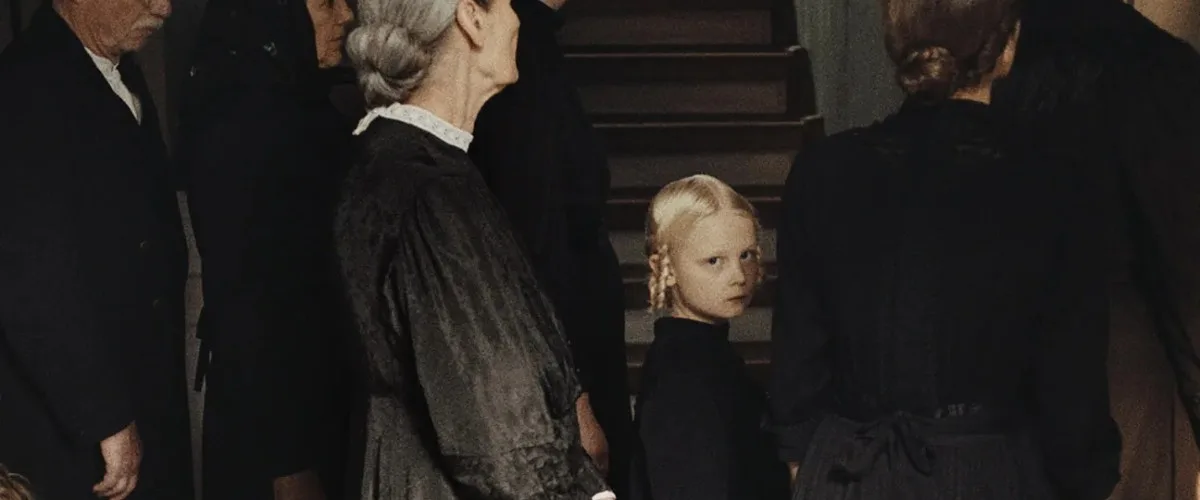
Across each era, Schilinski returns to a similar figure: a sharp-eyed young girl, alive with curiosity, hemmed in by the constant proximity of death. Sometimes she senses the danger. Sometimes she toys with it. Sometimes she’s oblivious. But the threat is always present, a low hum under every scene.
The film opens with teenage Erika (Lea Drinda) in a scene so strange and intimate it almost dares you to look away. She has bound one leg beneath her, mimicking her uncle Fritz (Martin Rother), who lies in bed as an amputee. Outside, a man her father, perhaps shouts for her to come help with the pigs. She ignores him. Instead, she stands over Fritz’s sleeping body, studying the hair on his chest, transfixed by the bead of sweat resting in his navel. It’s an unsettling moment, charged with something unspoken and taboo. And you begin to sense that this kind of forbidden intensity isn’t unique to Erika; it’s something embedded in the family, passed down like an heirloom no one acknowledges. Her clothes place her somewhere in the 1940s, and later, Schilinski will quietly reveal who she grows up to become, deepening the ache of what we’ve already witnessed.
Highly Recommended: Riot Women (2025) Parents Guide
The earliest thread centers on Alma (Hanna Heckt), a young child living with her siblings in a household defined by repression and silence. The adults are distant, opaque. Their emotional lives are closed rooms. Alma, sensitive and watchful, tries to decode the currents moving beneath the quiet. Her older brother Fritz (Filip Schnack) lies in bed after losing a limb, moaning in pain while Alma peers at him through a keyhole. Schilinski withholds orientation on purpose: we’re never fully sure who everyone is or when exactly we are. Like Alma, we’re left to piece together meaning from fragments.
There are flashes of what seems to be the First World War soldiers arriving to conscript men into the Kaiser’s army. Alma is too young to grasp the significance. What she does grasp, in her own halting way, is more symbolic and perhaps more devastating. She’s disturbed by an old photograph showing her mother standing over a dead child, cradling a doll. The child’s name, we learn, is Alma. Moments like this proliferate throughout the film: doubling, repetition, identities folding in on themselves. It’s as though time itself has lost its stability, as though the floor beneath history has given way.
Alma’s eldest sister Lia (Greta Krämer) is no longer a child but remains trapped at home. What prospects does a farm girl in 1915 actually have? Schilinski fills the film with haunting images and stories, but Lia lingers in the mind with particular force. Her presence feels like a question that never gets answered.
The film keeps circling around the idea of lives “lived in vain” the phrase is spoken more than once, and it lands heavier each time. Fritz, confined to his bed for what seems like decades: what did his suffering amount to? Lia, drifting through a life with no visible horizon: what was the purpose of her endurance? Women disappear without testimony. They’re absorbed into marriages, lost to childbirth, renamed, erased. “Sound of Falling” aches with the weight of those silences. It’s a film crowded with the unacknowledged dead.
The history of the region itself reinforces this sense of instability. The land has changed hands between empires over centuries. After World War II, it falls under Soviet control. By the 1980s in the GDR, the farmhouse has become a kind of unruly communal home. Angelika (Lena Urzendowsky), a volatile, searching teenager, comes to stay with her uncle Uwe (Konstantin Lindhorst) and aunt. Angelika is openly sexual, restless, hungry for something larger than the world she’s been given. Uwe notices.
Highly Recommended: Killer Whale (2026) Parents Guide
The film never spells anything out, but the implication that he is grooming her is hard to ignore. Angelika acts out in various ways, pushing against boundaries that were never designed to protect her anyway. Uwe’s wife, exhausted and humiliated, becomes the butt of jokes, her distress dismissed by everyone around her. In one quietly devastating moment, she swims across the nearby river into West Germany a forbidden crossing, a fleeting taste of freedom. You can’t help but feel that freedom should belong to Angelika instead. Her world is suffocating. And it’s dangerous.
By the present day, the property has been chopped into apartment units. A young couple and their two daughters move in, unaware that Alma, Lia, Erika, Angelika ever existed. The family dynamic is more open, the future theoretically full of choice. Yet the old currents persist. The older daughter, Lenka (Laeni Geiseler), develops an anxious, almost aching attachment to Kaya (Ninel Geiger), a glamorous, withdrawn girl whose mother has died. The younger sister, meanwhile, begins to experience a terrifying kind of dissociation, as if she’s slipping out of her own life. Progress, Schilinski suggests, doesn’t abolish the past. It just gives it new disguises.
One of the film’s most powerful elements is its sound design. The house speaks in creaks and groans. Silence becomes oppressive. Flies buzz with maddening insistence. And at intervals, a low, muffled tone swells into an overwhelming roar. It’s genuinely frightening but also deeply ambiguous. What is this sound? The emotional weight of everything left unsaid? The brutal indifference of time? Walter Benjamin’s “angel of history,” propelled forward while staring back in horror at the wreckage of the past? The film never answers, and that refusal is part of its power.
Stephen Dedalus famously says in Ulysses, “History is a nightmare from which I am trying to awake.” Schilinski seems to take that line as both inspiration and challenge. In “Sound of Falling,” the past doesn’t clarify the present. History doesn’t neatly integrate into who we are. We’re severed from it and yet it clings to us. One of the film’s central insights is that time erases people, but not entirely. They persist as atmospheres, as sensations, as flickers at the corner of the eye that vanish when you turn your head. These lives were real once, even if all that remains is a blurred shape on the edge of a photograph. The dead, Schilinski reminds us with quiet, devastating conviction, vastly outnumber the living. And they are everywhere.
Sound of Falling Parents Guide
Violence & Intensity: The film contains references to war, including forced conscription and implied deaths, and it portrays an amputee confined to bed across different periods of life. Themes of mortality, grief, illness, neglect, and existential despair run throughout. Children are frequently shown grappling with trauma they cannot understand. The sound design creaking floors, oppressive silences, and an intrusive low-frequency rumble intentionally heightens anxiety. Nothing is graphically depicted,but the cumulative psychological weight can be overwhelming. You don’t watch the dread; you absorb it.
Language: There is very little profanity and no notable use of slurs. Dialogue is restrained, often sparse. The issue here isn’t offensive language but emotional tone: the atmosphere is somber, introspective, and heavy, which may affect sensitive viewers more than words ever could.
Sexual Content / Nudity:
Sexuality appears in uncomfortable, emotionally complex ways rather than explicit ones. One early scene involves a teenage girl studying an adult male relative’s body in a manner that is deeply unsettling but not graphic. Later, there are strong implications of grooming between an uncle and teenage niece again, never shown directly, but made clear through subtext and behavior. There are no explicit sex scenes and no graphic nudity. Still, the themes of vulnerability, blurred boundaries, and confusion around intimacy are mature and potentially disturbing.
Drugs, Alcohol & Smoking: There is occasional background drinking and smoking, largely contextualized within historical settings. Substance use is not a central concern of the film and is never glamorized.
Age Recommendations:
This is not a film for children or younger teens. It is best suited to older teens and adults roughly 17+ particularly viewers who are comfortable with slow, contemplative cinema and heavy themes involving trauma, repression, death, and psychological ambiguity. Younger viewers are unlikely to understand the film and may find its emotional tone distressing.

Stephanie Heitman is a seasoned journalist and author dedicated to helping parents navigate the world of Hollywood entertainment through thoughtful, family-oriented film reviews. With over a decade of experience in writing and a passion for fostering safe, enriching viewing experiences, Stephanie launched Parentguiding.com to provide parents with the insights they need to make informed choices for their families.