Spoiler warning for Hijack season 2, episode 1.
The surprise return of Hijack for a second season fronted again by Idris Elba lands in that familiar middle space of streaming-era television: slick, competently made, intermittently gripping, and ultimately better suited to being devoured in a weekend haze than savored one episode at a time. It’s the kind of show that knows exactly how to press the right thriller buttons, even if it rarely lingers long enough to leave a bruise.
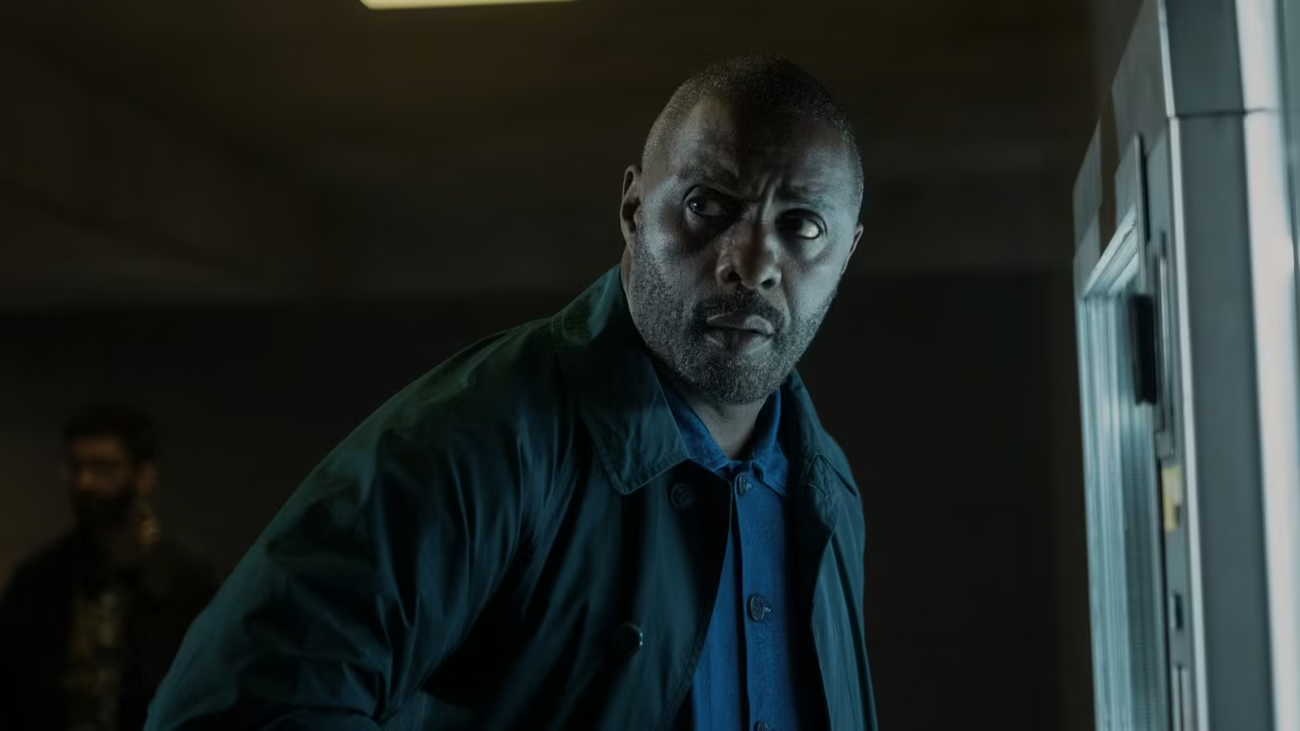
Season 2 opens by bringing us back to Sam Nelson, Elba’s coolly controlled business negotiator who, last year, talked down a mid-air hijacking on a commercial flight from Dubai to London. The twist this time is a provocative one, at the setting shifts to a subway train in Berlin, and Sam is no longer the man trying to stop the crisis. He’s the one causing it. It’s a bold narrative pivot, the kind that makes you sit up a little straighter, wondering whether the series is finally about to interrogate its own hero rather than simply admire him.
The new season is set roughly two years after the events of the first, unfolding in the present day, and from its opening minutes you can feel how closely it cleaves to the same aesthetic and storytelling blueprint. The production design is immaculate, the visuals gleaming to the point of sterility, and the narrative architecture feels less like lived-in drama and more like a strategic board game. Characters are introduced and maneuvered as pieces, not people. When Sam himself remarks that everything is a kind of poker game, it’s hard not to hear the show confessing its own approach and hard not to suspect that some viewers will call the bluff.
Highly Recommended: A Knight of the Seven Kingdoms (2026) Parents Guide
To be fair, Hijack remains a solid piece of entertainment, particularly if you have an appetite for hostage thrillers and the familiar pleasures of that genre. The first episode escalates quickly, and by the time the hour ends, the situation has become so tangled and volatile that genuine unpredictability creeps in. There’s a persuasive argument that the premiere is among the strongest installments of the season, if not the high point outright: a nerve-jangling start full of sudden turns, sharp reversals, and a brand of suspense that is gripping even when it’s occasionally maddening.
You can tell there’s real intelligence behind the construction. The plotting walks a narrow tightrope between intricacy and incoherence, and on rewatch, connections emerge that weren’t apparent in the moment. Yet there’s also a nagging sense that much of the mystery is sustained less by clever storytelling than by deliberate omission. Scenes often feel engineered around what the writers are refusing to tell us, and you can almost feel the withheld information hanging in the air, like a mechanical device rather than an organic secret.
Logic doesn’t always survive the demands of momentum. Over the course of eight episodes and nearly as many cliffhangers the show adopts a relentlessly solemn tone, punctuated by shock-driven twists that feel less like bold storytelling choices and more like cautious attempts to keep viewers watching. Instead of daring to go somewhere genuinely surprising, the series often settles for the safety of a late reveal that jolts but doesn’t resonate. The result is a show that looks serious, sounds serious, and strains to be taken seriously, yet rarely takes the kind of narrative risk that might justify that intensity.
A significant portion of the season somewhere between a third and a half unfolds in German, which means subtitles are part of the experience. That wouldn’t be an issue if the pacing were more assured in the quieter stretches. But the series struggles to sustain tension when the action slows, and you can feel the energy drain in scenes that should be simmering with unease. The premiere hits the ground running, but the deeper we get into the mechanics of the hijacking and its hidden motivations, the flatter the momentum becomes. It’s an odd paradox: more information leads to less urgency.
In an era where second seasons are often trimmed down, it’s genuinely surprising that Hijack expands to eight episodes, up from seven. Having watched the full season, it’s hard to escape the feeling that the story would have benefited from a tighter six. Beyond a handful of subplots most of them still orbiting Sam’s central arc the show spends much of its time oscillating between two main locations: the trapped train and the control room, where German intelligence and safety officials work desperately to save roughly a hundred hostages. The repetition dulls what should feel claustrophobic and intense.
Because of this structure, the show almost begs to be binge-watched. In fact, I’d actively recommend waiting until the finale arrives in March and consuming it in a handful of sittings. The emotional experience simply isn’t rich enough to sustain week-to-week anticipation, especially when compared to shows that genuinely make you ache for the next installment. Hijack works best when it’s allowed to blur together into a continuous stretch of tension rather than stand alone as episodic drama.
As in the first season, the show’s virtues are also its limitations. It’s striking to look at, deeply earnest, and undeniably tense but perhaps too polished to feel gritty, too relentless to offer tonal variation, and too reliant on misdirection that never quite conceals where everything is headed. Like the vehicles at the center of both seasons a plane, then a train the destination is visible long before we arrive.
After two seasons, the most honest descriptor for Hijack may be that it is perfectly adequate. It checks every box a modern thriller series is supposed to check: high production values, a recognizable global star, marketable premise, professional execution. What it lacks is harder to manufacture: a pulse. There’s little in the way of genuine emotional investment in these characters beyond the abstract idea that innocent lives are at stake. Without that deeper human connection, the series can feel oddly hollow.
Elba remains compelling his presence carries more weight than the material often deserves but Sam Nelson is not an especially inspired protagonist. His motivations are straightforward to the point of blandness, his personality rigid, his interior life barely sketched. These are shortcomings of the writing, not the performance. You can’t help wondering whether, without an actor of Elba’s stature anchoring it, the show would generate much interest at all. Straddling an awkward line between old-school thriller tropes and ultra-modern presentation, Hijack season 2 is watchable, intermittently engaging, and ultimately forgettable best experienced in a concentrated binge once the whole journey is finally available.
Hijack Season 2 Parents Guide
Hijack season 2 carries a TV-MA rating from the Motion Picture Association, and it’s a classification that reflects the show’s emotional weight more than its explicit content.
Violence & Intensity: The series trades graphic violence for sustained psychological tension. The central setting a hijacked subway train crowded with hostages creates an unrelenting atmosphere of confinement and fear. Characters are threatened, restrained, manipulated, and placed in genuine peril. The danger feels constant, and the anxiety is cumulative.
Physical violence does occur in short bursts: scuffles, moments of aggression, implied injuries. But the show largely avoids lingering on gore. The impact comes instead from the emotional pressure. You can feel the stress building scene by scene, and for younger viewers, that intensity may be more disturbing than overt bloodshed.
Language (Profanity, Slurs, Tone): Characters regularly use strong language, including F-bombs, in an attempt to ground the dialogue in realism. The overall tone is sharp, confrontational, and emotionally charged.
There are no recurring hate slurs, but the language is undeniably adult not casual or comedic, but shaped by fear, urgency, and desperation. It carries emotional weight, not just shock value.
Sexual Content / Nudity: This is not a sexually driven series. There are no explicit sex scenes and little to no nudity. Romance exists only faintly at the margins, and sexuality is not used as narrative spectacle. At most, viewers might encounter subtle references to relationships or implied intimacy, but nothing graphic.
Drugs, Alcohol & Smoking: Alcohol appears occasionally, often in social settings or moments of stress. Smoking is rare and typically used as a character detail rather than something glamorized. Drug use is not a major thematic concern and is not depicted in any sustained or graphic way. Substance use exists more in the background than as a focal point.
Recommended for ages 17+, aligning with the TV-MA rating. Older teens (16–17) who are accustomed to serious thrillers may handle it, but parental discretion is advised, especially for viewers sensitive to anxiety-inducing scenarios.
Highly Recommended:

Stephanie Heitman is a seasoned journalist and author dedicated to helping parents navigate the world of Hollywood entertainment through thoughtful, family-oriented film reviews. With over a decade of experience in writing and a passion for fostering safe, enriching viewing experiences, Stephanie launched Parentguiding.com to provide parents with the insights they need to make informed choices for their families.