
Sports dramas have always leaned on familiar architecture: the scrappy underdog, the tug-of-war between personal ambition and team loyalty, the surrogate families that form under pressure. Those beats are here too, beating steadily beneath Signing Tony Raymond.
But Glen Owens’ film doesn’t feel content to simply rehearse the genre’s greatest hits. Instead, it shifts the spotlight just enough to reveal something more uncomfortable and, frankly, more honest.
Owens’ film, which he also wrote and shot, doesn’t build toward a cathartic touchdown or a slow-motion victory montage. Its real arena is the cutthroat ecosystem of college football recruitment, and it treats that world as both absurdly funny and faintly tragic. The movie unfolds like a darkly comic chase, with universities scrambling to lock down the signature of a prized high school defensive end, and every scene seems alive to the desperation and performance of that pursuit. You can feel the anxiety humming beneath the jokes.
The film’s true subject isn’t a player, or a coach, or even the game itself. It’s the machinery behind the curtain: the economic logic that governs everything. Signing Tony Raymond quietly insists that sport should be powered by love, by devotion, by belief. But it also understands how naive that sounds in a system structured almost entirely around profit and leverage.
College football loves to sell the myth of purity “for the love of the game,” they say, endlessly. The film doesn’t deny that love exists. It simply argues that it’s only half the story.
The other half is colder: investments, returns, brand value, competitive edges. Idealism, in this environment, becomes decorative at best. And nothing exposes that contradiction more brutally than a full-blown recruiting war.
Recommended: People We Meet on Vacation Parents Guide
Tony Raymond known on the field as “Country Hurt” is only 18, but he’s already treated like a commodity. Played with a quiet, watchful intensity by Jackie Kay, Tony is the kind of talent programs build fantasies around. Coaches swarm. Promises escalate. The offers become grotesque: million-dollar NIL packages, luxury cars sitting idle in garages, even the whispered suggestion that Tony’s incarcerated father (played by Brian Bosworth) could be freed if the right paperwork finds the right desk. One character describes the process as “gangster.” It doesn’t feel like hyperbole.
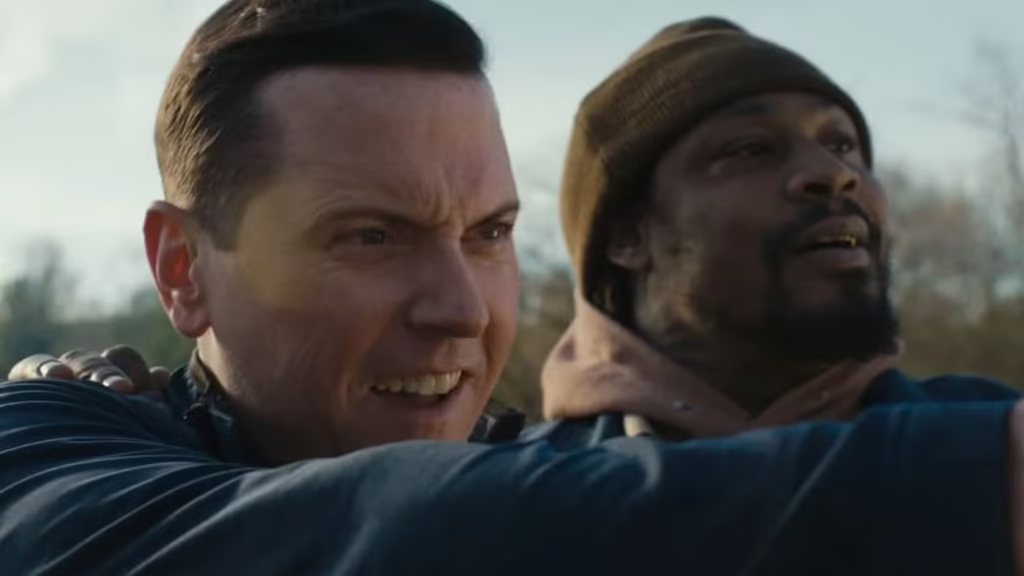
And the film is careful to show that this ugliness doesn’t end once the ink dries. One of its most sobering moments comes when a former star, now discarded after a devastating injury, reflects on how quickly the game abandons you when you’re no longer useful. He once filled stadiums; now he repairs air conditioners. The line lands with a dull thud of truth. It’s hard not to think of the countless real-life versions of this story.
Despite the title, Tony himself functions less as a protagonist than as a gravitational force—a narrative catalyst. The emotional core belongs to Walt McFadden, played with fragile sincerity by Michael Mosley. Walt is a special teams coach at Louisiana State University, tasked with convincing Tony to commit. This isn’t just another assignment. It’s a referendum on his entire career.
His head coach, Crew Marshall (Charles Esten), already doubts his worth after a previous recruiting failure. Walt’s position is precarious; his sense of self even more so. What makes the film interesting is that it never portrays him as incompetent. He’s thoughtful, hardworking, attentive to detail. What he lacks is the one trait the system rewards above all else: ruthlessness.
Other recruiters understand the unspoken rules. They bend ethics. They manipulate. They perform toughness. Walt doesn’t. He’s earnest to a fault, guided more by conscience than strategy, and the world punishes him for it. When Tony’s father snaps, “Your school must not think too much of my son if they sent you here,” you feel the sting linger in the air. It’s not just an insult; it’s a diagnosis.
Highly Recommended: The Night Manager Season 2 Parents Guide
Ironically, Walt’s journey drags him into behavior that looks anything but virtuous on paper. He fires guns without permits. He plays cards with strangers. He drinks too much with locals. He even winds up in jail. Yet the film suggests that these missteps stem not from corruption but from confusion. Walt is trying clumsily, desperately to bridge a cultural gap he doesn’t fully understand. What ultimately gives him a chance isn’t manipulation but sincerity. In a world that prizes predation, his refusal to become a “gangster” becomes a quiet act of rebellion.
That’s where the film’s moral spine begins to show. Walt comes to embody an outdated idea: that sports should be grounded in passion before profit. It makes him seem out of time, almost absurdly so. But it also makes him the only person in the story who feels remotely whole.
Family dynamics deepen that tension. The film is astute about how families, in recruitment culture, are less support systems than strategic assets. Tony’s parents his father Otis (Rob Morgan) and his mother (Mira Sorvino) understand this too well. They’ve lived long enough with disappointment to distrust sentiment. At first, Walt barely registers as a serious option. He brings no real leverage, no glamorous promises, no tangible security.
Yet something shifts. Slowly, awkwardly, a connection forms not through persuasive pitches but through a shared sense of being sidelined by the same brutal system. The three of them occupy similar margins: Tony’s parents as working-class survivors navigating exploitation, Walt as an expendable middleman in a results-obsessed hierarchy. They recognize something in each other, even if they can’t articulate it. Walt’s persistence, his gentle refusal to harden, becomes oddly grounding for a family accustomed to chaos. It’s a fragile, imperfect bond but the film treats it with real tenderness.
The setting amplifies these themes beautifully. Though filmed largely in Georgia, the story unfolds across rural Alabama, captured with an eye that appreciates both its quiet splendor and its suffocating limitations. The camera lingers on open fields, still lakes, sunlit porches. At the same time, the film doesn’t ignore the economic strain, the wary looks toward outsiders, the closed-off rhythms of small-town life. You might expect Walt to be chewed up by this environment. Instead, his awkward willingness to adapt to listen more than he speaks, to absorb rather than dominate allows him to move through it with surprising grace.
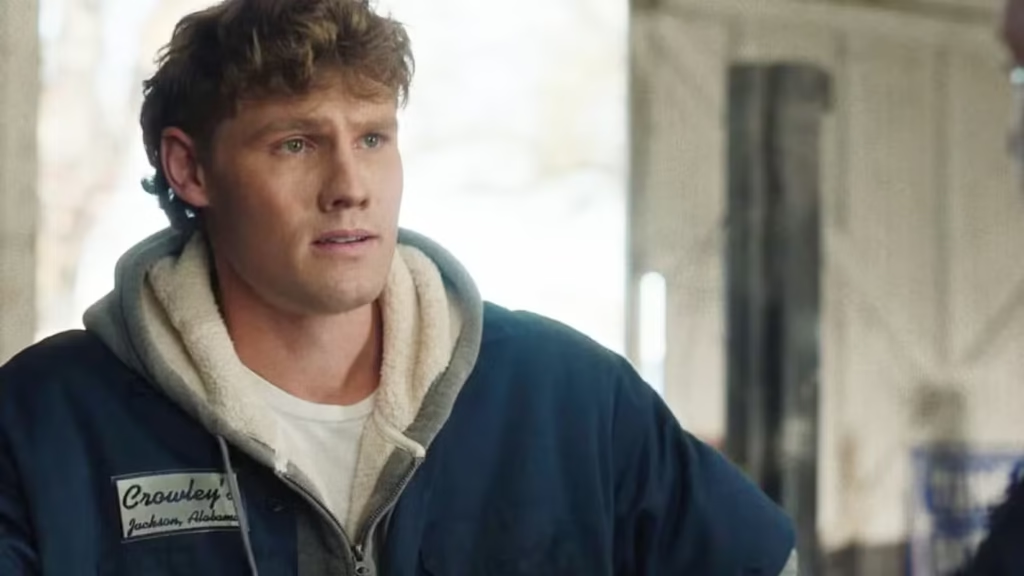
Visually, the film leans into a bright, almost buoyant color palette that complements its comedic instincts. There’s a lightness to the look that keeps the story from sinking into cynicism, even when the subject matter veers toward the bleak. The pacing is measured, confident, unhurried. And by the time the ending arrives carefully balanced, morally satisfying without being sentimental you realize how deliberately Owens has guided you here. Most characters receive outcomes that feel earned. The system isn’t magically fixed, but the human connections forged within it feel real.
In the end, Signing Tony Raymond delivers something rare in sports cinema: a story that understands the genre’s pleasures while also questioning its myths. It leaves you smiling, yes but also thinking. And maybe, just maybe, a little more aware of the cost behind every triumphant signing day photo.
Signing Tony Raymond Parents Guide
Signing Tony Raymond is not rated by the Motion Picture Association (MPA).
In terms of violence and intensity, the film contains little in the way of physical aggression. There are no fight scenes or brutal on-field moments designed to shock. Instead, the tension comes from social pressure and uncomfortable situations. Firearms appear when Walt recklessly fires guns without permits, and his eventual arrest brings moments of emotional distress rather than danger. Characters also speak openly about career-ending injuries, incarceration, and being discarded by the system. These moments land quietly but carry weight, and you can feel the emotional bruising even when no one is physically harmed.
The language is consistent with the environment the film portrays—casual, sometimes blunt, but rarely extreme. Mild to moderate profanity appears throughout, along with moments of sharp verbal confrontation when characters belittle or dismiss one another. The tone can sting, especially when Walt is treated as expendable, but the dialogue never feels gratuitous. It reflects character and context rather than aiming to provoke.
Sexual content is minimal to nonexistent. There is no nudity, no sexual activity, and only the occasional mild adult reference in conversation. This aspect of the film remains notably restrained, making it unlikely to raise concerns for most families.
Alcohol appears more frequently, though without glamorization. Characters drink socially, and Walt’s attempts to connect with locals often involve whiskey. These scenes communicate discomfort more than indulgence, underscoring how out of place he feels rather than presenting drinking as aspirational. There is no depicted drug use, and any smoking is brief and peripheral.
Age Recommendations
As for age appropriateness, the film is best suited to viewers aged 13 and up, not because of graphic content, but because of its themes. Younger teens may follow the story but miss the emotional and moral undercurrents that give it depth.
Highly Recommended: 28 Years Later: The Bone Temple (2026) Parents Guide

Stephanie Heitman is a seasoned journalist and author dedicated to helping parents navigate the world of Hollywood entertainment through thoughtful, family-oriented film reviews. With over a decade of experience in writing and a passion for fostering safe, enriching viewing experiences, Stephanie launched Parentguiding.com to provide parents with the insights they need to make informed choices for their families.