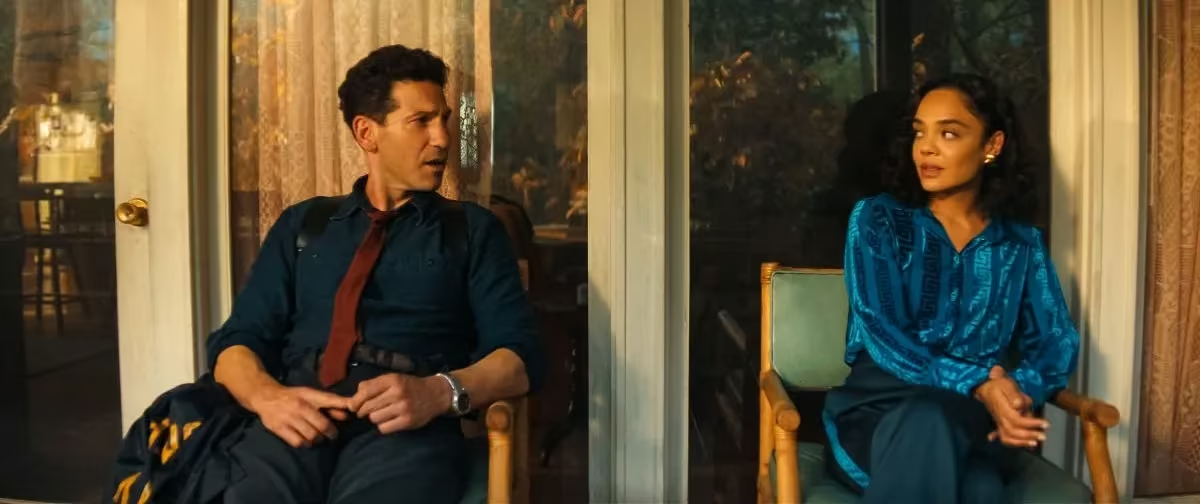
It’s shaping up to be a punishing year for anyone who watches every new thriller miniseries out of habit or hope. The genre is booming arguably bloated with shows like All Her Fault and The Beast in Me training audiences to expect high-concept hooks and cliffhanger endings. You can almost picture streaming executives feverishly skimming airport paperbacks, hunting for the next property that might trend for a weekend. Harlan Coben’s Run Away already dominated Netflix’s charts in early 2026, and scarcely has the algorithm cooled before we’re handed another glossy adaptation: His & Hers, based on Alice Feeney’s 2020 novel and shepherded to the screen by showrunner Dee Johnson.
Like Run Away, this is a series that seems to regard the viewer less as a thinking participant than as a gullible target to be manipulated. By the time the final episodes roll around, the plot has twisted itself into such elaborate knots that I found myself doing something I rarely do consulting a synopsis of the book just to determine whether the chaos was the fault of the adaptation or the source material. Alas, the show is faithful. And the story, it turns out, really is that bonkers. The result is the particular kind of frustration that feels almost personal: the anger of realizing you’ve invested hours in a narrative that collapses under the slightest scrutiny, and worse, one that exploits weighty subjects sexual assault, bullying, dementia not with care or insight, but as cheap accelerants for shock.
What stings most is how much raw talent the show squanders. Tessa Thompson and Jon Bernthal are not merely competent; they’re magnetic, actors who can carve inner lives out of the thinnest scripts. There are moments when their work almost convinces you to forgive the series out of gratitude alone. But the longer His & Hers goes on, the more it traps them in scenes clogged with clumsy dialogue and character decisions that make no psychological sense. Even performers this gifted eventually sink under the weight of it, bogged down in the humid, metaphorical mud of this Georgia-set melodrama.
Thompson plays Anna, an ambitious Atlanta reporter who returns to her hometown when a former classmate is brutally murdered a homecoming driven less by nostalgia than by the scent of career-making headlines. There she collides with Detective Jack Harper, played by Bernthal with his usual coiled intensity. Jack, in short order, turns out to be three things at once: the lead investigator on the case, a man who had been sleeping with the victim, and Anna’s estranged husband. It’s a pulpy setup, but the early episodes actually tease something intriguing. Johnson and her writers toy with shifting perspectives, encouraging you to wonder whether Jack might be guilty, or whether Anna herself is concealing darker knowledge about what happened. Both are compromised. Both are unreliable. Both are clearly hiding something. For a while, you can feel the series flirting with genuine moral complexity.
Jack works the case alongside his partner Priya (Sunita Mani), and their investigation predictably draws them to Clyde (Chris Bauer), the victim’s wealthy, eccentric husband, who all but announces himself as a suspect the moment he appears onscreen. The story also circles back to a high school friend group that Anna once belonged to. Through flashbacks, we see that Anna and the victim were part of a clique of cruel girls who singled out one vulnerable classmate. The murder, the show suggests, may be a reckoning for those long-ago sins. Jack’s sister Zoe (Marin Ireland) was in that circle too, as was Helen (Poppy Liu), now a local school headmistress. The suspect list expands mechanically, as if ticking boxes on a whiteboard.
Complication piles upon complication. Anna begins an affair with Richard (Pablo Schreiber), a cameraman whose presence feels engineered purely to add mess. Of course, he’s married to Lexy (Rebecca Rittenhouse), Anna’s rival back at the news station. The show wants this to feel like a sharp look at media culture, but its understanding of how television news actually works is so superficial that you could write an entirely separate critique just on that point alone.
We learn early that Anna and Jack’s marriage fractured under the unbearable weight of losing a child. In these scenes quiet, raw, and focused His & Hers briefly becomes the series it ought to have been. When Thompson and Bernthal are allowed to simply inhabit grief, to let silences stretch and emotions breathe, you glimpse a more serious drama struggling to emerge. Those moments are devastating in the best way. They also make everything else feel more exasperating. The current wave of streaming thrillers has trained writers to strip stories down to pure narrative propulsion: plot point after plot point, twist after twist. Compare that to shows like Big Little Lies, Sharp Objects, or Mare of Easttown, which understood that tension comes not just from surprises but from character, atmosphere, and internal logic. Those series trusted viewers. His & Hers does not.
By the time the finale arrives, any attempt to carefully trace how the characters got from point A to point Z collapses almost instantly. And once the plot fog clears, you start remembering what the show asked you to swallow along the way: the death of an infant, the rape of a teenager, traumas treated as narrative seasoning. At that point, the usual defense “It’s just escapism” rings hollow. Most fans of this genre are willing to suspend disbelief. We’ll accept coincidences, exaggerations, even a few outrageous turns. What we don’t want is to feel vaguely sullied for having gone along for the ride.
Anna’s voiceover insists that the series is about dueling perspectives. “There are at least two sides to every story,” she tells us. “Yours and mine. Ours and theirs. His and hers. Which means someone is always lying.” It’s a strong premise, the kind that suggests a layered, character-driven exploration of truth and self-deception. You can almost see the superior show that might have been built around that idea. Instead, what we get is something closer to His and Hers and a Writers’ Room That’s Completely Lost Its Mind. And it’s hard not to feel that the biggest lie here is the one the show tells about its own ambitions.
His & Hers Parents Guide
His & Hers is rated TV-MA by the Motion Picture Association (MPA),
Violence & Intensity: The series opens around a brutal murder, with recurring discussions of the crime and visual references to its aftermath. While not relentlessly graphic, the show leans heavily on psychological intensity: interrogations, threats, emotional confrontations, and revelations designed to shock.
More troubling than the on-screen violence, however, is the thematic weight of what the show uses as narrative fuel. The story incorporates the death of a baby, the rape of a teenager, and ongoing trauma connected to both. These events are not always depicted explicitly, but they are discussed often and used as major plot mechanics.
Language (Profanity, Slurs, Tone): Strong language is used throughout. Characters frequently swear in moments of stress or anger, including regular use of f-words and other harsh profanity. The tone of the dialogue can be caustic and bitter, reflecting the emotional damage many characters carry.
There are also moments of verbal cruelty tied to bullying and interpersonal manipulation, which may resonate more deeply than the sheer number of swear words. It’s the intent behind the language cutting, accusatory, demeaning that lingers.
Sexual Content / Nudity: Sexual content appears in multiple forms. There are references to affairs, infidelity, and sexual relationships that complicate the plot. An extramarital affair between two adult characters is a recurring element, and while not explicit in a graphic sense, it’s clearly portrayed as physical and emotionally charged.More serious is the inclusion of sexual assault in the backstory. The show references the rape of a teenager as part of its narrative structure.
Drugs, Alcohol & Smoking: Characters drink alcohol regularly, often socially but sometimes as an emotional crutch. Bars, drinks at home, and stress-fueled drinking appear throughout the series.Smoking is present in some scenes, typically used to underscore mood rather than glamorize behavior.
Illegal drug use is not a dominant element, but references to substance use occur in the broader landscape of the story.
Recommended for: Adults 18+
Some mature 16–17-year-olds might handle the content, but only with strong emotional resilience and, ideally, context for discussing the heavier themes. This is not edgy fun; it’s heavy content wearing the mask of a thriller. And parents should be aware that the emotional aftertaste may linger longer than the plot itself.
Highly Recommended:

Stephanie Heitman is a seasoned journalist and author dedicated to helping parents navigate the world of Hollywood entertainment through thoughtful, family-oriented film reviews. With over a decade of experience in writing and a passion for fostering safe, enriching viewing experiences, Stephanie launched Parentguiding.com to provide parents with the insights they need to make informed choices for their families.