There’s a familiar pattern to most TV crime dramas. In my experience, they usually land in one of three camps: the ones that are dreadful from the opening scene and never course-correct, the ones that start solid and coast along at that level, and the rare gems that feel confident and inspired from first episode to last. Girl Taken, a new British series on Paramount+, seems to invent a fourth category all its own. It begins with such startling effectiveness that you lean forward with genuine anticipation and then, by episode three, it collapses under the weight of its own limitations, never quite finding its footing again.
Adapted from Hollie Overton’s novel Babydoll, the show makes it clear early on that it’s not interested in the puzzle-box pleasures of recent whodunits like Poker Face, The Residence, or Mare of Easttown. Nor does it dig into the more cerebral terrain of modern “whydunits” such as The Beast in Me or Task. There is no mystery about who the villain is. We meet him immediately. Rick Hanson (played with unnerving commitment by Alfie Allen) is a well-liked teacher in a small town, the kind of man parents trust and teenagers admire. You can almost feel the sickening familiarity of the performance: the soft smile when girls jokingly call him “Mr. Handsome,” the careful calibration of charm and restraint. In private, he begins to groom graduating senior Abby Riser (Delphi Evans), encouraging her to call him Rick, urging her toward university, and feeding her the poisonous idea that he alone truly understands her potential. He subtly undermines her family—her twin sister Lily (Tallulah Evans), a more impulsive free spirit, and their single mother Eve (Jill Halfpenny) suggesting that they can’t see her the way he does. It’s manipulative, predatory, and painfully believable.
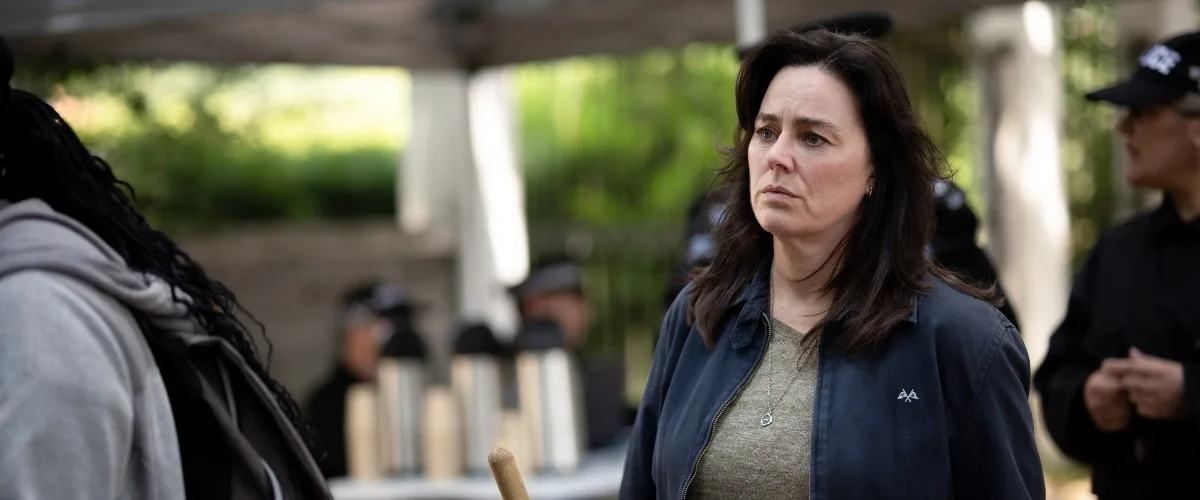
The horror arrives with a cruel twist of fate. Rick doesn’t end up abducting Abby, the girl he’s been grooming, but Lily instead by accident. She is taken, chained in the basement of a remote cottage, and effectively erased from her former life. From there, the series fractures into three parallel threads: Lily’s captivity; the slow collapse of Eve and Abby as they wait years for Lily to be found, their grief calcifying into addiction and dysfunction; and Rick’s ongoing double life as he maneuvers through his marriage to Rachel (Niamh Walsh), toys with local cop Tommy Shah (Vikash Bhai, stranded in a frustratingly thin role), and, the show implies, begins seeking out a new victim as Lily “ages out” of his interest.
In theory, that’s a rich and ambitious structure. In practice, it reveals a painful imbalance. The material meant to explore Eve and Abby’s devastation offers Jill Halfpenny and Delphi Evans little more than variations on screaming and sobbing. You understand the intention the series wants to honor the endurance of a family shattered by violence but the writing gives them so few textures to play that the emotional beats start to blur together. Meanwhile, Rick’s storyline remains perversely the most compelling, largely because Allen is simply doing more interesting work. His performance is detailed, unsettling, and disturbingly human, which makes it hard not to find yourself drawn to his scenes despite the revulsion you’re meant to feel.
The acting issues don’t stop there. Neither Tallulah nor Delphi Evans manages to convincingly embody the kind of terror and psychological disintegration that captivity and loss would realistically produce. Their performances often feel closer to what you might see in a competent high school production than in a prestige TV drama. Halfpenny, who has proven herself capable in other projects, is saddled with a characterization that reduces Eve to a near-caricature: the perpetually drunken, emotionally corrosive mother who lashes out with surgical cruelty. There are glimmers of nuance elsewhere. Niamh Walsh, in particular, finds genuinely moving moments as Rachel begins to confront the reality of her marriage to Rick. Her quiet reckonings, her dawning horror, carry an emotional truth that may hit uncomfortably close to home for anyone who’s survived an abusive relationship. But even these scenes are too often sacrificed to the show’s infatuation with moody filler endless shots of fog-drenched woods and desolate roads that signal “prestige” without actually deepening the story.
What makes this all the more frustrating is how strong the series initially feels. The early episodes refuse to sanitize the brutality of the crime, and some sharp editing choices give those moments real force. For a while, you think you’re in the hands of storytellers willing to confront ugliness with honesty. But that early boldness turns out to be misleading. The writers seem to run out of meaningful ideas for how to sustain that intensity. It’s one thing to depict horrifying acts against a child and a community; it’s another to build a thoughtful psychological drama about trauma, memory, and justice. The show gestures toward that deeper terrain but rarely commits to it. There are a few tender, understated exchanges—especially between Abby and Wes (Levi Brown), Lily’s boyfriend when she disappeared—that hint at a more introspective, emotionally layered series. Those are the moments where you can almost see a better version of Girl Taken struggling to emerge. Unfortunately, directors Laura Way and Bindu de Stoppani repeatedly choose explosive confrontations over reflective silence, as if afraid that stillness might lose the audience.
It’s easy to imagine some viewers comparing Girl Taken to Adolescence, another drama about the consequences of neglect, fractured families, and fragile social support systems. But the resemblance is superficial. Where Adolescence interrogates the systems and failures that shape its tragedy, Girl Taken largely ignores them. Eve’s parenting and preexisting dependence on alcohol are barely sketched before disaster strikes. The school’s responsibility in employing a predator is never seriously examined. Mental health support so central to any realistic exploration of long-term trauma is mentioned exactly once across the entire six-episode run. That absence isn’t just an oversight; it’s a thematic void.
By the end, you’re left with the uncomfortable sense that the series wants the emotional weight of serious drama without doing the intellectual and moral work that such weight requires. Whatever potential glimmered in those early episodes fades into something far thinner and more exploitative than it ought to be. This isn’t the kind of storytelling that belongs in the same conversation as thoughtful crime drama. Harsh as it sounds, it’s closer in spirit to made-for-TV melodrama than to the prestige television it seems to aspire toward.
Girl Taken 2026 Parents Guide
Girl Taken is Rated TV-14 (MPA)
Girl Taken carries a TV-14 rating, but that label feels, at times, more like a bureaucratic formality than a meaningful reflection of how heavy this series can feel. While the show avoids graphic exploitation, its subject matter child abduction, psychological manipulation, family breakdown often lands with an emotional weight that lingers long after scenes end.
Violence & Intensity: The series opens with startling force. A teenage girl is kidnapped and held captive, chained in a basement for years. While the camera often pulls back before anything overtly graphic occurs, the psychological intensity is relentless, especially in the first two episodes.
Language: Moderate strong language appears throughout, often tied to moments of anger, despair, or addiction. Characters lash out verbally, and the tone can be harsh, bitter, and cruel.
There are no frequent slurs, but the dialogue often carries emotional violence cutting remarks between family members, manipulative language from the abuser, and verbal cruelty that may affect younger viewers more deeply than the profanity itself.
Sexual Content / Nudity: There is no explicit sexual imagery or nudity. However, the series deals heavily in sexual manipulation and grooming. A teacher emotionally grooms a student, blurring boundaries, manipulating her self-worth, and exerting psychological control.
While handled without graphic sexual scenes, the implications are unmistakable. This is mature thematic material that requires emotional maturity to process. Younger teens may understand the surface but miss the danger or feel unsettled without fully knowing why.
Drugs, Alcohol & Smoking: Substance use becomes a major narrative element. Alcoholism is depicted in sustained, sometimes ugly detail. A mother’s reliance on alcohol contributes to family breakdown, and addiction is portrayed not as edgy decoration but as corrosive and destructive.
There are also suggestions of drug use as characters spiral through years of unresolved grief.
Age Recommendations
Despite the TV-14 label, this series feels more appropriate for older teens (16+) and adults.
The themes abduction, grooming, psychological trauma, addiction, emotional abuse are simply too heavy for most younger teens to contextualize safely. Parents watching with teens may want to be present, prepared for discussion, and attentive to emotional reactions.
Highly Recommended:

Stephanie Heitman is a seasoned journalist and author dedicated to helping parents navigate the world of Hollywood entertainment through thoughtful, family-oriented film reviews. With over a decade of experience in writing and a passion for fostering safe, enriching viewing experiences, Stephanie launched Parentguiding.com to provide parents with the insights they need to make informed choices for their families.