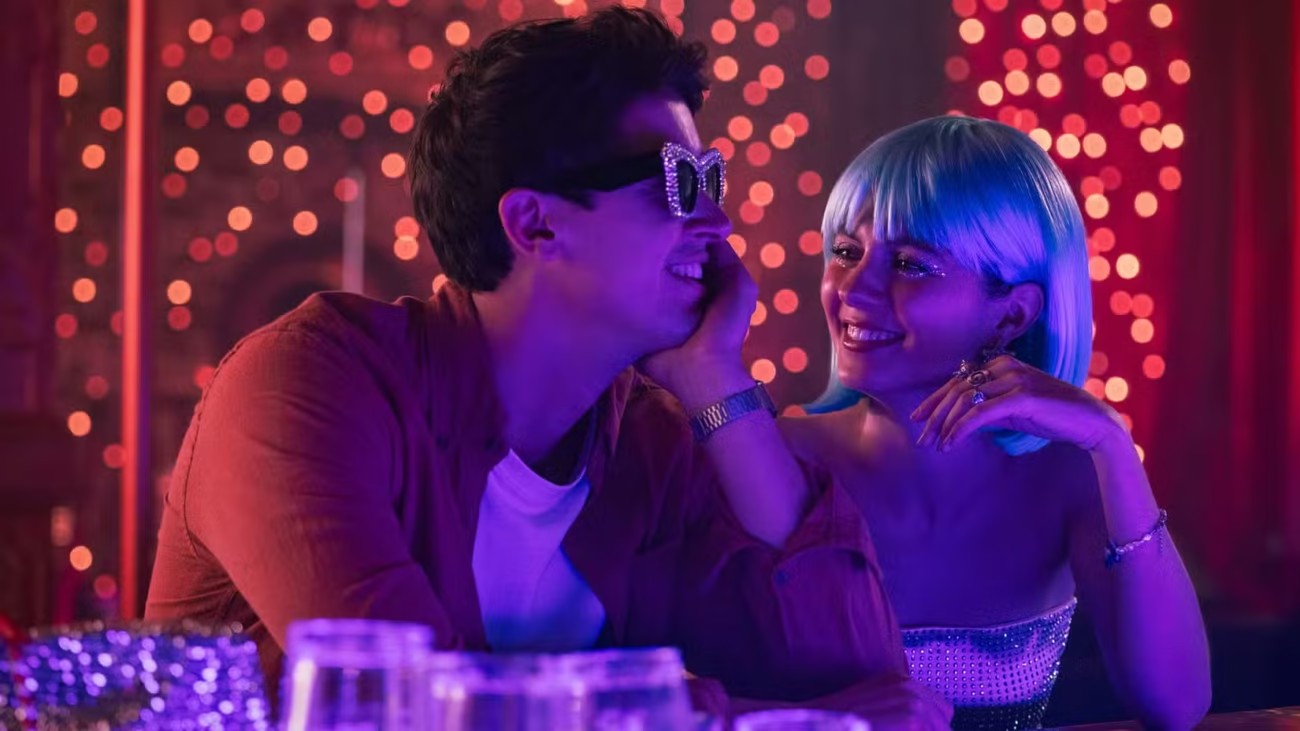
People We Meet on Vacation is Rated PG-13 Motion Picture Rating (MPA) for sexual content, drug use, nudity and brief strong language.
Emily Henry’s beachside crowd-pleaser becomes, on screen, another Netflix rom-com that mistakes familiarity for feeling. People We Meet on Vacation opens by tracking Poppy, a hyperactive travel writer played by Emily Bader, at a moment when the job that once defined her has curdled into restlessness. She’s professionally successful, technically fulfilled, and unmistakably unhappy. It doesn’t take long for the film to reveal what’s really gnawing at her: Alex, her college best friend, emotional counterweight, and the person she has been orbiting and avoiding since they first fell into an easy, charged friendship years earlier.
Their origin story is pure rom-com setup. They meet in college, bond over an impromptu road trip from Boston College back to their shared hometown of Linfield, Ohio, and establish a ritual that becomes the spine of the film: one vacation together every year. Just the two of them. Different destinations, same unspoken tension. Year after year, they circle each other emotionally, each convinced the other doesn’t or couldn’t feel the same way. You can feel how the movie wants this structure to ache, to accumulate meaning as time passes. Instead, it mostly just ticks boxes.
The timeline skips around restlessly, mirroring Poppy’s own jittery energy. When Alex finally breaks free from his long, looping relationship with his high-school sweetheart Sarah, right before his brother’s wedding, something in Poppy snaps into motion. She bails on a work trip, flies to Barcelona, and decides perhaps for the first time to confront what she’s been avoiding. Not just Alex, but herself. It’s a familiar crossroads: the moment where the rom-com promises emotional honesty at last. You want to lean in. You’re ready for it to go somewhere real.
But the film never quite earns that moment. The premise has the bones of something sturdy, yet what unfolds feels like a collage of better movies shuffled together without connective tissue. You can spot the DNA of When Harry Met Sally…, My Best Friend’s Wedding, One Day, and even a dash of The Notebook, but what’s missing is the thing those films understood instinctively: character specificity. The people here feel less like lived-in souls and more like placeholders moving through familiar beats.
That thinness extends behind the camera. Brett Haley, a filmmaker who once brought quiet emotional acuity to I’ll See You in My Dreams, The Hero, and Hearts Beat Loud, and who even found grace within Netflix’s glossy machine on All the Bright Places, seems oddly disengaged this time. The film drifts between timelines without rhythm or purpose. It’s shot almost entirely in an ultra-wide frame that never justifies itself. Scenes feel strangely hollow, with compositions so empty they start to echo the script’s emotional flatness.
Most baffling is Haley’s resistance to close-ups. This is a movie about withheld feeling, about glances that linger a beat too long. And yet, the camera keeps its distance, defaulting to dull medium shots that flatten the actors’ work. Tom Blyth, who plays Alex, is especially underserved. He’s an actor whose face can register entire conversations in silence. His performance lives in reaction tiny shifts, swallowed words, eyes that say what his mouth won’t. And still, in scenes that demand intimacy, his face is barely visible, often no larger in frame than the back of Bader’s head. It’s hard not to feel frustrated watching potential slip through the cracks like this.
The script doesn’t help. Credited to three writers Yulin Kuang, Amos Vernon, and Nunzio Randazzo it gestures toward inner lives without ever filling them in. We’re told Poppy writes for a travel magazine called R&R, but what that actually means is anyone’s guess. Does she review places? Chronicle experiences? Reflect on culture? The film never decides. Her boss, Swapna, played by Jameela Jamil, is reduced to a shorthand version of sophistication: a British accent, couture outfits, and little else. It’s not a character so much as a vibe.
Poppy’s personal world is just as skeletal. She appears to have exactly one friend outside of Alex, played by Alice Lee, who shows up for a single scene involving SoulCycle, public yelling, and impulsive bad decisions. Then she’s gone. You might suspect the novel gave this relationship texture and warmth, but the film barely remembers her existence. Rom-coms used to understand the pleasure of a sharp, scene-stealing best friend the Judy Greer school of emotional support and comic relief. Here, the character doesn’t even get a name, let alone a second appearance.
Alex fares no better. We’re told he was pursuing a PhD before abandoning it to teach high school in Linfield, choosing stability and familiarity with Sarah over ambition. But what was he studying? What did he give up, exactly? These details matter, especially in a story built on roads not taken. His family is similarly underwritten. His younger brother David insists that Poppy is “like family,” yet the film never shows us why. Their lone shared scene is at the wedding, and the intimacy feels asserted rather than earned.
It’s impossible not to think of My Best Friend’s Wedding, where Jules’ long history with Michael’s family is communicated through posture, ease, and the unspoken comfort of familiarity. That film understood how much storytelling lives in body language and it didn’t hurt that Michael’s father was played by the incomparable M. Emmet Walsh. By contrast, Alex and David’s father barely registers. He’s present, technically, but leaves no impression. Poppy’s parents, played by Alan Ruck and Molly Shannon, are given more screen time but no more depth. They pop in to mug and riff, including a bizarre moment where Shannon references Never Been Kissed, seemingly for no reason other than to remind us she once starred in it. The scene lands with a thud.
By the time the credits roll, the film feels like a scrapbook of gestures toward other, better romances. It’s glossy, hollow, and strangely detached from the emotional core it keeps insisting is there. More than anything, it feels engineered for secondary consumption for TikTok edits, Tumblr GIFs, and fan cams that isolate moments the film itself never deepens. The movie would rather chase postcard backdrops across the globe than spend time in Linfield, the small town that supposedly defines both characters. Alex loves it. Poppy resents it. And yet, aside from a single, anonymous tree-lined street, we never really see it. Its warmth, its claustrophobia, its contradictions all absent.
That absence lingers. It’s disappointing to watch Haley, once such a sensitive chronicler of emotional in-between spaces, drift into autopilot. It’s even more dispiriting to see two promising actors stranded in material this thin. Bader and Blyth have both shown, in smaller films like Fresh Kills and Plainclothes, that they can do far more with far less. Here, they’re left circling a story that never quite meets them halfway. The small mercy is that their careers, unlike this movie, still feel wide open.
People We Meet on Vacation Parents Guide
Violence & Intensity: There is no physical violence in the film, nor are there moments of peril or threat. The intensity is emotional rather than physical, rooted in unresolved feelings, awkward conversations, and the frustration of characters who consistently avoid saying what they mean. Arguments are mild and short-lived, usually played as uncomfortable or quietly tense rather than explosive.
Language: The language throughout the film remains mild and consistent with a PG-13 rating. Characters occasionally use common profanity in moments of stress or casual conversation, including words like “shit” or “fuck.” There are no slurs or hateful expressions, and the overall tone of the dialogue is conversational rather than aggressive. The swearing is brief and unremarkable, though younger teens may still notice how casually it’s used.
Sexual Content / Nudity: Sexual content is present but understated, leaning more toward implication than depiction. Adult characters share kisses, intimate moments, and conversations that suggest sexual relationships without showing explicit activity. Brief nudity may appear in transitional or private settings, but the camera does not linger or frame it provocatively.
Drugs, Alcohol & Smoking: Alcohol consumption appears regularly in social contexts such as vacations, weddings, and nights out, reflecting adult leisure rather than excess. Recreational drug use is briefly referenced or implied but not shown in detail or framed as aspirational. Smoking, if present, is minimal and fleeting. These elements are treated as part of adult life rather than as focal points of the story.
Age Recommendations: While the film is rated PG-13 and contains nothing that exceeds those boundaries, it is likely best suited for older teens and adults. The themes career dissatisfaction, emotional stagnation, missed opportunities, and romantic regret are more likely to resonate with viewers who have some life experience.
Highly Recommended:

Stephanie Heitman is a seasoned journalist and author dedicated to helping parents navigate the world of Hollywood entertainment through thoughtful, family-oriented film reviews. With over a decade of experience in writing and a passion for fostering safe, enriching viewing experiences, Stephanie launched Parentguiding.com to provide parents with the insights they need to make informed choices for their families.