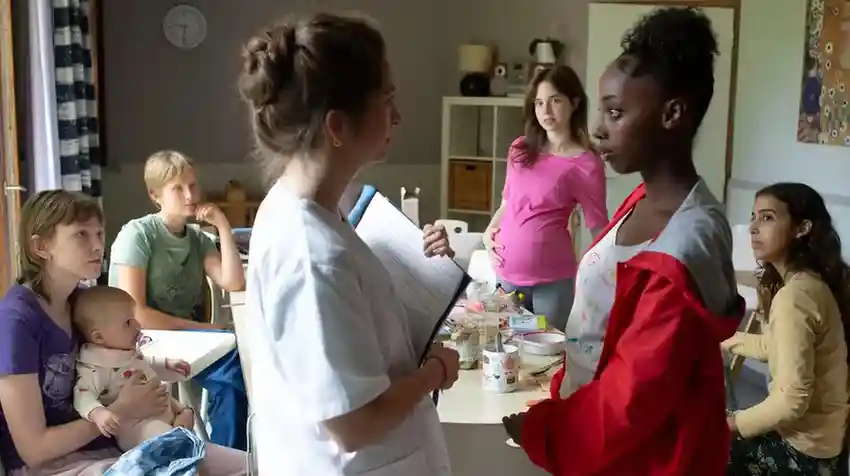
Five teenage girls move through Young Mothers carrying infants, pregnancies, and histories that already feel heavier than their years. The Dardenne brothers follow them closely, patiently, as they eat, argue, relapse, hope, and brace themselves for disappointment. It’s familiar terrain for Jean-Pierre and Luc Dardenne this is the kind of working-class, observational realism they’ve been refining for decades but this time, something essential feels muted, as if the film is watching hardship rather than interrogating it.
Set largely within and around a maternity shelter, the movie unfolds as a loose mosaic rather than a tightly braided ensemble piece. These young women live under the same roof, yet their stories barely intersect, a choice that may be realistic but also leaves the film feeling oddly fragmented. Life, the Dardennes seem to suggest, doesn’t arrange itself into neat arcs or shared revelations. Still, you can’t help wishing for a stronger sense of accumulation, some pressure building beneath the surface.
Perla, played with raw vulnerability by Lucie Laruelle, reunites with her boyfriend Robin after his release from prison. There’s a tremor of hope in their early moments together, the kind that feels fragile even as it’s being grasped. Almost immediately, that hope collapses. Robin disappears again, and Perla is left weighing whether she can or should raise her child alone. Laruelle makes Perla heartbreakingly recognizable: a girl trying to perform adulthood while still believing that love can be preserved if you just say the right things, press the right emotional buttons.
Jessica, nearing her due date, turns her attention backward rather than forward. Desperate to connect with the mother who abandoned her, she tries to stitch together a relationship from absence and resentment. The scenes between Babette Verbeek and India Hair are quietly agonizing, filled with pauses that speak louder than dialogue. You can feel the ache of a daughter hoping motherhood might retroactively make sense of her own childhood.

Julia’s story is perhaps the most painful in its familiarity. Struggling to stay sober, she clings to the stability offered by her fiancé Dylan, who remains steadfast even when she falters. Elsa Houben plays Julia with a constant undercurrent of tension, as if relapse is always just a breath away. When it finally arrives cruelly timed, just moments after the couple secures an apartment it lands less as tragedy than as a kind of grim inevitability. It’s hard not to feel the filmmakers pushing her back down simply because realism demands it, and that manipulation leaves a bitter aftertaste.
The film’s darkest thread belongs to Ariane, trapped in an emotionally abusive relationship with her mother, Nathalie. Janaïna Halloy Fokan gives Ariane a haunted stillness, while Christelle Cornil’s portrayal of Nathalie is chilling in its narcissistic volatility. Watching Ariane attempt to disentangle herself from this bond is exhausting in the way real emotional abuse is exhausting—there’s no catharsis, just attrition. It’s the film’s most compelling narrative, and also its bleakest, offering little beyond survival itself.
Naïma, meanwhile, exists almost on the margins. She has a job opportunity, a sense of community, and a future that doesn’t seem entirely foreclosed. The Dardennes give her the least attention, as if stability were less cinematically interesting than despair. Intended or not, her relative absence makes her feel less like a counterpoint and more like an afterthought, a symbolic nod toward hope that the film doesn’t fully commit to exploring.
There’s no denying the craft on display. The performances many by non-professional actors are tenacious and unvarnished. The Dardennes’ camera remains as controlled and intimate as ever, offering near-documentary access to lives shaped by systemic neglect and personal misfortune. You’re right there with these girls, feeling the frustration of small setbacks that carry enormous consequences.
Yet the film remains strangely opaque. Earlier Dardenne works used realism as a means toward moral inquiry or political urgency. Here, realism feels like an endpoint rather than a tool. The suffering accumulates, but the perspective never sharpens. Compared to the provocations and missteps of Young Ahmed, this film is gentler, more tender but also less engaged, content to observe rather than challenge.
Young Mothers is not without compassion. In fact, its empathy is its strongest asset. But empathy alone isn’t insight. By the time the film ends, you may admire its restraint and its performances, yet still feel something missing a sense that these stories, so carefully rendered, might have pointed toward something larger than their own quiet despair.
Young Mothers Parents Guide
Young Mothers is not rated by the Motion Picture Association (MPA), which feels appropriate given how deliberately uncommercial and emotionally demanding the film is. Like much of the Dardenne brothers’ work, it isn’t interested in sensationalism, but it does confront difficult realities with an unflinching, almost austere honesty. For parents, the concerns here aren’t about shock value so much as emotional weight.

Violence & Intensity: There is no conventional physical violence, but the film carries a steady emotional intensity that can be difficult to sit with. The most troubling material comes from psychological and emotional abuse, particularly in the relationship between Ariane and her mother. The manipulation, gaslighting, and verbal cruelty are portrayed realistically and without softening, and you can feel how corrosive this dynamic is over time.
Language: The dialogue is naturalistic and unsanitized, reflecting the working-class environments and emotional volatility of the characters. Some mild to moderate profanity appears, usually during moments of stress or conflict. There are no repeated slurs or hate speech, but the tone can be harsh, dismissive, or cruel especially in parent-child exchanges.
Sexual Content / Nudity: Sexual content is minimal and non-graphic, though the subject of sex is implicit throughout due to the film’s focus on teenage pregnancy and motherhood. There is no explicit sexual activity shown, and any intimacy is handled discreetly and without erotic framing.
Drugs, Alcohol & Smoking: Substance use is a significant thematic element, particularly in Julia’s struggle with narcotics addiction. Drug use is not glamorized, but it is depicted with sobering realism, including relapse. The emotional consequences shame, disappointment, instability are central to her storyline.
Age Recommendations: Due to its mature themes, emotional heaviness, and focus on addiction, abuse, and teenage pregnancy, Young Mothers is best suited for viewers 16 and up, with 17+ being more appropriate for unsupervised viewing.
Young Mothers opens in select theaters on January 9, 2026.
Highly Recommended:

Stephanie Heitman is a seasoned journalist and author dedicated to helping parents navigate the world of Hollywood entertainment through thoughtful, family-oriented film reviews. With over a decade of experience in writing and a passion for fostering safe, enriching viewing experiences, Stephanie launched Parentguiding.com to provide parents with the insights they need to make informed choices for their families.