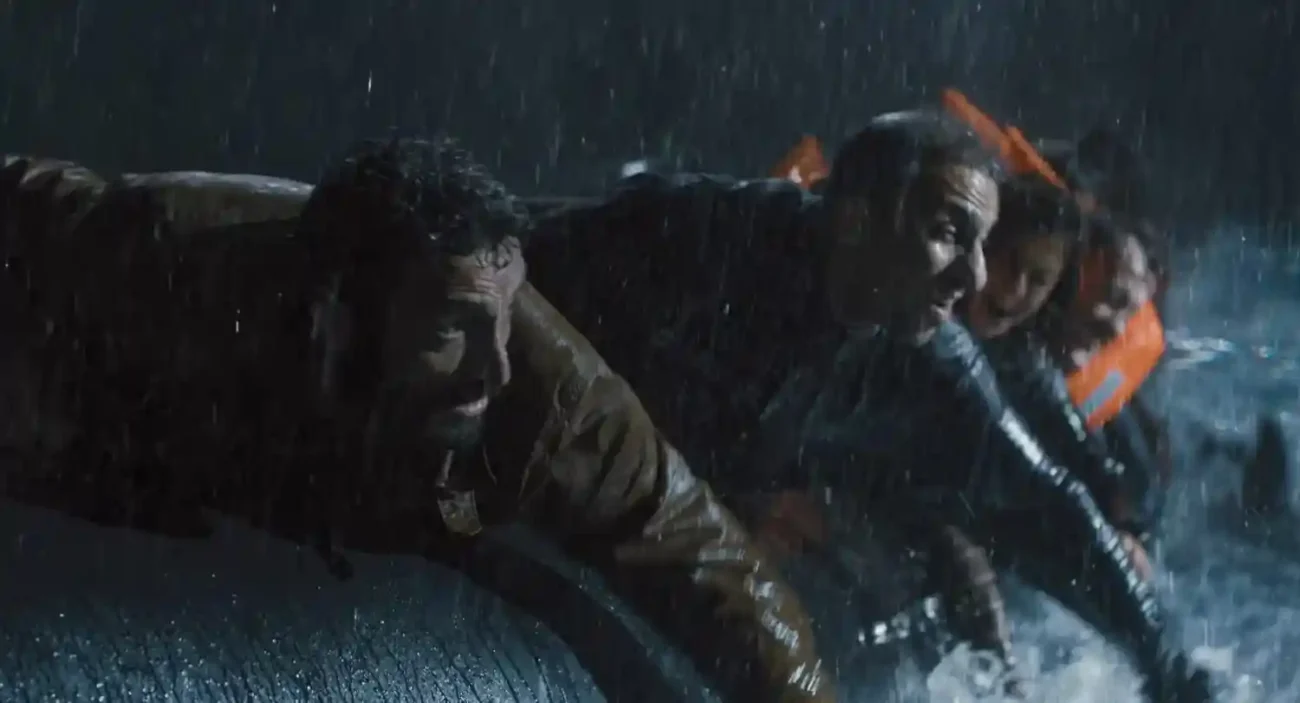
Scholars have recently argued convincingly that a three-page passage in Sir Thomas More (written sometime between 1591 and 1593) can be traced back to William Shakespeare himself. If that attribution holds, it suggests something quietly radical about the Bard: a deep, almost startling empathy for immigrants, or “strangers,” as they were called then. At the very least, it shows a writer capable of imagining displacement not as an abstraction but as a lived terror. I Was a Stranger, a five-part neorealist drama set during the height of the Syrian civil war in 2015, opens by invoking that idea directly. The film begins with Shakespeare’s fiery plea to an angry mob, urging them to picture themselves as exiles children clinging to their backs, their lives reduced to whatever they can carry. The question hangs in the air, as it did four centuries ago: if you were forced to flee, would you expect mercy, or would you be met with fists and fire?
Writer-director Brandt Andersen clearly believes in that question. His intentions are sincere, his politics worn openly on his sleeve. And yet, the decision to foreground the film with Shakespeare’s long-lost words feels less like a grounding principle than a warning flare. From the outset, I Was a Stranger is framed through a distinctly Western lens, one that never quite disappears. At just 97 minutes and told in fractured, Pulp Fiction style chronology, the film arrives pre-packaged for the festival circuit urgent, portable, and emotionally declarative. You can almost sense the Q&A sessions baked into its structure.
It’s a curious strategy. In certain respects, Andersen’s film calls to mind Agnieszka Holland’s Green Border, which chronicled the brutal realities facing Ukrainian refugees at the Polish frontier. But where Holland commits to a single narrative thread, allowing us to stay close to feel the exhaustion, fear, and grinding uncertainty of displacement Andersen keeps shifting his focus. No perspective is allowed to breathe for more than fifteen minutes. The result is distance. Instead of intimacy, we’re left observing, always just outside the emotional perimeter.
The film is told in reverse order, opening in Chicago in April 2023. A slow, conspicuous crane shot glides toward Trump Tower an image heavy with implication before moving us into a hospital where Dr. Amira Homsi (played by Yasmine Al Massri, excellent as always) is beginning her shift. There’s a quiet, almost eerie beat as she realizes it’s her birthday, as though the day itself has caught her off guard. Then the film snaps back to Aleppo in 2015, and the calm vanishes. Amira is running an emergency room under siege, treating a teenage boy who’s bleeding out while simultaneously tending to a soldier wounded by gunfire. The soldier levels a gun at her and snarls that saving “the enemy” makes her one too. Outside, bombs fall with terrifying regularity, the walls trembling as if they might give way at any second. You can feel the chaos pressing in from all sides.
Against the odds, Amira survives her shift and returns home, where her family is gathered for a birthday celebration. The relief is fleeting. A bomb crashes through the living room ceiling, obliterating any sense of safety. Amira and her daughter, Rasha (Massa Daoud), live. The rest of the family does not. Soon, the two are crammed into the trunk of a car, hurtling toward an uncertain escape route, smuggled out of a city collapsing in on itself.
The film then pivots to Mustafa (Yahya Nagayni), the same soldier who threatened Amira in the ER. He is the son of a legendary resistance fighter, though how he ended up serving Bashar al-Assad is left frustratingly opaque. Mustafa appears steady, almost numb, until he witnesses his commanding officer execute children at point-blank range. He faces a moral crossroads: help Amira escape, or kill his superior. It’s a potentially powerful moment one that might have anchored the film emotionally but Andersen cuts away before the choice is made, as he does repeatedly throughout the movie.
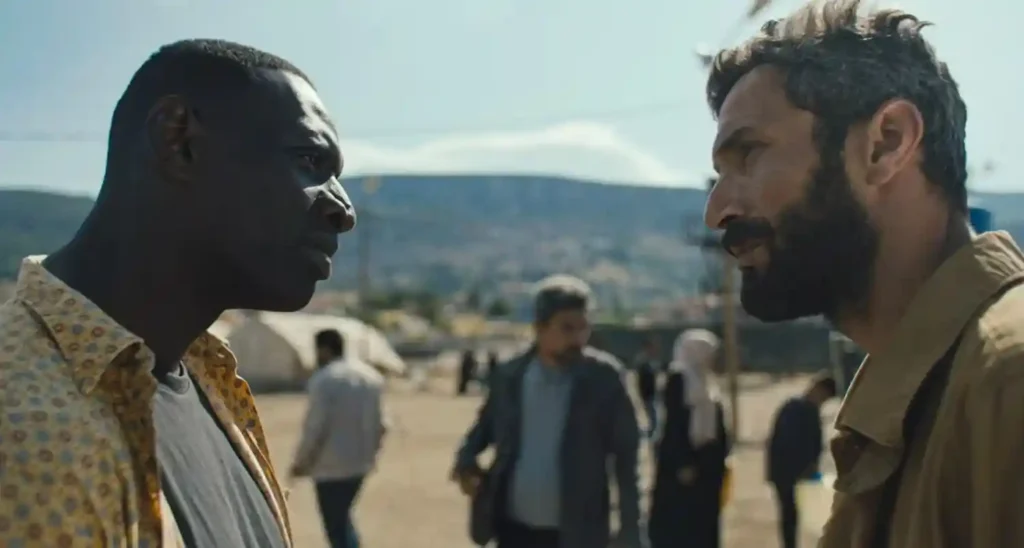
Then there’s Marwan, played by Omar Sy, the most baffling figure in the film. Sy is the production’s biggest name, and his performance oscillates wildly. In some scenes, Marwan is a near-caricature of villainy, exploiting desperate migrants with ruthless efficiency. In others, he’s tender and soft-spoken, caring for his sick son Yusuf (Baeyen Hoffman) as they dream together about eating deep-dish pizza in Chicago. Complexity is one thing; incoherence is another. Marwan and Yusuf are both French, living in Turkey, yet they speak English, and the film never quite explains why. It’s hard not to notice how artificial it feels, as though realism has been sacrificed for accessibility.
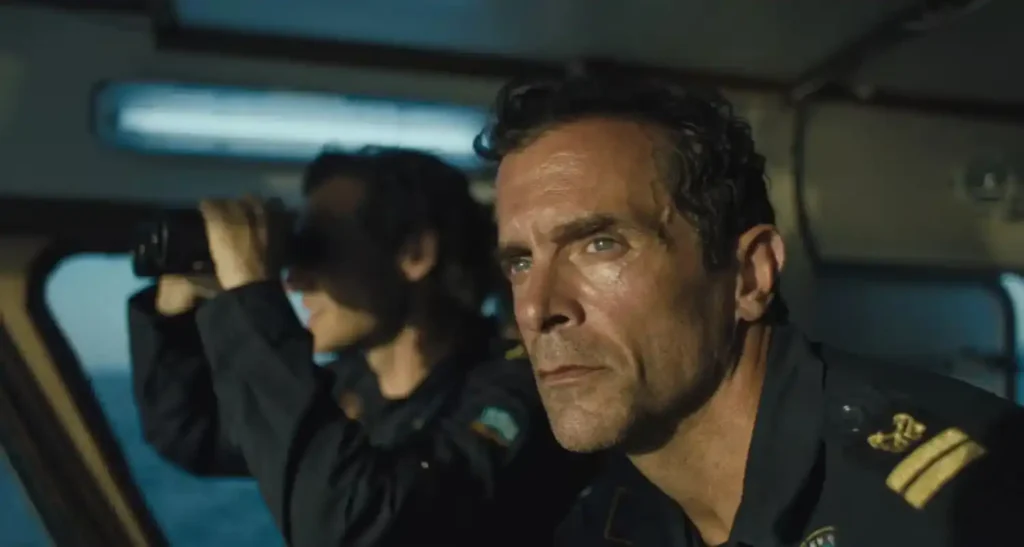
Next comes Fathi (Ziad Bakri), Amira’s brother, whose journey unfolds aboard a lifeboat organized by Marwan. This is the shortest section of the film and, strangely, the most disposable. It offers little insight and disappears almost as soon as it arrives. From there, Andersen takes us to Greece, where Captain Stavros (Constantine Markoulakis) leads a relentless rescue operation, pulling migrants from the sea day after day. Stavros is exhausted but resolute, determined to save as many lives as possible. Yet one scene curdles that heroism: Stavros, his colleagues, and even his family keep a running tally of the people he’s rescued, congratulating themselves with a performative modesty that rings hollow. It plays uncomfortably like white saviorism unfolding in real time.
Andersen’s commitment to immigrant rights is genuine and longstanding. He has flown aid into Gaza himself, run filmmaking workshops for displaced people across the globe, and founded REEL, an organization that helps immigrants process their experiences through art. This isn’t the work of someone parachuting into unfamiliar territory. Still, the film feels strangely empty. The characters are thinly sketched, and more troubling is the movie’s refusal to contextualize the conflict it depicts. By avoiding specifics, it risks reducing Middle Eastern violence to a vague, interchangeable backdrop something “over there,” rather than a crisis shaped by identifiable forces and decisions.
At its strongest, I Was a Stranger captures the raw desperation of migration in ways that complicate the lazy, dehumanizing narratives pushed by the far right. But too often, it slides into trauma porn, lingering on suffering without digging deeper. You can imagine a well-heeled audience member leaving the theater feeling morally cleansed, satisfied simply for having cared for two hours. The film never seriously interrogates the systems or power structures that fuel the migrant crisis, nor does it fully invite us into the inner lives of its characters their contradictions, their private fears, their fragile hopes.
As a piece of action-driven cinema, the film is competent, occasionally gripping. But it’s hard to escape the sense that the story Andersen wants to tell deserves more than momentum and spectacle. These lives are not set pieces. They are not metaphors. And turning them into entertainment, however well-intentioned, feels like a compromise the film never quite justifies.
I Was a Stranger – Parents Guide
Violence & Intensity: Violence is central to the film’s reality, even when it isn’t stylized as spectacle. Much of it unfolds in war-torn Syria, where bombs fall close enough to rattle walls and nerves alike. Hospitals are overwhelmed, gunfire is routine, and civilians’ children included are placed in immediate danger. You see blood. You see bodies. You see injuries that don’t resolve neatly before the next crisis arrives.Some of the most disturbing moments involve moral violence rather than physical force: a soldier threatening a doctor at gunpoint for treating the “wrong” patient; authority figures making life-and-death decisions with chilling detachment; children killed or imperiled as collateral damage. These scenes aren’t gratuitous, but they are direct, and they linger in the mind. You can feel the pressure of constant fear, the sense that safety is always provisional. Sensitive viewers, especially younger teens, may find the cumulative effect overwhelming.
Language: Overall profanity is limited, but when language cuts, it cuts sharply. There is at least one racial slur used in a hostile context, meant to reflect real-world bigotry rather than provoke shock. The tone of much of the dialogue especially in moments of conflict is aggressive, despairing, or emotionally raw. Characters speak from stress, anger, and grief, not from a place of composure. Parents should be aware that while the language isn’t frequent, it carries weight.
Sexual Content / Nudity: There is no explicit sexual content in I Was a Stranger. No nudity, no sexualized behavior, and no romantic scenes meant to titillate or distract from the film’s central concerns. The focus remains firmly on survival, family, and displacement. Any references to relationships are contextual and understated.
Drugs, Alcohol & Smoking: Smoking appears intermittently, often as a coping mechanism for stress or exhaustion rather than a glamorized habit. There is little emphasis on alcohol or drugs, and no scenes of substance abuse. Still, the presence of smoking is noticeable and may be worth flagging for parents of younger viewers.
Age Recommendations: Although rated PG-13, I Was a Stranger is best suited for older teens and adults. The themes war, forced migration, moral compromise, systemic violence require emotional maturity to process. Younger teens may struggle not only with the intensity of the images but with the film’s bleak worldview and unresolved ethical questions.
For families interested in watching together, this film may work best as a guided viewing experience, followed by conversation. It raises important issues about refugees, empathy, and global responsibility, but it does so without cushioning the blow. This is not a movie that reassures; it challenges. And parents should be prepared for the questions and emotions it may stir long after the screen goes dark.
Highly Recommended:

Stephanie Heitman is a seasoned journalist and author dedicated to helping parents navigate the world of Hollywood entertainment through thoughtful, family-oriented film reviews. With over a decade of experience in writing and a passion for fostering safe, enriching viewing experiences, Stephanie launched Parentguiding.com to provide parents with the insights they need to make informed choices for their families.