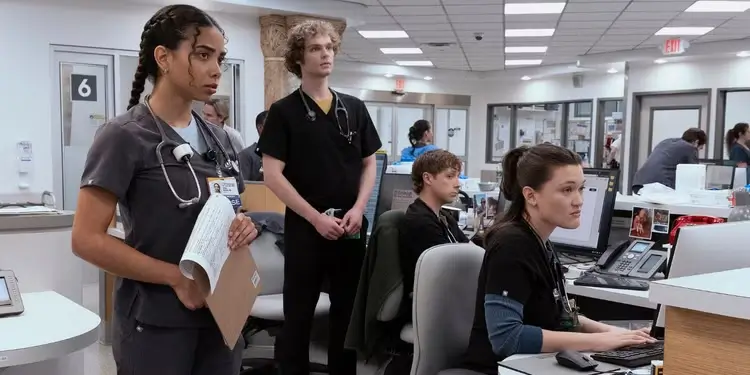
The people who put HBO’s The Pitt together almost certainly believed in what they were making. Still, it’s hard to imagine even they anticipated just how forcefully the series would land, emerging as one of the standout television achievements of 2025. What the show ultimately proves is something both reassuring and quietly radical: the medical drama isn’t exhausted at all. It simply needed to be treated with respect. By approaching medicine as a lived profession rather than a backdrop for glossy melodrama, The Pitt finds a direct line to viewers’ empathy and intelligence.
Anchored by what may be Noah Wyle’s finest work to date a performance that didn’t just earn awards but genuinely deserved them the first season arrived in January 2025 with an almost eerie sense of timing. It drew power from still-raw memories of COVID, the unshakable dread of mass shootings, and a country’s ongoing anxiety about healthcare itself. Its real structural gambit, though, was just as important: 15 relentless hours inside a Pittsburgh hospital, unfolding in near real time. As Wyle guided a strikingly strong ensemble through that crucible, the show gathered momentum episode by episode, until it became something people talked about with urgency. By the time the Emmys rolled around months later honoring it as Best Drama, along with wins for Actor and Supporting Actress the verdict felt inevitable rather than inflated. The real test, of course, was what came next. And so far, the second season hasn’t slipped even slightly.
Season two takes place on a day that feels almost cruelly appropriate for a trauma center: the Fourth of July. Fireworks outside, chaos inside. Dr. Robby (Wyle) walks into the Pittsburgh Trauma Medical Center for what’s supposed to be his final shift before a long sabbatical, a notion his colleagues greet with thinly veiled skepticism. Robby stepping away from work feels like imagining gravity taking a break. One of the smartest creative decisions here is that creator R. Scott Gemmill and his team resist the temptation to simply repeat themselves. Season one’s portrait of Robby a fundamentally brave man barely containing a lifetime of accumulated trauma as it finally threatened to spill over was among the most emotionally devastating character studies television has offered in years. Trauma hasn’t vanished in season two. Some of it lingers directly from last year, including echoes of the mass shooting. But it no longer defines everything, especially not Robby’s trajectory. It couldn’t. A story like that only works once.
One thread that does carry over cleanly and pointedly involves Dr. Langdon (Patrick Ball). Robby’s discovery of Langdon’s drug use last season ended with Langdon being expelled from the hospital, an act Robby treated as moral necessity rather than personal betrayal. Now it’s a holiday, and Langdon is back for the first time since then. He’s spent ten months in rehab. He’s made apologies. Most of the staff seems ready, or at least willing, to let him try again. Robby, however, is not most people. He is deeply principled to the point of rigidity, especially when it comes to stealing medication from patients. Whether Langdon can ever earn Robby’s trust again — or whether Robby is even capable of granting it becomes one of the season’s central tensions, and it’s handled with the kind of moral seriousness the show thrives on.
The rest of the ensemble, impressively, feels even more fully inhabited this time around. Many return carrying invisible weight from season one unresolved cases, emotional residue even as they plunge into new emergencies. Dr. Evans (Katherine LaNasa) remains the quiet backbone of the hospital, and LaNasa’s performance is invaluable. There’s a hard-earned authority to her confidence, but also a refusal to let years of exposure to trauma hollow her out. She’s seen everything, yes, but she still sees people.
Nearly everyone comes back Tracy Ifeachor’s Dr. Collins being the notable absence and the writers wisely allow these characters to advance naturally along the arc of experience and competence. They trust that the audience has grown attached to these doctors and trainees, which means the show can reference past lives without pausing to explain them. Mentions of Dr. King’s sister or Dr. Javadi’s mother slip by like shared memories, not exposition. It’s striking how quickly The Pitt has achieved the texture of a long-running series. And when the season introduces its one major new presence, Dr. Baran Al-Hashimi, the impact is immediate. Sepideh Moafi gives a performance so assured and layered it already ranks among the year’s best, adding both tension and gravity to the ensemble.
All of this only works because the writing and acting make you believe these people existed during the gap between seasons that Dr. Mohan (Supriya Ganesh), Dr. McKay (Fiona Dourif), Dr. Santos (Isa Briones), and Dr. Whitaker (Gerran Howell) didn’t blink out of existence when the cameras stopped rolling. That might sound like a small thing, but it’s essential. When you feel the characters live beyond the plot, the show’s emotional blows land as earned rather than engineered. These doctors aren’t chess pieces moved around to service drama. They feel like professionals with interior lives, which makes every success and failure resonate more deeply.
The patients, too, are handled with the same balance as before. The series alternates between sprawling, multi-episode cases and smaller crises that resolve within a single hour. Among the longer arcs are some genuine heartbreakers, many built around an experience most of us recognize all too well: you go to the doctor for something that seems manageable, maybe even routine, and suddenly the floor drops out. A man learns he has a tumor. A woman fights a devastating leg infection. You can feel how quickly ordinary life collapses under that kind of news.
While The Pitt often earns praise for its medical accuracy, what stands out just as strongly is its emotional precision. Even to a non-doctor, the human detail is unmistakable. Every episode contains small, piercing moments brief exchanges shaped by fear, hope, desperation, or grace. There’s a scene where former spouses are reunited under the shadow of a possible brain tumor, and the ex-husband, a man who likely hasn’t offered kindness in years, quietly tells his former partner, “You deserve to be happy.” It’s not flashy. It’s devastating. The show understands how hospitals strip away defenses, how they reorder priorities, how they can force people into honesty they didn’t know they still had.
The series also captures, with unnerving clarity, how terrifying an emergency room can be — for everyone involved. A dull ache becomes a life-threatening emergency. A patient fails to respond. Alarms erupt. Doctors are required to override fear and move faster than instinct allows. As the season progresses, the writers build toward at least two major events on this Fourth of July, moments large enough to reshape multiple episodes, much like last season’s shooting. Because only nine of the season’s fifteen episodes were made available for review, it’s impossible to judge how fully those arcs resolve. But having now seen twenty-four episodes across both seasons, there’s reason to trust the show’s discipline and compassion. It feels like a series that knows exactly where it’s going and why. One can only hope it continues for a long time.
Nine episodes were screened for review. The Pitt premieres on HBO Max on January 8, 2026.
The Pitt Parents Guide
As for suitability, The Pitt carries a TV-MA rating, and it earns it.
The intensity of its medical emergencies, depictions of injury and crisis, strong language, references to substance abuse, and emotionally heavy subject matter make it firmly adult viewing.
Violence is largely contextual and medical but often graphic.
Profanity reflects the high-stress environment.
Sexual content is minimal but mature. Drug and alcohol issues are addressed directly and seriously.
This is a show best suited for older teens and adults not because it seeks to shock, but because it refuses to soften the reality it portrays.
Highly Recommended:

Stephanie Heitman is a seasoned journalist and author dedicated to helping parents navigate the world of Hollywood entertainment through thoughtful, family-oriented film reviews. With over a decade of experience in writing and a passion for fostering safe, enriching viewing experiences, Stephanie launched Parentguiding.com to provide parents with the insights they need to make informed choices for their families.