The Great Flood is rated TV-MA (due to intense disaster sequences, violence, and mature thematic content).
The Great Flood wears the familiar mask of a traditional disaster movie. The premise is straightforward: a global cataclysm sets the stage for high-stakes survival, as relentless tsunamis and rising waters chase a handful of characters through the claustrophobic verticality of a Seoul apartment complex. Writer-director Byung-woo Kim clearly knows the playbook of the genre he’s channeling the thrills and tension of past hits, and the film delivers a few genuinely inventive survival sequences.
But The Great Flood isn’t content with simply pushing heart rates or staging planetary-scale fear. Beneath its watery chaos, Kim is trying to explore something more ambitious, though the screenplay sometimes feels burdened by its own ambitions, tacking on narrative extensions that strain the core of the story. Still, the film maintains momentum through committed performances and a director eager to probe what our technological future might look like under extreme pressure. By the hour mark, however, the film makes a persuasive argument for restraint: sometimes, spectacle doesn’t need to be this knotty to land.
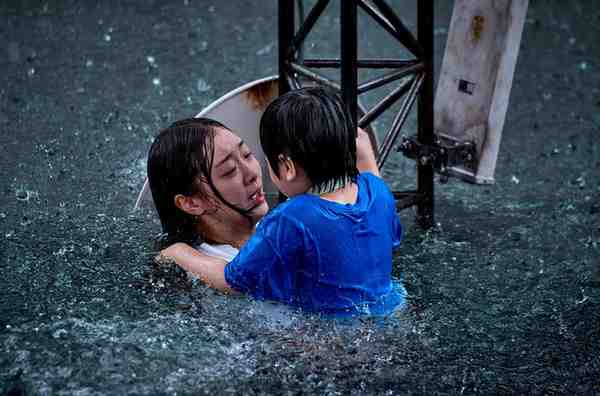
The story centers on An-na (Kim Da-mi), an overworked mother whose morning routine with her young son, Ja-in (Kwon Eun-sung), is disrupted by the sudden onset of torrential rain. The initial flooding seems almost mundane, easily ignored but the threat grows swiftly, forcing An-na to carry Ja-in through a building that has become a vertical battleground. As panic rises and the water climbs, the narrative becomes as much about parenthood and moral courage as it is about physical survival. Along the way, An-na encounters a spectrum of neighbors each grappling with their own emergencies. Into this chaos steps Hee-jo (Park Hae-soo), a security professional from the Darwin Center. Hee-jo is charged with escorting An-na to safety and safeguarding an AI researcher whose work on the so-called “Emotion Engine” promises a radical reimagining of humanity itself. The stakes are cosmic, yet grounded in the intimate, desperate choices of people trapped between water and fate.
Highly Recommended: Ballerina 2024 Parents Guide
Early sequences root us firmly in An-na’s domestic reality. We see her negotiating the small but exacting demands of motherhood, from Ja-in’s whims to ordinary morning routines. And then the city becomes unrecognizable: what began as a storm escalates into an apocalyptic deluge. Kim’s direction emphasizes the immediacy of danger the water isn’t a distant threat, it’s physical, aggressive, insistent. The screenplay doesn’t linger in mystery about the source of this catastrophe, eventually revealing the planetary crisis behind it, but the early tension is almost exclusively about survival: An-na on the move, Ja-in on her back, stairwell after stairwell, floor after floor, with neighbors clinging to life beside her.
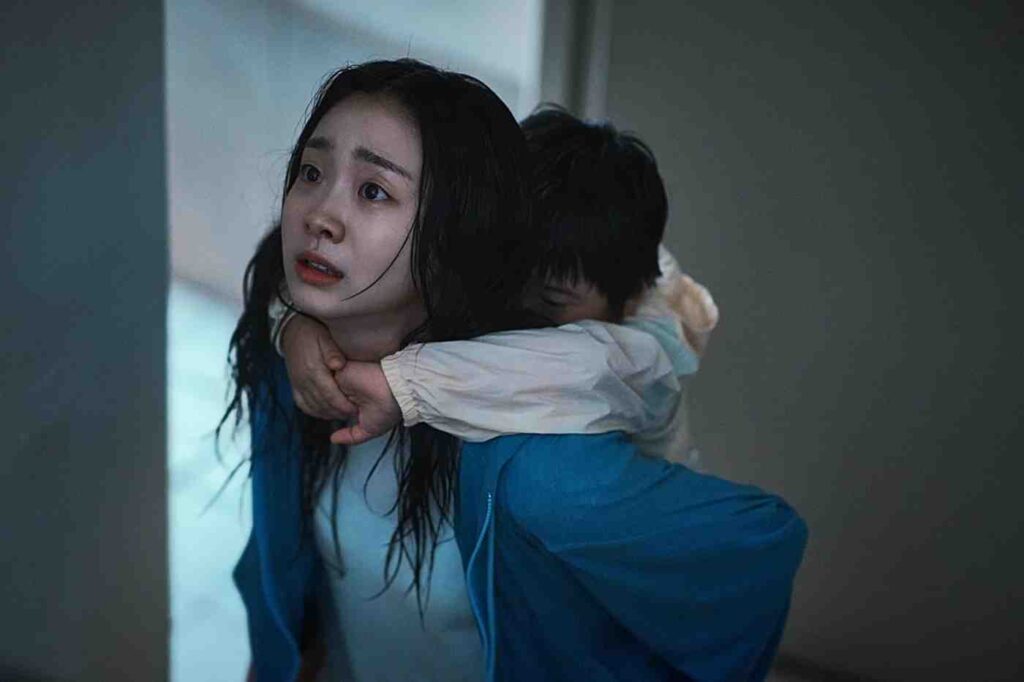
For nearly fifty minutes, the film is a relentless, almost vertiginous experience. An-na’s climb becomes both literal and metaphorical, a test of endurance, ingenuity, and maternal devotion. The tsunamis are as much a narrative force as the human characters, undoing progress with each surge. Hee-jo’s arrival introduces the familiar trope of a competent protector with a plan, a gun, and a helicopter waiting at the roof. Yet Kim also allows space for quieter, stranger human moments amid the flood. A pregnant woman labors and gives birth under impossible circumstances. An elderly couple is immobilized by their frailty. Men opportunistically exploit the chaos, introducing tension that feels as raw and immediate as the rising water. Even Ja-in’s insistence on a bathroom break brief, comic, undeniably human reminds us that survival in cinema is never just a series of set pieces; it’s punctuated by the minor absurdities of life that persist even in the end times.
Highly Recommended: Imaginary 2024 Parents Guide
Visually, the film succeeds in conveying both scope and peril. The effects are sturdy, the set pieces often thrilling, and there is genuine fun in the chaos of people fighting both water and each other. Yet as the narrative unfolds, Kim’s ambitions begin to push the story into more cerebral terrain. An-na’s role expands in unexpected ways after her superior dies, thrusting her into a responsibility for the continuity of humanity itself. The Great Flood veers into conceptual territory, flirting with philosophical questions, genre-bending flourishes, and cinematic homages. It’s bold, and there’s something to admire in that ambition. But the transition from adrenaline-driven disaster to speculative reflection is uneven. The puzzle-like layering of plot elements doesn’t quite match the visceral thrill of the flood sequences, and the film occasionally loses the narrative clarity that made its early tension so compelling.
Ultimately, The Great Flood is a movie of contrasts. Its best moments are kinetic, immediate, and terrifyingly tangible An-na sprinting up a waterlogged stairwell, a wave smashing through a glass window, human courage colliding with elemental force. Its more meditative, philosophical detours are intriguing but less effective, reminding us that sometimes the simplest spectacle characters against disaster, choices against the clock can resonate more powerfully than sprawling conceptual ambition. There’s a sense throughout that Kim wants to do it all: thrill, ponder, and provoke. And while the result is uneven, it’s never uninteresting. You can feel the director’s care for his characters, his fascination with technology, and his desire to ask what humanity really means in a world that seems increasingly uncontainable. It’s messy, audacious, and occasionally overstuffed but it’s also, in its own way, profoundly alive.
Detailed Content Breakdown for Parents

Violence & Intensity: The movie features frequent perilous situations, including fast-rising floodwaters, collapsing floors, and chaotic stairwell escapes. There are a few scenes of human-on-human aggression, such as looting and intimidation during the disaster. While there’s no graphic gore, the intensity is high, and danger feels very real your child might feel tense or anxious during these sequences.
Language: Mild to moderate profanity is scattered throughout. No racial slurs or hate speech are prominent, but the tone is often urgent and panicked, reflecting the stress of survival situations.
Sexual Content / Nudity: There is minimal sexual content, with no nudity. A pregnant character gives birth during the flood, which is handled in a tense but non-explicit manner.
Drugs, Alcohol & Smoking: There’s no depiction of recreational drugs or smoking. Characters may drink water or other basic beverages, but nothing stands out as drug- or alcohol-related content.
Recommended Age Range: Teenagers (14+) will be best equipped to handle the tension and dramatic intensity. Parents may want to preview for younger teens or sensitive viewers

Matthew Creith is a movie and TV critic based in Denver, Colorado. He’s a member of the Critics Choice Association and GALECA: The Society of LGBTQ Entertainment Critics. He can be found on Twitter: @matthew_creith or Instagram: matineewithmatt. He graduated with a BA in Media, Theory and Criticism from California State University, Northridge. Since then, he’s covered a wide range of movies and TV shows, as well as film festivals like SXSW and TIFF.