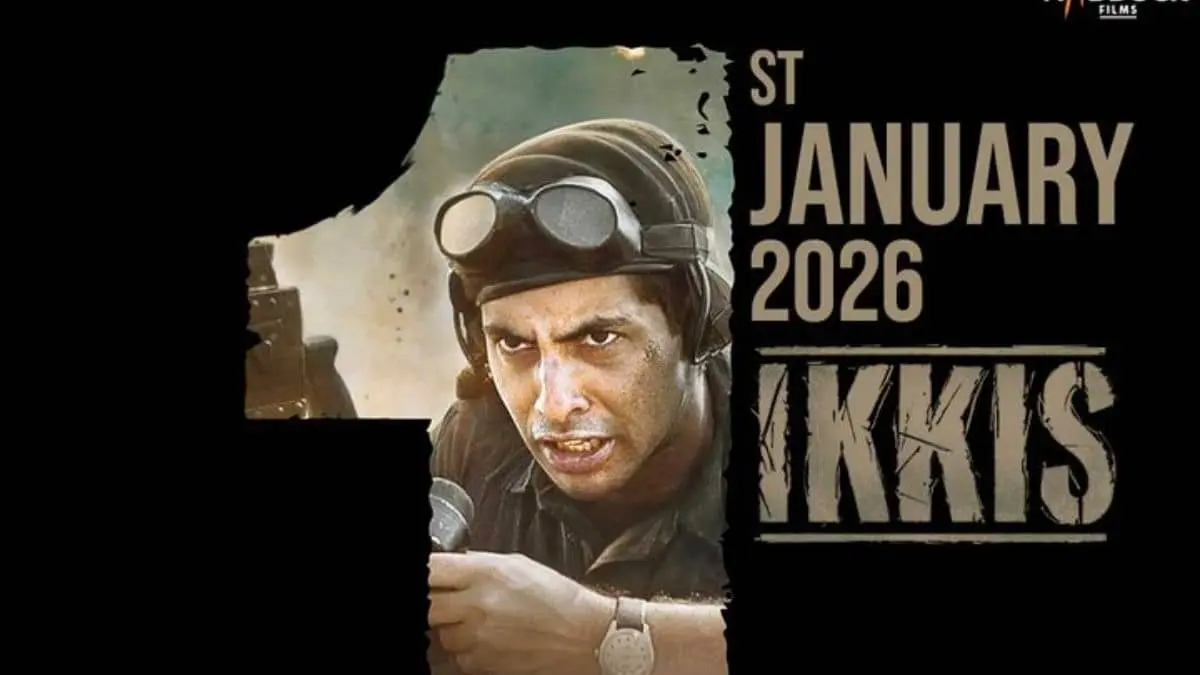
There’s a peculiar hush at the start of Ikkis, a stillness that seems to settle over the screen like dust in sunlight, long before the first battle roars to life. It’s a quiet that carries weight the gravity of history, the burden of duty, the looming sense that this story is not just about action but about the lives it inhabits. Sriram Raghavan, a filmmaker whose command of tension and character is unmistakable, approaches the tale of Second Lieutenant Arun Khetarpal with a rare reverence. This is a war story, yes, but it is one that refuses to let spectacle overshadow the human cost. It is both sweeping in ambition and intimate in emotional focus, and that balance delicate and demanding is where the film stakes its claim.
At the heart of this narrative is Agastya Nanda, who steps into Khetarpal’s shoes with a mixture of youthful zeal and quiet fragility. You can feel the weight of the role pressing down on him, not only as a biographical challenge but as a statement of personal ambition a first lead that carries the double burden of legacy and expectation. There’s tension in every glance, a kind of nervous energy that breathes life into scenes that could have otherwise drifted into reverence or abstraction. Watching him, you sense a young man testing himself against history itself.
Highly Recommended: Sirai (2025) Parents Guide
The story CENTRE with Arun’s early years, his training, his eagerness, the camaraderie of cadets forging themselves in discipline. Raghavan lingers on these moments with care, allowing the audience to inhabit the rhythms of preparation and anticipation. You watch Arun clench his jaw, feel his determination, and it lands as something deeply human an earnest resolve that does not need to shout to be felt. The narrative moves with a measured patience, letting character and context breathe before the inevitable heat of war consumes the frame.
When the film shifts to the 1971 Indo-Pak war, the rhythm changes. The Basantar front is rendered in a palette of dust and sun, in sounds that cut and reverberate artillery, engines, the soft rattle of tension in the air. Khetarpal’s legendary engagement, his refusal to yield even as his own tank is struck, his destruction of enemy armor, is presented with a stark clarity that leaves the viewer breathless. These sequences are not spectacle for spectacle’s sake; they are calibrated, visceral, a study in courage under relentless pressure. You can almost feel the vibration of the ground beneath the treads, the tremor in the air as choices are made that mean life or death.
Yet what distinguishes Ikkis is not only its battlefield realism but its quieter, more reflective moments. There’s a scene in which Arun speaks to his mother before heading to the front. Her words simple, unwavering are not fear-laden, but a gentle insistence on courage: “Fight with the courage of a lion.” It’s a line that could have felt saccharine in lesser hands, but here it resonates because it anchors the story in human truth. Raghavan allows these moments to linger, to remind the audience that war is as much about inner fortitude as it is about outward action.
Family, both literal and symbolic, threads through the film. The presence of Dharmendra, in what now stands as his final performance, adds a weight that is impossible to ignore. His character functions as a bridge between generations, linking the past and present, the sacrifices endured and the stories that must be remembered. His performance, infused with the poignancy of real-world absence Dharmendra passed before the final cut lends a layer of emotional resonance that lingers long after the frame fades to black. It’s impossible not to notice the film’s meditation on legacy, both familial and cinematic.
Highly Recommended: Teri Baaton Mein Aisa Uljha Jiya 2024 Parents Guide
Skeptics might approach Ikkis with hesitation, questioning casting or the pressures of lineage in Bollywood, and those concerns are not without merit. But the film answers quietly, with clarity: the core of the story Arun’s courage and resolve is unassailable. It asks for engagement, empathy, and attention, and it earns them. You are not just watching history; you are inhabiting it, moment by moment, heart by heart.
Visually, Raghavan avoids the temptation to dazzle with excess. The battle sequences are sharp, judicious, almost surgical in their intensity, demanding presence rather than awe. In contrast, the quieter interludes a shared cigarette among comrades, a letter home, a brief moment of laughter or fear are imbued with texture and truth. The film’s rhythm, its alternation between tension and repose, underscores the central lesson: the heart of a war story is not in explosions, but in the spaces between them.
When the credits finally roll, it is not triumph or grief that lingers most insistently, but reflection. Ikkis refuses easy resolution; it doesn’t deliver catharsis, it delivers resonance. It reminds the audience, beautifully and painfully, that heroism is less about invincibility than the conscious choice to stand, to act, to face fear without flinching.
Highly Recommended: Malaikottai Vaaliban 2024 Parents Guide
In the end, Ikkis is more than a war film. It is a meditation on courage, legacy, and human fragility. It is cinema that asks for your empathy and commands your attention not because it simplifies or romanticizes, but because it respects both the enormity of its subject and the quiet heartbeat at its center.
Detailed Content Breakdown for Parents
Violence & Intensity: Ikkis is firmly rooted in a real war, there are battle scenes, explosions, tanks, and depictions of combat. These aren’t cartoonish or glamorized they carry a sense of danger and realism. Expect the kind of visceral wartime intensity that might be unsettling for younger children: shots of wounded soldiers, mines, heavy gunfire, and emotional losses. This isn’t horror, but it’s unequivocally war. The tension is deliberate, not sensational it’s meant to help the audience understand the stakes and bravery involved.
Language: from trailers and early descriptions, Ikkis seems to use naturalistic military dialogue rather than crude or gratuitous profanity. Any stronger language would likely be in the context of stress or battlefield urgency, not casual swear words.
Sexual Content / Nudity: There are no indications of sexual content or nudity in the film’s official promotion or synopsis. The focus remains on the military story, camaraderie, and personal sacrifice rather than romantic or sexual storylines.
Drugs, Alcohol & Smoking: The movie suggests any significant focus on drug use. Some characters may smoke or drink lightly in off‑duty moments, which is common in depictions of soldiers, but it isn’t highlighted as a major theme.
Recommended Age Range: Ages 13+ feels like the sweet spot for this film. Teens and adults are more likely to handle the intensity and appreciate the historical and emotional layers. Younger kids might be overwhelmed by the battle realism and the deeper emotional themes.
Release date: January 1, 2026 (India)

Stephanie Heitman is a seasoned journalist and author dedicated to helping parents navigate the world of Hollywood entertainment through thoughtful, family-oriented film reviews. With over a decade of experience in writing and a passion for fostering safe, enriching viewing experiences, Stephanie launched Parentguiding.com to provide parents with the insights they need to make informed choices for their families.