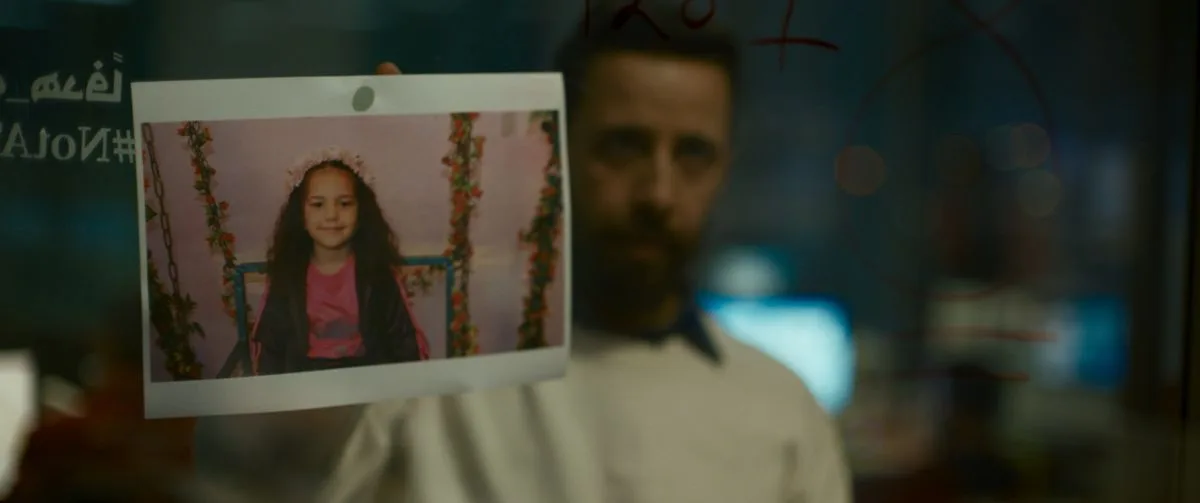
On January 29, 2024, the Israeli Army issued an evacuation order for Tel Al-Hawa, a neighborhood in Gaza. What followed that day is almost unbearable to recount, even now. Six members of the Hamadeh family were traveling by car with their six-year-old niece, Hind Rajab, when Israeli gunfire tore into the vehicle. Five people were killed instantly. Somehow, impossibly, a fifteen-year-old girl named Layan survived long enough to place a call to the Palestinian Red Crescent Society. Her voice panicked, wounded, fading reached the other end of the line before she, too, died. When the call ended, Hind was left alone in the car. She was six years old, surrounded by the bodies of her family, clutching a cellphone with unreliable reception. That phone became the only fragile thread connecting her to the world beyond the wreckage.
Kaouther Ben Hania’s The Voice of Hind Rajab takes this unbearable reality and transforms it into something quietly devastating: a docudrama built almost entirely around those phone calls between Hind and the Red Crescent workers trying, against impossible odds, to save her life. Ben Hania, whose previous films The Man Who Sold His Skin and Four Daughters both earned Oscar nominations, premiered the film at the 82nd Venice International Film Festival, where it won the Grand Jury Prize. It arrives amid a striking wave of Palestinian cinema receiving international recognition this year Annemarie Jacir’s historical epic Palestine 36 at TIFF, Cherien Dabis’ multigenerational tragedy All That’s Left of You at Sundance, and Sepideh Farsi’s deeply intimate documentary Put Your Soul on Your Hand and Walk at Cannes.
Highly Re commended: Fallout’ Season 2 Parents Guide
Jacir and Dabis look backward, excavating history long denied a Palestinian point of view. Palestine 36 unfolds during the Arab revolt against British colonial rule between 1936 and 1939, while All That’s Left of You traces three generations through the Nakba, the 1967 occupation, and the First Intifada. These films reclaim the past, insisting it be remembered accurately, fully. Farsi’s film, by contrast, stays with the present tense. Her year-long filmed friendship with photojournalist Fatma Hassona during the current assault on Gaza becomes a living record made even more harrowing by the fact that Hassona was killed by Israeli forces just one day after the film was accepted into Cannes.
What unites these works is their reliance on archives some inherited through oral history, others preserved in songs, photographs, films, newspapers, and family memory. Many of these records have been erased or destroyed over decades, yet they persist as proof of presence, endurance, humanity. Farsi, in filming Hassona, inadvertently created an archive of her friend’s life: her images, her voice, her relationships, even her recollections of family. It’s at this intersection where preservation itself becomes an artistic act that The Voice of Hind Rajab finds its emotional core.
Ben Hania frames the film in an ultra-wide aspect ratio and uses spectrogram visuals to render Hind’s voice visible, allowing her small, tremulous sound to stretch across the screen. At times, it feels as though her voice fills the room, hovering over everything. The wide frame also accommodates the Red Crescent workers Rana (Saja Kilani), gentle and attentive; Omar (Motaz Malhees), animated and urgent; Mahdi (Amer Hlehel), procedural and composed; and Nisreen (Clara Khoury), whose calm becomes its own lifeline as they share the space, working together in real time. With one exception, where Ben Hania subtly incorporates actual footage from the Red Crescent office posted on social media, the film stays grounded in classical dramatic form.
Highly Re commended: Avatar: Fire and Ash Parents Guide
Close-ups dominate. Faces register fear, frustration, restraint, exhaustion. We watch them listen to Hind, talk to her, reassure her, and then steel themselves to navigate the bureaucratic maze that governs rescue efforts in restricted zones. The film unfolds like a chamber drama: a single location, a handful of people, and a voice on the line that keeps cutting in and out sometimes because of weak reception, sometimes because the Israeli Army jams the signal.
Keeping the camera inside the office proves to be a devastating choice. Ben Hania refuses to turn Hind’s terror or death into spectacle. Much as Farsi keeps Hassona’s face centered in her film, resisting sensationalism, Ben Hania leaves the violence offscreen. We hear it instead gunfire cracking through the phone, distant explosions bleeding into the calls. There’s nothing here to scroll past, no images to mute or avert your eyes from. Just Hind’s voice, and the strained, helpless faces of the people trying to reach her. Like the aid workers, you are forced to stay present. To listen. To witness. To sit with a child as she asks, again and again, to be saved.
This structure also exposes, with sickening clarity, the machinery that delays rescue until rescue becomes impossible. Hind’s car was only eight minutes from the nearest Red Crescent ambulance. Eight minutes. Yet, as Mahdi insists they must follow protocol “to the letter,” three hours pass while permissions are sought first through the Red Cross, then the Ministry of Health, and finally the Israeli Army itself, whose approval is required to actually use the designated route. Watching this unfold, administrative violence stops being an abstract phrase. It becomes visceral. Each minute that ticks by feels as cruel as a bullet. Ben Hania doesn’t need to place the camera inside the car; the horror is already fully visible.
Highly Recommended: Little Disasters Parents Guide
The film also quietly dismantles the notion that there exists a “correct” way to navigate the bureaucratic labyrinth of occupation that if only procedures are followed properly, lives will be spared. The fate of Hind, and of the two ambulance workers, Youssef Zeino and Ahmed Madhoun, makes that painfully clear.
Midway through the ordeal, the Red Crescent office turns to social media, releasing audio clips and photographs of Hind in hopes that international outrage might pressure authorities into granting that elusive green light. Watching this, you might wonder especially if you don’t already know how the story ends whether the tension risks becoming exploitative. I can’t fully answer that question. I only know what it stirred in me.
It took me back to that day in January. I was at Sundance, juggling screenings for work while following Hind’s story on Instagram, aware that many people around me were sealed inside the festival bubble, oblivious to what was happening an entire world away. That dissonance hasn’t faded. Watching the film now, as awards season looms, it feels just as sharp. There hasn’t been a single day since that I haven’t thought about Hind about the life she never got to live. Ben Hania asks the viewer to do the same: to remember her smile, her voice, her love of the sea. To remember her as a person, not a headline.
That act of remembrance recalls Kamal Aljafari’s With Hasan in Gaza, assembled from MiniDV footage shot during the Second Intifada as Aljafari searched for a former cellmate. In one moment, children on a beach beg him to turn the camera toward them. They want proof they were there. The footage becomes testimony. In much the same way, the recordings of Hind’s phone calls function as an archive not only of her existence, but of the system that allowed her to die alone in a car eight minutes from help.
Hind Rajab’s life ended in martyrdom. The Voice of Hind Rajab is not merely a call to say “never again,” though it is that. More urgently, it asks you to remain with this violence not the spectacle of blood, not the abstraction of statistics, but the lived reality of it. The physical terror. The mental anguish. The administrative cruelty. All inflicted on a child who, like so many others, should still be here.
Detailed Content Breakdown for Parents
Violence & Intensity: No constant action violence, but heavy psychological tension throughout
Threats, coercion, and emotional abuse play a central role Likely includes moments of physical danger or implied violence, Sustained unease rather than jump-scare horror
Language: Strong language likely, including profanity. Tone is often sharp, manipulative, or cruel rather than casual. Language is used to exert power and control
Sexual Content / Nudity: Adult sexual themes expected. Possible sexual manipulation, affairs, or coercive dynamics. Nudity (if present) is likely brief but not romanticized
Drugs, Alcohol & Smoking: Alcohol use likely among adult characters. Drinking may be tied to control, escape, or dysfunction. No indication of glamorized drug use

Stephanie Heitman is a seasoned journalist and author dedicated to helping parents navigate the world of Hollywood entertainment through thoughtful, family-oriented film reviews. With over a decade of experience in writing and a passion for fostering safe, enriching viewing experiences, Stephanie launched Parentguiding.com to provide parents with the insights they need to make informed choices for their families.