Atropia is not rated because it has not undergone the official rating process by the Motion Picture Rating (MPA). Not recommended for younger children (under 13–14).
Wartime comedies that poke holes in the logic and mythology of American militarism have been with us for decades, as have films fascinated by the uneasy overlap between staged performance and actual conflict think of the way Tropic Thunder or Wag the Dog blur those lines for laughs and discomfort in equal measure. Hailey Gates’ Atropia enters that lineage with a premise that feels both inspired and uncomfortably close to home. Its setting is a real military training installation in the California desert, a scrubby, sunbaked expanse just a short drive from Hollywood itself, where American soldiers rehearse war in whatever country the U.S. happens to be occupying at the moment. In 2006, when Gates sets her film, that country is Iraq. Expanding on her 2020 short Shako Mako, Gates spends much of Atropia’s opening act having sharp, dry fun skewering not only the brutality of the American war machine but also the pop-cultural shorthand and lazy visual cues that came to define the War on Terror. You can feel how much she enjoys pricking those inflated myths. It makes it all the more frustrating when the film eventually loses its grip on that sharp focus.
Highly Recommended:Merv (2025) Parents Guide
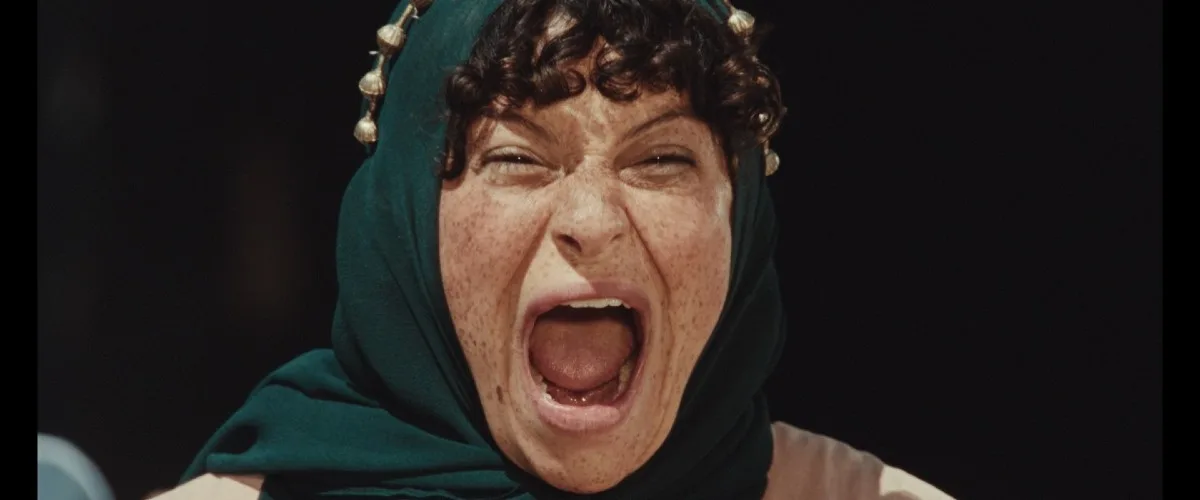
At its strongest, Atropia leans fully into the idea of simulated combat as a way of interrogating the exploitative gaze of war cinema itself. The opening sequence sets the tone beautifully. We’re dropped into a familiar image: soldiers under fire, a devastated Iraqi woman wailing over a mutilated corpse, the kind of scene we’ve seen countless times, even recently in films like Alex Garland’s Warfare. Then the illusion snaps. The woman stops crying, steps out of character, and the whole Orientalist performance collapses in an instant, as if someone offscreen has just yelled “cut.” It’s a smart, bracing gesture one that immediately tells you this film is as interested in the machinery behind these images as it is in the images themselves.
That woman is Fayruz, played by Alia Shawkat, and she’s one of several performers hired to “play Iraqi” inside “The Box,” Atropia’s current war-game setup designed to prepare young recruits for the occupation of Iraq. Fayruz stands apart from most of the other extras for a crucial reason: she actually has Iraqi heritage. We’re told many of the others are Mexican, filling in wherever needed. Her parents are openly unhappy with her participation in what they see as a rehearsal for the invasion of their homeland, but Fayruz, an aspiring actor, convinces herself that this job could be a stepping stone toward real recognition. Shawkat gives her a quietly fascinating interior life, shading every act of generosity toward her fellow performers with a hint of self-interest. You can see it in her irritation toward another extra who starts getting more attention despite not even speaking Arabic. Shawkat lets those contradictions live in her posture and her glances; nothing is overstated, and that restraint pays off.
In these early passages, Atropia feels especially alive, functioning as a mordantly funny critique of Hollywood’s comfort with stereotype and its appetite for sanitized carnage. Gates fills the film with telling details: bombastic orientation videos that whip up patriotic fervor for Atropia’s mission, downtime between scenarios that resembles nothing so much as the aimless bustle of a studio backlot. (“The thing about California,” one character observes with weary irony, “is she can play any part you want.”) The military brass Tim Heidecker and Chloë Sevigny, both amusingly miscast in the best way might as well be casting directors, while special-effects technicians debate which prosthetic limbs will most convincingly stand in for victims of IED blasts. One early sequence even features a sly cameo from a major movie star known for war films, parachuting into this Iraq War LARP to “research” a role. It’s a bit that lands because it exposes how easily real suffering becomes abstract spectacle once it’s filtered through storytelling. The artificiality is the point, and the film’s sharpest laughs come from how earnestly everyone commits to this hollow pageant, all in service of a war that history has already judged harshly.
Highly Recommended:Not Without Hope Parents Guide
Trouble sets in when Gates shifts her attention toward Fayruz’s growing fascination with “Abu Dice,” played by Callum Turner a white American combat veteran who, in a twist that’s initially provocative, is himself pretending to be Iraqi while waiting to be sent back overseas. Their connection starts as a strange, charged flirtation and soon spills into a series of sexual encounters that are, at first, oddly tender and playfully transgressive. (There’s a Port-a-Potty scene that will permanently rewire how you think about those plastic boxes.) Early on, the relationship has a warped sweetness to it. But as the film moves forward, it becomes harder to ignore that Shawkat and Turner lack the chemistry needed to anchor the story’s emotional center. The script doesn’t help them much either, offering neither character enough depth or momentum to make their bond feel fully earned.
As a result, Atropia begins to wobble tonally. Gates seems torn between pushing further into stranger, more provocative ideas about this literal theater of war and circling back to Fayruz and Dice as they fumble toward connection or escape. The film’s earlier, more satirical edge softens as it asks us to take this romance seriously. Without sufficient groundwork or the heat to make their attraction resonate beyond its fetishistic surface you may find yourself feeling unmoored by the final act. It’s hard not to notice how these conventional plot beats dilute the film’s sharper insights, particularly its critique of how American culture manufactures consent for war by packaging it as thrilling, immersive play.
In the end, Atropia plays like a film reaching toward several genuinely compelling ideas about the military-entertainment complex and the way its logic seeps into the lives of everyone it touches. The moments that come closest to clarity are the ones that shift attention to the young soldiers themselves the supposed audience for this elaborate production. They’re basically kids: awkward, immature, goofing off to mask how terrified they are of what lies ahead. Because everyone understands that this is all staged, a kind of interactive performance (imagine Sleep No More filtered through American Sniper), these recruits feel oddly peripheral, spectators in a drama that’s meant to define them. You sense there’s a richer film hiding in that observation. Instead, Gates often diverts into surreal asides, like the recurring presence of an endangered California tortoise, whose safety becomes the only thing in The Box that carries real, tangible stakes. It’s a funny, telling detail but it also underscores how much more Atropia might have had to say if it trusted its sharpest instincts all the way through.
Content Breakdown for Parents
Violence & Intensity: There is no graphic combat in the traditional sense, but Atropia is steeped in simulated violence. Characters rehearse explosions, IED aftermaths, gunfire, and civilian distress as part of training exercises. Prosthetic injuries and staged deaths are shown, sometimes played for satire, sometimes for discomfort. While blood and gore are limited, the emotional weight of violence especially its casual repetition is heavy.
Language: Language includes frequent profanity, including f-words and other adult expressions. The tone is often casual and cynical, reflecting military environments and backstage spaces rather than heightened aggression. There are also moments where racial or cultural stereotypes are discussed or enacted as part of the satire, which may require contextual understanding for younger viewers.
Sexual Content / Nudity: Sexual material is explicitly adult. There are several sexual encounters between adult characters, presented in unconventional settings and with a deliberately uncomfortable edge. Nudity is limited, but the sexual situations are frank and not played for romance so much as power, confusion, and escapism. This content alone places the film firmly outside kid- or family-friendly territory.
Drugs, Alcohol & Smoking: Some casual drinking appears, primarily among adults during downtime. Drug use is minimal or implied rather than shown. Substance use is not glamorized but treated as part of the background culture.
Recommended Age Range 17+ (older teens and adults) Even mature teens should ideally watch with context or discussion afterward. This film rewards emotional maturity more than age alone.

Stephanie Heitman is a seasoned journalist and author dedicated to helping parents navigate the world of Hollywood entertainment through thoughtful, family-oriented film reviews. With over a decade of experience in writing and a passion for fostering safe, enriching viewing experiences, Stephanie launched Parentguiding.com to provide parents with the insights they need to make informed choices for their families.