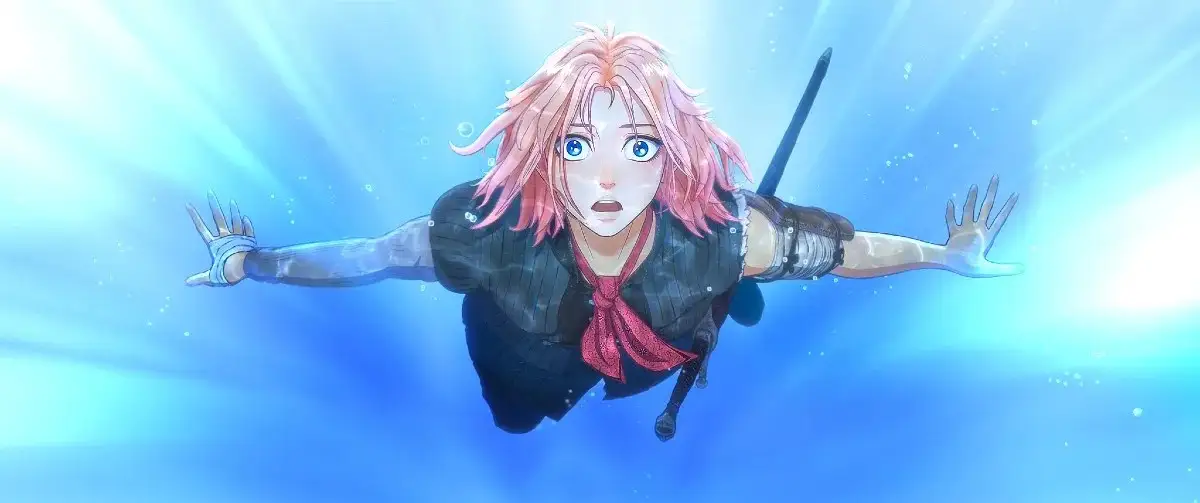
Scarlet is Rated PG-13 by Motion Picture Rating (MPA) for strong violence/bloody images.
Ambitious and undeniably inspired, yet weighed down by its own excess, “Scarlet” an anime reimagining of Hamlet opens with visual bravura and narrative confidence before gradually losing its footing. At first, it feels bracing, even daring. We meet Scarlet (voiced by Mana Ashida) wandering a barren, dreamlike realm, driven by a singular purpose: to avenge her father’s murder at the hands of her uncle, Claudius (Koji Yakusho). Claudius has done what Shakespeare taught us to dread killed his own brother, King Amlet, to seize the crown and claim Gertrude (Yuki Saito) as his wife. On the surface, Hosoda’s decision to gender-swap Hamlet seems like a clean, almost elegant provocation. But then he introduces a temporal twist one that bends time, space, and the logic of the original tragedy and from that moment on, you can feel the film beginning to strain under the weight of its own invention.
Highly Recommended: Kill Bill: The Whole Bloody Affair Parents Guide
There are echoes here of Hosoda’s earlier, female-centered fantasia “Belle,” another literary adaptation filtered through a digital-mythic lens. As with that film, “Scarlet” luxuriates in ornate, storybook imagery. We see Scarlet as a child in a palace dripping with gold, its opulence almost aggressively bright, as if daring fate to intervene. And intervene it does. The royal guard drags her father away, and from a balcony high above the courtyard, Scarlet watches helplessly as men with axes encircle him, urged on by a bloodthirsty crowd. He appears to be speaking perhaps a warning, perhaps a final comfort but the distance robs her of his words. By the time she reaches him, it’s too late. His body lies still, blood seeping into the stone. You can feel the trauma settle into her bones in that moment, the kind that calcifies into obsession.
Years pass. Scarlet trains with single-minded fury, sharpening herself into a weapon meant for one purpose only. When she finally confronts Claudius, she chooses poison a quieter, more intimate form of murder. It backfires. Cups are switched. Scarlet collapses instead, convulsing on the floor as Claudius looks on. It’s a cruel irony, and Hosoda stages it with the cold inevitability of fate closing a trap.
Highly Recommended: Dust Bunny Parents Guide
Death, however, is not the end here. Like “Belle” and “Mirai,” this film becomes a journey an odyssey through a realm that exists between destinations. Scarlet awakens in an otherworldly purgatory suspended between the Infinite Lands and absolute oblivion. She believes she has failed, and it’s hard not to share that despair with her. But a mystical old woman tells her Claudius is here too, hiding in this liminal expanse. Worse, he has been recruiting the dead, promising them passage to paradise while waiting for Gertrude to join him. Reinvigorated by purpose, Scarlet presses on, scavenging armor from corpses half-buried in sand, piecing together protection as she crosses hostile terrain filled with Claudius’s loyal soldiers and roving bandits. It’s survival as archaeology history literally worn on her body.
Up to this point, Hosoda’s adaptive instincts feel sharp and imaginative. Then comes the jolt that changes the film’s texture entirely. Scarlet encounters Hijiri (Masaki Okada), a paramedic from the future who has died and landed in this mythic in-between. Hijiri is gentle, hesitant, openly disturbed by Scarlet’s readiness for violence. Their dynamic sets up a philosophical tension especially when the sky itself erupts with mythic chaos, including a dragon formed of storm clouds and lightning. Hijiri slowly learns what the film wants to argue but never quite articulates: that pacifism has limits, and that sometimes survival demands force.
Highly Recommended: Ella McCay (2025) Parents Guide
And yet, “Scarlet” wants to be more than a revenge saga. Hosoda gestures toward a critique of vengeance itself, nudging the story toward forgiveness and emotional healing. Should Scarlet attempt to understand Claudius? Is redemption ever appropriate for someone who has caused so much harm? These are rich, dangerous questions. Unfortunately, the film circles them at a distance, speaking in generalities rather than dramatizing the conflict. Hosoda keeps Scarlet emotionally restrained clear-headed to a fault while Hijiri’s reactions remain muted. The result is a strange emotional flatness, a sense that the story is pausing to contemplate itself instead of moving forward. You start to feel the momentum slip away.
Eventually, you may find yourself wondering what emotional crescendo this film is reaching for. There’s a striking moment when Claudius is confronted by a rebellious mass, largely composed of impoverished people of color a potentially loaded image but Hosoda lets it drift by without interrogation or consequence. Similarly, Scarlet and Hijiri encounter a diasporic community whose cultural exchange culminates in a charming dance sequence. It’s pleasant, even sweet, but it registers as decorative rather than meaningful. Hosoda can still conjure moments of visual transcendence he has always been able to but here they feel untethered, beautiful images searching for emotional gravity.
In the end, “Scarlet” mistakes scale for substance. Its epic gestures feel hollow when they aren’t rooted in lived emotion. Instead of allowing the story to simply be messy, painful, unresolved it reaches for grandeur as a substitute. What’s left is a film that wants desperately to mean something profound, and occasionally brushes against that depth, but too often settles for the echo rather than the feeling itself.
Content Breakdown for Parents
Violence & Intensity: There is frequent fantasy violence, though it’s more emotionally intense than graphically explicit. Viewers see:A murder shown early in the film (blood is visible, though not gratuitous)Battle scenes involving swords, armor, and supernatural enemiesCorpses, skeletal remains, and imagery of death in an otherworldly settingCharacters in physical pain, including a poisoning sceneThemes of revenge and moral conflict that linger emotionally. The violence is stylized and often symbolic, but it carries real weight. Sensitive viewers may find it upsetting even without extreme gore.
Language: Language is mild overall. There’s no frequent profanity, though the tone is often intense, bitter, or despairing. Emotional cruelty and manipulation matter more here than swear words.
Sexual Content / Nudity: There is no explicit sexual content or nudity. Romantic themes exist—particularly around desire, betrayal, and obsession—but they’re handled in a mature, non-sexualized way.
Drugs, Alcohol & Smoking: Poison plays a key role in the story as a method of murder. Alcohol appears briefly in a ceremonial context. There’s no recreational drug use.
Parental Concerns
Parents may be surprised by how somber and philosophical the film is. Despite its animation and fantasy elements, this is not light viewing. Younger teens may find the pacing slow or the themes confusing, while sensitive viewers could be affected by the pervasive melancholy.
Recommended Age Range: Best for ages 13+, with the strongest appeal to older teens (15+) and adults who enjoy thoughtful, emotionally rich storytelling. Watching together can open the door to meaningful conversations.

Stephanie Heitman is a seasoned journalist and author dedicated to helping parents navigate the world of Hollywood entertainment through thoughtful, family-oriented film reviews. With over a decade of experience in writing and a passion for fostering safe, enriching viewing experiences, Stephanie launched Parentguiding.com to provide parents with the insights they need to make informed choices for their families.