Some subjects resist being turned into entertainment, and for good reason. You’ve probably felt it yourself: that queasy shift when a writer tries to “darken” a story by tossing in a sexual assault, as though the mere presence of violence against women automatically grants a plot some kind of grim sophistication or worse, a lurid charge. When mishandled, these moments do more than cheapen the narrative. They belittle the lived reality of those crimes and reinforce the very attitudes that allow them to flourish. They reduce women to narrative fuel.
To that list of things storytellers should approach with immense care, I’d add child abuse. It’s an area where a filmmaker can easily go wrong, and Paramount+’s Little Disasters is a case study in just how wrong things can go.
Highly Recommended: Ella McCay (2025) Parents Guide
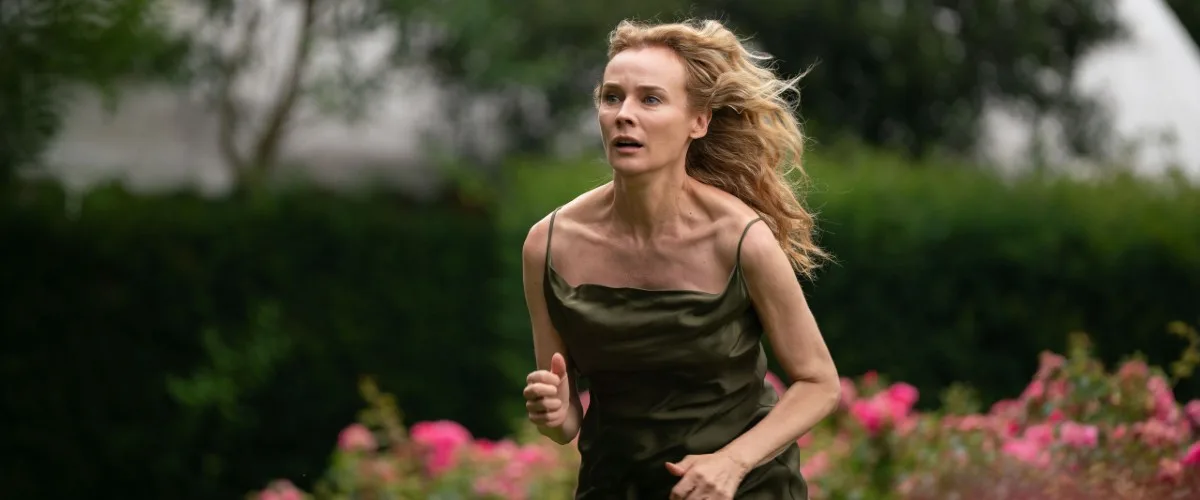
Adapted from the novel of the same name, this six-episode drama centers on a comfortable, upper-middle-class couple in the UK whose lives implode when their ten-month-old daughter is rushed to the hospital with a skull fracture. Jess Carrisford played with a steady, anxious strain by Diane Kruger can’t, or won’t, offer a coherent explanation for how the injury happened. The ambiguity draws child services into the family’s life, and the show never stops circling that unnerving question: what happened to the baby, and who caused it?
The situation gains an additional edge because the examining physician, Liz Burgess (Jo Joyner), is not just Jess’s doctor but an estranged member of the same tight-knit friend group four couples who bonded in a birthing class a decade earlier. The show seems to think this added history complicates things in a juicy way; in practice, it mostly adds clutter.
From there, Little Disasters settles into a fairly traditional mystery framework, inviting us to track clues and weigh motives surrounding tiny Betsy’s injury. But you can feel the strain almost immediately. Trying to build a whodunit around the breaking of an infant’s skull is like trying to turn a house fire into a cozy puzzle. There’s no comfort in it, no sense of play. The act itself sits too close to real-world dread to ever become mere “story mechanics.”
Instead of asking who had opportunity or who’s lying about their whereabouts, the show nudges us into something far more unsettling: hours spent wondering whether Jess’s postpartum depression has eroded her so deeply that she might have harmed her child. Or whether her outwardly mild husband Ed (JJ Feild) hides an inner brutality capable of something unthinkable. The mystery becomes a kind of emotional torture chamber.
And it’s not remotely fun.
That alone wouldn’t be a dealbreaker grim mysteries can work beautifully if Little Disasters had anything meaningful to say about the nature of parental violence or the contours of abuse. It doesn’t. For a time, the early episodes gesture toward something raw and recognizable. As a mother the same age as many of these characters, I found certain scenes genuinely unsettling; the show is good at triggering those pangs of parental doubt, the memories of our own lowest moments. You might recognize that anxious shiver yourself.
But the pain never leads anywhere. After dragging us through a hall of domestic horrors, with the specter of violence tucked into every shadowy corner, the series resolves itself with a finale so neat, so Scooby-Doo tidy, that it borders on parody. Everything is clarified. Everyone is either good or bad, with no messy overlap. And in that moment, the whole endeavor reveals its hand: this isn’t a story trying to deepen our understanding of abuse. It’s an exploitation machine, trivializing trauma for the sake of a convenient ending.
Highly Recommended: The Mysterious Gaze of the Flamingo Parents Guide
That ending also leaves a harsh spotlight on the show’s limp subplots. It’s hard to care about Charlotte’s (Shelley Conn) marital discontent or her exhaustion with IVF treatments when we’ve spent entire episodes staring at shots of a baby strapped to a hospital bed a recurring image the show seems almost perversely fond of. Liz’s drinking problem, softened by her supportive husband and friends, barely registers. Other side stories flicker briefly and then fade, leaving no emotional trace.
Visually, the series is glossy and inviting almost distractingly so. These characters live in immaculate homes full of sunlit rooms and curated textures. The school’s manicured hedges look plucked from a lifestyle catalog. Their getaway in Provence is the sort of rental you daydream about on a bleak Thursday afternoon. Even the wardrobes carry a deliberate sheen, though the symbolism borders on heavy-handed. Charlotte’s structured blacks and whites announce her chilly professionalism. Liz shuffles around in rumpled, practical clothes meant to telegraph her frayed interior. Mel (Emily Taaffe), the resident free spirit, floats about in bright prints and breezy silhouettes. You don’t have to work hard to decode any of it.
Jess, however, receives the most meticulous visual treatment. Her stay-at-home-mom ensembles are luxurious neutrals beiges, creams, soft earth tones that suggest serenity while hinting at something tightly wound underneath. When she steps outside, she favors flowing, backless dresses that highlight her beauty without ever tipping into overt sensuality. Even her hair becomes a barometer for her emotional state: loose, uneven waves when she’s crumbling; glossy, perfectly tousled curls when she’s steady. The show clearly wants us to study her.
Highly Recommended: Marjorie Prime’ Broadway Movie For Parents Concerns
At moments, it looks as though Little Disasters is assembling a commentary about privilege about how abuse doesn’t respect socioeconomic boundaries, how pain can bloom even in beautiful homes. But the series never follows through. In fact, it tilts so far in the opposite direction that it inadvertently crafts a different message: that some affluent, impossibly attractive people really are living lives better than yours… and perhaps they’ve earned it. Whatever bite the story might have had dissolves into a kind of aspirational melodrama.
In the end, Little Disasters amounts to a frustratingly hollow experience. It stares into the darkest corners of domestic life and drags us along but refuses to offer insight, empathy, or even a compelling narrative reward. It plunges viewers into despair and then leaves them there, empty-handed.
A toothless, wearying exercise. A show fixated on suffering but uninterested in understanding it. It takes us to a terrible place and gives us nothing in return.
Detailed Content Breakdown for Parents
Violence & Intensity
This series revolves around a very disturbing premise an unexplained infant injury and the fallout that follows. There are scenes in hospitals, emotional breakdowns, moments that feel like danger even when not explicit, and heavy psychological stressors. While there’s no action violence like explosions or shootings, the emotional intensity is high and sustained.
There are medical scenes and implications of harm to a baby that many parents may find deeply upsetting.
Language
Expect some strong language appropriate to adult drama. Characters are under stress and speak with the kind of bluntness that comes with fear, betrayal, and heated confrontations. It’s not gratuitously profane, but the tone is raw and real.
Sexual Content / Nudity
There’s no focus on sexual content or nudity as an entertainment device. Any such references are contextual and not the point of the story.
Drugs, Alcohol & Smoking
Some characters may drink alcohol socially or use it to cope, but there is no glamorization of substance use. It’s shown as part of adult life and emotional coping — not a highlight or focus.
Parental Concerns
This is not light entertainment. Some things to keep in mind:
- The core situation involves unexplained harm to an infant. That topic alone can trigger intense emotional reactions in many parents.
- Sustained psychological tension throughout the series, rather than calming relief.
- Not appropriate for children or teens — the emotional weight and themes are very adult.

Stephanie Heitman is a seasoned journalist and author dedicated to helping parents navigate the world of Hollywood entertainment through thoughtful, family-oriented film reviews. With over a decade of experience in writing and a passion for fostering safe, enriching viewing experiences, Stephanie launched Parentguiding.com to provide parents with the insights they need to make informed choices for their families.