Bruno Forzani and Hélène Cattet have long carved out their own shimmering corner of genre cinema, a place where European pulp thrillers of the ’60s and ’70s are not simply referenced but reawakened dazed, seductive, and a little dangerous. Their films don’t just tip their hats to the lurid pleasures of giallo and other pulp traditions; they plunge headfirst into those sensations, letting color, sound, and texture crash over the viewer until you feel as if your senses have been rewired. There’s always been something almost assaultive in their approach, as though the directors want to overwhelm not just the eyes but every nerve ending. And yet, that shock to the system is very much the point.
What’s most striking is that Forzani and Cattet aren’t content to merely mimic the filmmakers they revere Argento, Martino, Bava, and the other Italian stylists whose fingerprints mark their frames. Instead, they channel those influences through their own feverish aesthetic, a heightened state where pleasure and dread coil around each other. You can feel this in the way they sculpt sound until it feels tactile, or in their editing rhythms, which veer into the dreamlike and the disorienting. Narrative becomes an unstable thing, a loose scaffolding for sequences that emphasize the pure, primal pull of image and audio. Their cinema often feels like it exists at the threshold of delirium.
Highly Recommended: Rosemead (2025) Parents Guide
Their early features, Amer and The Strange Color of Your Body’s Tears, were lush, bruised love letters to the hyper-sensory extremes of giallo. Let the Corpses Tan shifted their obsessions westward, reimagining the spaghetti Western as a sun-bleached hallucination. Now, with Reflection in a Dead Diamond a giddy, self-aware riff currently streaming on Shudder they turn their attention to the Eurospy films of the late ’60s. Those movies, with their gaudy gadgets, psyched-out palettes, and latex-wrapped villains, always skirted the edge of camp. Forzani and Cattet embrace that flamboyance with open arms, mixing it with the graphic shock and erotic exaggeration of fumetti neri, the Italian noir comics that often inspired those spy capers in the first place.
The story begins at a luxurious seaside hotel on the Côte d’Azur, where John Diman (Fabio Testi), now retired and numbing his days with alcohol, drifts through what remains of his life. One afternoon, as he watches a young woman basking in the Riviera sunlight, his gaze catches on the diamond glinting from her nipple piercing. The jewel flashes, almost impossibly bright. In that moment, something in his mind unlocks, and suddenly he’s thrust back into a bygone era where he was a debonair secret agent, effortlessly entangled in globe-spanning conspiracies, pursued by lethal enemies and embraced by dangerously beautiful women. Or so he remembers.
The film never tells us exactly what these memories are flashbacks, fantasies, or perhaps scenes from a career spent playing a superspy rather than being one. Forzani and Cattet deliberately cloud the borders of truth, inviting us into Diman’s fractured headspace where time folds in on itself and fiction melts into reality. As he tries to make sense of who he once was (or still is), he becomes trapped in a labyrinth of his own making, wandering through reflective surfaces that bounce back distorted versions of himself, as though every mirror holds a different life he might have lived.
Highly Recommended: Kill Bill: The Whole Bloody Affair Parents Guide
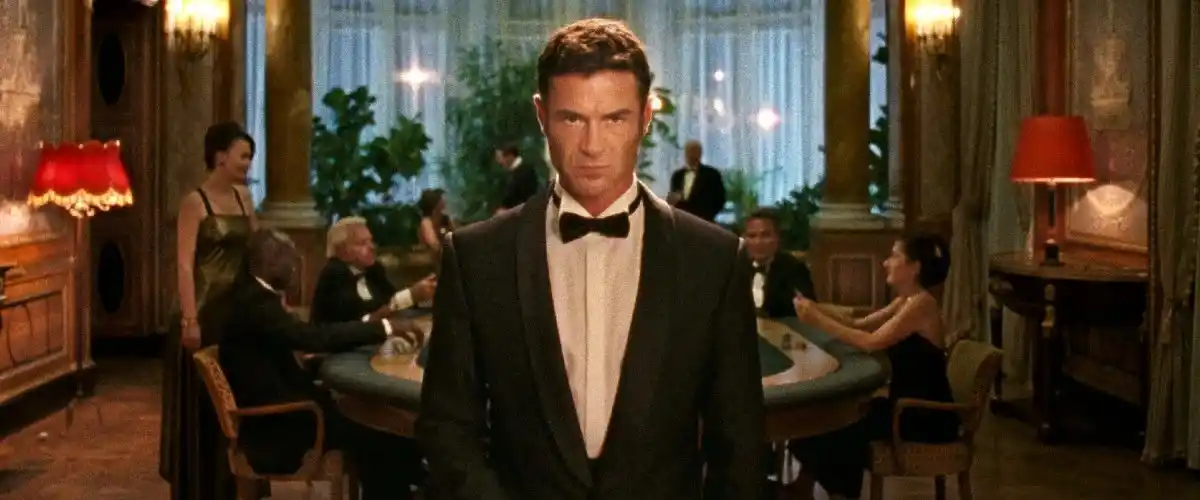
Yannick Renier plays the younger Diman, a polished, Bond-like figure assigned to protect an oil tycoon (Koen De Bouw). But that straightforward mission soon mutates, splintering into an increasingly tangled collage of masked assassins, screeching car chases, treacheries within treacheries, lost lovers, stolen gems, and films nested inside other films. The pace is relentless; scenes seem to race past one another, collapsing chronology until you feel suspended in a continuous rush of imagery. It’s the kind of narrative that resists strict decoding and the directors seem to ask you, gently but firmly, to stop trying. Just take the ride.
The instability of Diman’s identity begins to feel like a symptom, a possible hint of memory decay. And that anxiety is doubled in the figure of Serpentik (Thi Mai Nguyen), a lethal chameleon of an assassin with red metal talons and the eerie ability to assume any woman’s face. Before long, Diman sees her everywhere in strangers, in lovers, in ghosts of his past. She becomes the embodiment of his unraveling, his fear, and his desire all at once.
Visually and tonally, the film owes a clear debt to Mario Bava’s Danger: Diabolik. You can sense it in the pop-art flair, in the gleefully chaotic tone, in the way plot seems almost secondary to the pure sensual rush of the images. Forzani and Cattet revel in optical tricks and imaginative flourishes. One standout set piece features a woman wearing a dress made of chain-linked discs; those shimmering circles aren’t just fabric, but concealed weapons. They shoot off her body like metallic fragments of a hypnotic explosion, tearing through a swarm of attackers as though she’s become a living booby trap.
Highly Recommended: Man Finds Tape Parents Guide
But what’s most impressive this time around is how confidently the directors handle action. Their set pieces brutal bar brawls, razor-edged chases are orchestrated with a meticulousness that borders on sleight of hand. They bring the same gorgeously excessive energy to these scenes that they bring to their more abstract moments, making the film feel both bodily and dreamlike. You sense that they’re pushing themselves, stretching the boundaries of what their style can encompass.
Reflection in a Dead Diamond is, ultimately, a hypnotic and exhilarating work. It dazzles, teases, and unsettles, all while shimmering with the cold beauty of its titular jewels. Forzani and Cattet have made something that feels like a natural evolution a film cut with the clarity and hardness of a gemstone, and one that catches the light in thrilling, unexpected ways.
Content Guide for Parents
Violence & Intensity: The movie leans heavily into stylized violence the kind you expect from pulp-spy thrillers or neo-noir fever dreams. Masked assassins, gunfights, and sudden bursts of brutal action appear throughout. The violence isn’t cartoonish; it’s intense, sometimes graphic, and shot in a heightened, artistic way that can feel disorienting or claustrophobic. Younger viewers may find it unnerving.
Language: While official counts vary depending on the language track or subtitles, the general tone is adult. Expect mature dialogue, occasional profanity, and a world where everyone speaks with the edge of someone who’s lived too close to danger for too long.
Sexual Content & Nudity: This film draws openly from ’60s Euro-spy sensuality, which means seduction is woven into the aesthetic. There’s erotic imagery, sexualized framing, and moments of nudity. Nothing feels pornographic, but the movie absolutely embraces adult sexuality in a way that is not meant for kids or young teens.
Drugs, Alcohol & Smoking: John Diman spends much of his present-day life drinking subtly communicating loneliness, regret, and perhaps avoidance. Alcohol is present throughout, and the film aligns with the classic spy-genre vibe where indulgence is part of the atmosphere. Smoking may also appear.
Parental Concerns
Parents should know this is not a “fun spy movie.” It’s visually gorgeous but psychologically heavy a surreal, violent, erotic fever dream filled with ambiguity. Teens expecting a traditional James Bond-style narrative may feel lost or uncomfortable. And younger viewers will likely be overwhelmed by the sensuality and violence.

Matthew Creith is a movie and TV critic based in Denver, Colorado. He’s a member of the Critics Choice Association and GALECA: The Society of LGBTQ Entertainment Critics. He can be found on Twitter: @matthew_creith or Instagram: matineewithmatt. He graduated with a BA in Media, Theory and Criticism from California State University, Northridge. Since then, he’s covered a wide range of movies and TV shows, as well as film festivals like SXSW and TIFF.