Rosemead is Rated R by Motion Picture Rating (MPA) for some language. Recommended Age Range: Best suited for older teens (16+) and adults, due to mature themes and psychological intensity.
Mass shootings have become, tragically, part of the American landscape, woven into the very fabric of our national consciousness. The questions that follow each new headline Why? Who is responsible? Could this have been prevented? feel rote, almost ritualistic. They offer no real comfort, no sense of resolution. Eric Lin’s debut feature, Rosemead (written by Marilyn Fu), doesn’t pretend to answer them. Instead, it invites us to sit in the uneasy collision of mental illness, cultural stigma, and the crushing weight of model-minority expectations, set against the lived reality of an immigrant community. The film does not absolve; it interrogates. And the outcomes it presents are as harrowing as they are inevitable, inspired by events too real to ignore.
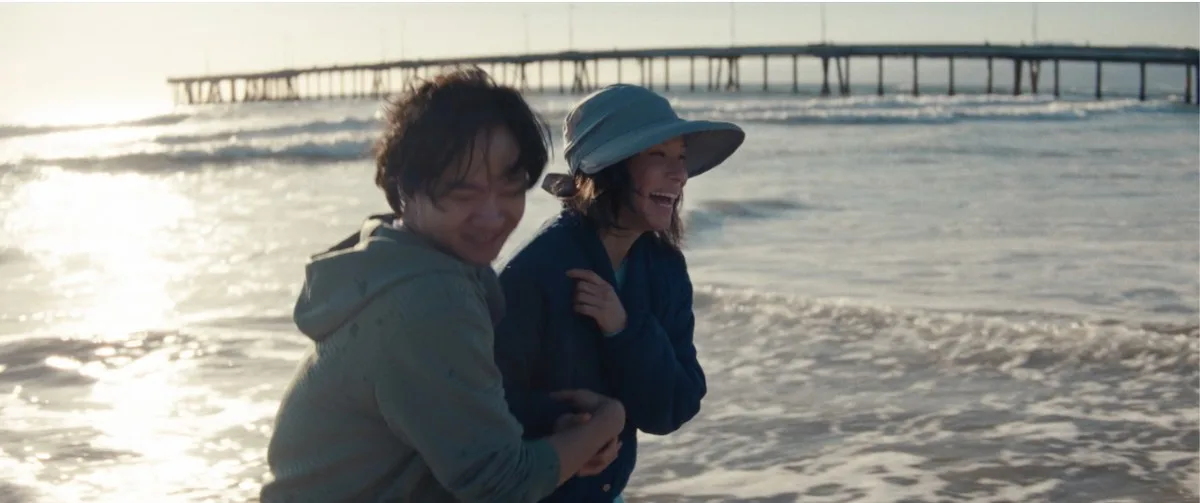
At the heart of the story is Irene (Lucy Liu, incandescent), a widow concealing her terminal cancer from the son she adores. She runs a modest print shop in Rosemead, a corner of Los Angeles with a predominantly Asian-American population, and she watches over Joe (Lawrence Shou), her bright son who once seemed destined for success. Since his father’s death, Joe has struggled to find solid ground; his schizophrenia has worsened, and he has stopped taking his medication, writing in his blog that they “dull his vigilance.” You can feel the tension in these early sequences: every glance between mother and son carries both love and fear, protection and suspicion.
Highly Recommended: Blue Moon (2025) Parents Guide
The bond between Irene and Joe is quietly luminous. Joe senses that his mother is sicker than she admits; Irene fears that her son’s illness may be slipping beyond their control. They touch, embrace, and yet constantly observe one another from the corners of their eyes a dance of intimacy laced with anxiety. It is tender, protective, and profoundly human, and Lin explores it with a sensitivity that lingers long after the credits.
The narrative evokes We Need to Talk About Kevin, though Lin approaches the thematic territory with his own deliberate, understated cadence. Joe’s episodes become more frequent, more violent shattering iPads, wrecking rooms, harming himself. The media’s relentless coverage of mass shootings becomes a leitmotif: Irene turns it off; Joe immerses himself, drowning in the litany of victims and the minutiae of weapons. His open laptop tabs are a catalog of past horrors Sandy Hook, Virginia Tech, Aurora and the film makes it impossible not to recognize the mother’s mounting dread. You watch her wrestle with the unanswerable: what can she do to prevent what may already be inevitable?
Highly Recommended: Blue Moon (2025) Parents Guide
The pressures of cultural pride and shame further complicate the path to intervention. Whispers ripple through the local Asian-American community, offering superstition or blame “the prescriptions are poisoning him,” or perhaps “a dark spirit has taken hold.” Initially, Irene internalizes these pressures, keeping therapy appointments at bay, trying to maintain a fragile quiet. Over time, her fear tips toward action: she brings evidence of Joe’s online obsessions to his therapist and even enlists the local gun shop owner to alert her if Joe shows any dangerous curiosity. It’s a delicate balancing act between vigilance and desperation, and Lin stages it with a quiet, unnerving precision.
The film’s candor is one of its most striking qualities. Lin neither sensationalizes nor sanitizes mental illness. He does not compound stigma; instead, he illuminates the sheer difficulty of loving someone in the grip of a disorder that resists control. Irene exhausts every measure she knows, but the inevitability of her cancer and the approach of Joe’s eighteenth birthday create a suffocating tension the clock is her enemy as much as her son’s illness is.
Highly Recommended: The Family Plan 2 (2025) Parents GuideLucy Liu’s performance holds the film aloft. Her Irene is tender, fragile, and fiercely determined, a figure caught between hope and helplessness. Shou, in his debut, struggles to match Liu’s subtlety; his Joe occasionally tips into overt melodrama, and Lin’s direction of these sequences feels heavy-handed. Yet the film shines when it lingers on the quiet betrayals of emotion: the silent evidence of past events, the long, careful portrait shots that allow grief, anxiety, and love to breathe. Tenderness persists, even in the midst of fear, and that persistence makes the story all the more devastating.
Rosemead understands the danger of labeling violent individuals with reductive terms like “evil” or “monster.” Such words distance them from the human experience, masking the complex interplay of psychological, familial, and sociocultural forces that shape behavior. Lin does not excuse violence, nor does he seek to justify it. Instead, he asks us to look carefully at the spaces where compassion and control intersect and, crucially, where they fail. The film is bleak, unflinching, and yet suffused with a kind of empathy that lingers, hauntingly, long after the final frame.
Detailed Content Breakdown for Parents
Violence & Intensity: The film portrays psychological and self-directed violence rather than graphic gore. Joe experiences outbursts breaking objects, destroying rooms, and self-harm—which are depicted realistically and carry emotional weight. Parents should know that the film’s tension and sense of impending tragedy are constant, and some scenes may feel unsettling.
Language: The dialogue is largely restrained, reflecting the characters’ cultural context, but there are moments of frustration and strong language consistent with the intensity of the story. There are no pervasive slurs, though some emotionally charged outbursts include profanities.
Sexual Content / Nudity: There is minimal sexual content, with no explicit scenes or nudity. Any references are brief and contextually relevant.
Drugs, Alcohol & Smoking: These are largely absent from the storyline. The focus remains on mental health and family dynamics.
Parental Concerns
Intense psychological content may be upsetting for younger or sensitive viewers
Themes of illness, self-harm, and mass violence may be emotionally challenging
Some teens may struggle to process the film’s darker emotional tones

Matthew Creith is a movie and TV critic based in Denver, Colorado. He’s a member of the Critics Choice Association and GALECA: The Society of LGBTQ Entertainment Critics. He can be found on Twitter: @matthew_creith or Instagram: matineewithmatt. He graduated with a BA in Media, Theory and Criticism from California State University, Northridge. Since then, he’s covered a wide range of movies and TV shows, as well as film festivals like SXSW and TIFF.