The Thing with Feathers is Rated R by Motion Picture Rating (MPA) for language and some bloody violent content. Recommended Age Range: This film is best suited for older teens (16–17+) and adults.
There’s an endless tug-of-war around book-to-film adaptations, the kind of debate where people insist a movie review should ignore the novel entirely. You’ve heard that argument: the critic should treat the film as its own creation. There’s truth in that a movie needs to stand on its own legs but anyone who has watched adaptations for years knows something quietly consistent: when an adaptation stumbles, the trouble usually begins with the choices made in translating the text to the screen. Fidelity alone doesn’t save a film; reverence can smother it. Yet changes for their own sake can alienate the very energy that made the story worth filming.
This tension sits right at the heart of The Thing with Feathers, Dylan Southern’s take on Max Porter’s celebrated 2015 debut, Grief Is the Thing with Feathers. Southern casts Benedict Cumberbatch as a widowed father, a man so submerged in sorrow he can barely steer his two young sons through daily life and all the while, an enormous crow lurks around the family home. In Porter’s novel, the crow is less a creature than a presence, a shape of grief that slips into rooms, murmurs unsettling truths, and shadows the boys as though testing their resilience. The story’s voice fractures among father, sons, and crow, creating an eerie chorus of mourning. Porter once said the boys’ experience came from the loss of his own father at six a revelation that feels woven into every unsettled breath of the book. (The title, of course, comes from Dickinson’s famous meditation on hope taking feathered form.)
Highly Recommending: Wake Up Dead Man: A Knives Out Mystery Parents Guide
Before it reached the screen, the novel had already taken on another life. Enda Walsh adapted it for the stage in 2019, with Cillian Murphy carrying its London premiere on a knife’s edge of live-wire grief. Walsh has a gift for shaping literature into performance his screenplays for Small Things Like These and Die My Love prove as much but Southern chose not to use Walsh’s adaptation. Instead he returned to the novel himself, altering crucial pieces and framing the story within a horror vocabulary. The result leans heavily on genre signals jump scares, stylized shadows, a sense of overstatement and in doing so, something fragile and poetic in Porter’s work gets flattened.
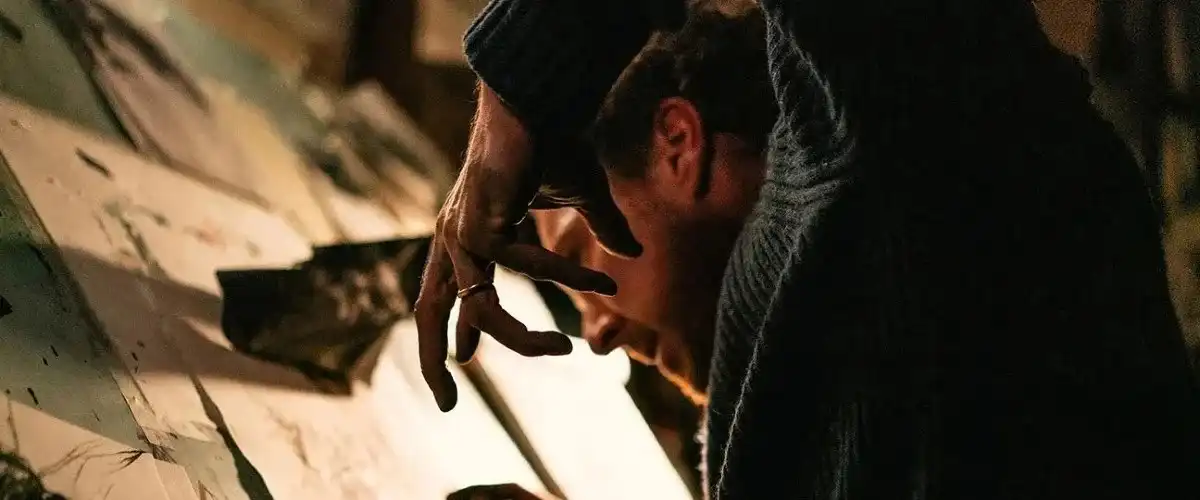
Still, the performances keep pulling you in. Cumberbatch, along with real-life siblings Richard and Henry Boxall as the boys, gives the family a bruised authenticity. The father, now reimagined as a graphic novelist (a label he grumbles about), is battling a looming manuscript deadline. But creative focus is nearly impossible when a human-sized crow voiced with a needling hiss by David Thewlis hovers like an unwanted muse. As the father unravels, you see flashes of him mutating emotionally, even physically, into something birdlike, while his sons scramble to keep the last parent they have from disintegrating.
Cinematographer Ben Fordesman shoots the film in blacks so deep they feel like holes punched through the screen. The crow often emerges from those voids, its outline merging with the darkness until you’re not quite sure where the creature begins. (Fordesman also lensed Saint Maud, Love Lies Bleeding, and this year’s Anemone, and you can feel the same fascination with shadow here.)
Highly Recommending: Zootopia 2 Parents Guide
Nicola Hicks’ crow design leans into an unsettling oddness a long, arched neck, a silhouette that borders on grotesque comedy. Its spike-like claws evoke the Babadook, and the comparison is hard to unsee. The two films walk similar thematic ground, yet The Babadook succeeds because it knows exactly why its monster exists: a terrifying manifestation of untreated grief and mental illness. Its rules feel deliberate. In The Thing with Feathers, the crow’s reason for being never quite crystallizes. Why a crow? Why this family? Why this form? Since the father’s graphic novel has nothing to do with corvids, the creature feels arbitrary an oddity rather than an inevitability.
This is where the source material becomes impossible to ignore. In Porter’s novel, the “why” of the crow isn’t just explained it is the spine of the entire story. The father isn’t a graphic novelist at all, but a scholar writing a book about Ted Hughes’ 1970 collection Crow: From the Life and Songs of the Crow. Even if you’re not familiar with the seismic impact of Hughes’ work, Porter draws you into its orbit. Hughes’ poetry was forged in a crucible of personal devastation: his marriage to Sylvia Plath had collapsed in 1962, and her suicide a year later with their children asleep upstairs left a wound that shaped the mid-sixties work. The tragedy deepened when Assia Wevill, Hughes’ partner after Plath, also died by suicide in 1969, taking with her their young daughter. Crow emerged in the wake of these losses, a collection wrestling with death, guilt, renewal.
If you’re making a film about a bereaved father raising two boys alone under the shadow of a looming, almost mythic crow, this context isn’t extra it’s essential. Porter’s novel ties the creature directly to Hughes’ “central bird,” a figure born from suffering, myth, and brutal introspection. Remove that link and you sever the story from its own bloodstream. The crow on the screen becomes just a strange intruder pacing the hallway, more Babadook than Hughes a symbol without a source.
In Porter’s book, the crow even tells you what he is quoting Hughes as he does so in a passage that reads like a manifesto of multiplicity:
I was friend, excuse, deus ex machina, joke, symptom, phantom, analyst, babysitter… I was, after all, the bird at every extreme.
Cutting the Ted Hughes connection erases that lineage, that echo of creation. What remains is a creature without a mythology and a film left searching for the meaning the book carried so naturally.
Detailed Content Breakdown for Parents
Violence & Intensity: The film doesn’t shy away from disturbing imagery. There are scenes of emotional breakdown, psychological horror, and “bloody violent content,” likely involving some degree of gore or at least unsettling horror tropes. The mood is heavy, with grief and mental instability at its core. The “crow” as a supernatural or symbolic presence creates tension, fear, and horror elements that may be overwhelming.
Language: The “R” rating cites language, which suggests some profanity is used. That might include strong words or adult-level expressions.
Sexual Content / Nudity: There is no indication from public descriptions or rating summaries that the film contains sexual content or nudity. The focus is more on grief, horror, and psychological themes.
Drugs, Alcohol & Smoking: I found no mentions in the available parental guides or reviews of drug use, smoking, or alcohol consumption.
Parental Concerns: The horror elements and disturbing imagery may be too intense for children or younger teens.The emotional weight the father’s breakdown, grief, and psychological horror might feel overwhelming or triggering, especially for kids who have experienced loss.
The film premiered at the 2025 Sundance Film Festival, and is scheduled for general theatrical release November 28, 2025.

Stephanie Heitman is a seasoned journalist and author dedicated to helping parents navigate the world of Hollywood entertainment through thoughtful, family-oriented film reviews. With over a decade of experience in writing and a passion for fostering safe, enriching viewing experiences, Stephanie launched Parentguiding.com to provide parents with the insights they need to make informed choices for their families.