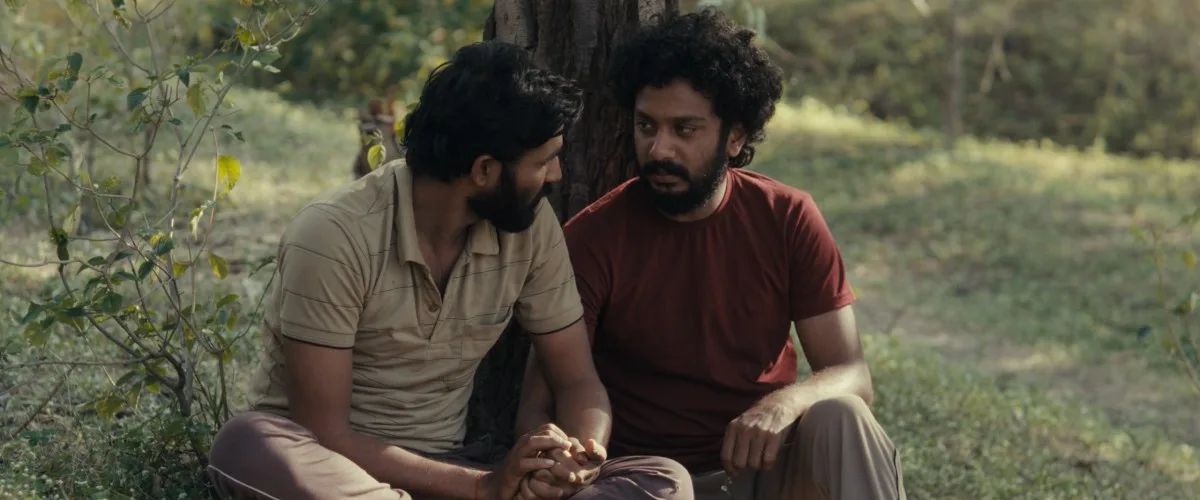
Rohan Kanawade’s Cactus Pears may be one of the softest, most tender films to emerge this year a queer love story whose quiet pulse gradually wraps around you like someone placing a warm hand on your shoulder. Its gentleness is not a posture but a mode of seeing. Through the story of a man mourning his father and returning to the village he once outgrew, Kanawade unfolds a deeply felt collision between old customs and the modern world, between the confinement of heteronormativity and the fragile emergence of queer desire. The film moves at a patient, unhurried tempo, and in those long breaths it finds moments of startling beauty. It’s no wonder that, when it premiered at Sundance, Cactus Pears walked away with the Grand Jury Prize for World Cinema Dramatic. In a movie where the most profound truths bloom from small, nearly invisible gestures, Kanawade invites us to consider how grief can crack open the ground and make room for love.
Highly Recommending: Altered (2025) Parents Guide
The opening frames gently announce the film’s emotional intent. Anand (Bhushaan Manoj) appears in extreme close-up, his face drained, as if the world has slipped out from under him. Only then do we discover he’s sitting in a hospital waiting room beside his mother, Suman (Jayshri Jagtap). When Anand steps away to gather their relatives, the camera refuses to chase after him. Instead, it stays with Suman. She sits still, letting tears fall at a pace that feels too slow to be anything but real. Her husband Anand’s father is gone. And Anand, standing in that liminal space between adulthood and arrested boyhood, has no idea how to move forward.
His first instinct is to flee. He tries to negotiate down the traditional ten-day mourning period: he’ll attend the first two days, disappear back to Mumbai, and return for the final rituals. It’s only Suman’s quiet insistence, her ache wrapped inside practicality, that pulls him back home. On the journey, he types and deletes a message to a man named Chetan, whose profile picture shows him smiling with a family. Even from this fleeting moment, you can feel Anand’s longing slipping through the cracks. Once he arrives in his village, that longing becomes something he tries awkwardly, unsuccessfully to hide. He hovers at the edges of frames like someone who no longer remembers the choreography of home.
The village greets him not with tenderness but with rules. Because he’s unmarried, his relatives argue he shouldn’t light his father’s funeral pyre. His black T-shirt he insists it’s dark grey sets off another small debate. Then come the long list of mourning customs: no footwear until the tenth day; no visiting others’ homes unless he sits on the floor; sleeping on the floor; only two modest meals a day with no rice, milk, or second helpings; no temples; no haircuts; only black tea. It’s a dizzying parade of do-this-not-that. And yet, for all the sternness with which these rules are delivered, there’s amusing ambiguity around the edges. Can he wash his hair? No one seems sure. If he’s starving between meals, fruit is apparently allowed. Kanawade never mocks these customs they matter, and Anand honors them but he’s not afraid to let their contradictions nudge out a wry smile.
Recommending: Jay Kelly (2025) Parents Guide
Still, Anand can obey every instruction and the problem remains: he is not married. His mother has spun an elaborate story for their extended family, claiming Anand once had his heart shattered by an unfaithful fiancée and simply hasn’t recovered enough to pursue another woman. It’s a flimsy fiction, and the film knows it. The truth is simple. Anand is gay.
His father’s death stings in part because the man accepted him quietly, privately and helped maintain the façade for the relatives who would rather not know. They rationalize everything about Anand through the lens of Mumbai, a city so strange, in their eyes, it explains away anything that doesn’t fit their worldview. But the one thing the village cannot explain away is Bayla (Suraaj Suman), Anand’s former lover. The moment Anand returns, the air shifts. Within a day, the two are exchanging glances that say far more than the dialogue ever will, riding together on a motorcycle across wide, burnt-gold landscapes that feel both enormous and intimate.
Kanawade has a gift for investing the tiniest movements with deep emotion. Watch the scene where Anand and Bayla sit together late at night by a village square. Anand smokes. Bayla studies him with the kind of tenderness you only grant someone whose absence once hurt you. The camera sits still, almost reverent, letting you catch every nervous swallow, every shy dart of Bayla’s eyes as they trace the outline of Anand’s body. In another moment, Bayla reaches out to run his fingers through Anand’s curls an extreme close-up captures the softness of the gesture, the way touch can be both an admission and a question. A nighttime dip in a pond gives them permission to hold each other without fear, letting water wash away the dread of being found out. And then there are the cactus pears peeled, offered, shared red at the center like a quiet metaphor for the sweetness tucked inside danger. Their presence becomes a small, vivid signal of the romance’s simmering heat.
Related: 100 Nights of Hero Parents Guide
Yet the film’s emotional generosity extends beyond these lovers. Suman, who initially seems stern and guarded, gradually reveals herself to be gentler, wiser, and more accepting than Anand expects. Bayla, like so many closeted men in rural pockets of the country, dreams of escape yet fears the cost. Anand himself, for all the freedom supposedly offered by the city, is trapped in a job that exploits him reminding us that the urban world has its own constraints. Kanawade frames these lives within rounded-edge compositions that soften the image, subtly suggesting a world where people bend, adapt, and take winding paths toward whatever happiness they can claim.
And like the fruit from which Cactus Pears takes its name, the film hides its sweetness beneath a few thorns. But once you break through that exterior once you sit with its silences, its hesitations, its quiet longing you discover a story pulsing with compassion. At its core lies a belief that love, even bruised by loss, will still find a way to bloom.
Detailed Content Breakdown for Parents
Violence & Intensity: Very minimal. The “violence” is primarily emotional: grief over the death of a parent, family tensions, and internal conflicts.
No physical fighting or action scenes the story is gentle, introspective, and dialogue-driven.
Language: The film is in Marathi, so any profanity will be contextual and culturally specific.
No reports of pervasive strong language; it leans more into emotional realism than shock value.
Sexual Content / Nudity: The romance between Anand and Balya is tender and intimate. There are scenes of caressing, nighttime swimming, and affectionate closeness. Some implied sexual content, but not graphic. Nudity is subtle, used to convey vulnerability rather than eroticism.
Drugs, Alcohol & Smoking: Smoking: At least one scene shows Anand smoking, particularly in a quiet, reflective moment. No significant drug use is reported. Alcohol is not a major part of the narrative, based on available descriptions.
Parental Concerns: Some parents may worry about the same-sex romance, especially if they come from more conservative backgrounds.The pacing is slow and reflective; children used to fast-paced films may find it less immediately engaging.There is emotional heaviness grief, shame, and family pressure which could be challenging for sensitive viewers.
Release date: November 21, 2025 (United States)

Stephanie Heitman is a seasoned journalist and author dedicated to helping parents navigate the world of Hollywood entertainment through thoughtful, family-oriented film reviews. With over a decade of experience in writing and a passion for fostering safe, enriching viewing experiences, Stephanie launched Parentguiding.com to provide parents with the insights they need to make informed choices for their families.