Left-Handed Girl is R for “Sexual Content and Language.
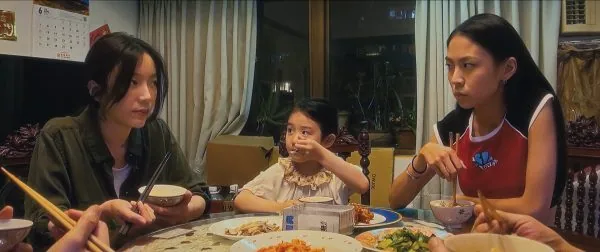
Ever felt like you were doing everything right and life still refused to cut you a break? That’s the quiet ache that hums beneath Left-Handed Girl, Shih-Ching Tsou’s deeply moving solo directorial debut. It’s a film about a mother, her two daughters, and the invisible weight of expectations familial, cultural, economic that never seem to lift. The result is an intimate, bustling slice of life that feels both distinctly Taiwanese and universally human.
At the center of the film is Shu-Fen (played with quiet exhaustion and grace by Janel Tsai), a single mother who has uprooted her two daughters to Taipei to run a tiny noodle stand in one of the city’s bustling night markets. Every day is a balancing act money is scarce, rent is high, and every bowl of noodles sold feels like a small victory. Yet the heart of her struggle isn’t just economic it’s emotional. Shu-Fen is trying to hold together a family fraying at every seam.
Recommending: Playdate (2025) Parents Guide
Her eldest daughter, I-Ann (Shih-Yuan Ma), is caught in that restless in-between space of early adulthood. She’s smart, capable, and full of potential, but she’s also drifting angry, disillusioned, and unsure how to bridge the widening gap between her mother’s sacrifices and her own need for independence. To make extra money, she takes a job at a betel nut stand, where the women are encouraged to dress provocatively to draw in customers. The work is transactional, slightly sleazy, and yet I-Ann handles it with a kind of detached acceptance. It’s not shame it’s survival.
Meanwhile, the youngest daughter, I-Jing (a breakout performance from Nina Ye), watches it all unfold with the innocent confusion only a child can possess. Her world is small school, the market, her mother’s cramped stall but her curiosity is boundless. She’s trying to make sense of why her sister lashes out, why her grandfather calls her “cursed” for being left-handed, and why her mother works until her hands ache. Her left hand becomes a quiet metaphor for rebellion a symbol of the parts of ourselves the world insists we hide.
Recommended: Now You See Me: Now You Don’t Parents Guide
Tsou captures their lives with stunning intimacy. The camera lingers on cluttered kitchens, sweat-streaked foreheads, and the steam rising from noodle broth under fluorescent light. You can almost smell the fried garlic and hear the faint hum of scooters echoing through the market. It’s an environment that feels alive, even as it suffocates the people inside it.
The emotional heart of Left-Handed Girl lies in Shu-Fen’s sense of duty to her estranged husband, who’s dying alone in a hospital bed. Despite having been abandoned years ago, she feels compelled to visit him, to pay for his funeral, to care for a man who gave nothing back. Her family doesn’t understand it, and honestly, neither do we until we realize that for Shu-Fen, compassion is both her strength and her curse. She keeps giving because she doesn’t know how to stop.
I-Ann resents these visits. Every hour her mother spends at the hospital is an hour away from the stand, an hour closer to losing their spot at the market. She’s tired of watching her mother pour herself into people who’ve already left. That resentment bubbles beneath nearly every scene between them arguments half-whispered, silences that stretch too long. Tsou doesn’t stage these confrontations with melodrama; she lets them simmer naturally, the way real families fight. Love never disappears, but it’s tangled with frustration and fatigue.
Also Read: The Carpenter’s Son Parents Guide
There’s also a quiet romantic subplot woven through the chaos Shu-Fen’s hesitant connection with a shopkeeper who sells “magic sponges” next door. Their relationship is tentative, born out of shared exhaustion rather than passion. But there’s a sweetness in their glances, a suggestion that even in survival mode, people still crave connection. It’s a reminder that love, however small, can still exist in the margins of struggle.
Tonally, Left-Handed Girl feels like a cousin to The Florida Project or Minari films that find poetry in poverty and beauty in imperfection. The cinematography captures Taipei as both harsh and luminous: the fluorescent lights of the night market, the damp alleys reflecting pink neon, the quiet solitude of dawn when the city finally sleeps. The film’s pacing is unhurried some might even call it meandering but that’s part of its charm. It wants you to live with these people, to feel the monotony of their routines and the brief sparks of joy that keep them going.
Nina Ye’s performance as I-Jing deserves special attention. Child performances can easily tip into precociousness, but Ye’s portrayal feels entirely organic. She’s not acting; she’s simply existing within the world Tsou has built. When she pockets small trinkets from nearby market stalls convinced her “devil hand” gives her permission you can’t help but smile and ache at the same time. She’s funny, flawed, and heartbreakingly real.
Recommending: The Running Man (2025) Parents Guide
Sean Baker’s editing gives the film a familiar rhythm unpolished yet deliberate, like life unfolding without a script. Still, there are moments when the film’s narrative feels scattered. With three central characters and a dozen intersecting storylines, not every thread lands with the same force. Some scenes drift, others repeat emotional beats we’ve already felt. But even when Left-Handed Girl loses narrative momentum, it never loses authenticity.
Then, in the final act, Tsou pulls everything together. Without spoiling the twist, a late revelation redefines much of what we’ve seen, reframing this small family drama into something bigger something quietly profound about forgiveness and the ghosts we carry. It’s the kind of emotional payoff that doesn’t announce itself; it just arrives, like a lump in your throat you didn’t realize was forming.
What makes Left-Handed Girl resonate is how it turns a cultural superstition into a metaphor for identity. In Taiwanese tradition, using your left hand is considered improper an old-world belief that’s both absurd and symbolic. For Tsou, it becomes a stand-in for anyone who feels out of place in their own life. Shu-Fen, I-Ann, and I-Jing are all “left-handed” in their own ways: misunderstood, nonconforming, quietly defiant.
That’s what gives the film its emotional power. It’s not about overcoming poverty or finding redemption. It’s about existing in the gray spaces between duty and desire, tradition and change, resentment and love. It’s about people who are too busy surviving to realize they’re still capable of tenderness.
In the end, Left-Handed Girl is a small story told with enormous heart. It’s tender, messy, and imperfect just like the people it portrays. Shih-Ching Tsou has crafted a debut that stands confidently beside Sean Baker’s best work, yet feels distinctly her own: feminine, grounded, and quietly powerful.
Detailed Content Breakdown for Parents
Violence & Intensity: The film is generally low on physical violence. However, emotional intensity is high: there are arguments, family stress, work-pressure scenes, and a subplot of abandonment (the father figure is absent/ill). The ambience can feel heavy.
Language: The film is in Mandarin/Taiwanese with subtitles (for many viewers). For the U.S. version there is an “R” rating for language, so there are likely some stronger words. I didn’t find detailed lists of slurs or extremely graphic profanity, but parents should expect mature dialogue.
Sexual Content / Nudity: There is a subplot in which I-Ann takes a job where dressing in a sexually suggestive way is encouraged to boost sales (betel nut stand). This suggests there is sexualized context or implication. Likely not explicit nudity, but possibly scenes that are mature.
Drugs, Alcohol & Smoking: There is mention of betel nuts—a locally used stimulant product—which may carry health risks and stands as a form of moderate drug-related content. No major scenes of heavy drug use or alcohol highlighted in the reviews I saw.
Parental Concerns:
Mature themes: economic hardship, family abandonment, moral ambiguity (kleptomania of the younger child, ethically questionable work by older sister).
Sexualization: Older daughter’s job involves sexualized selling tactics.
Some cultural specificity: The superstition around left-handedness may be confusing for younger kids without context.
Emotional heaviness: Not a light family comedy; there is real pain, conflict and melancholy.

Stephanie Heitman is a seasoned journalist and author dedicated to helping parents navigate the world of Hollywood entertainment through thoughtful, family-oriented film reviews. With over a decade of experience in writing and a passion for fostering safe, enriching viewing experiences, Stephanie launched Parentguiding.com to provide parents with the insights they need to make informed choices for their families.