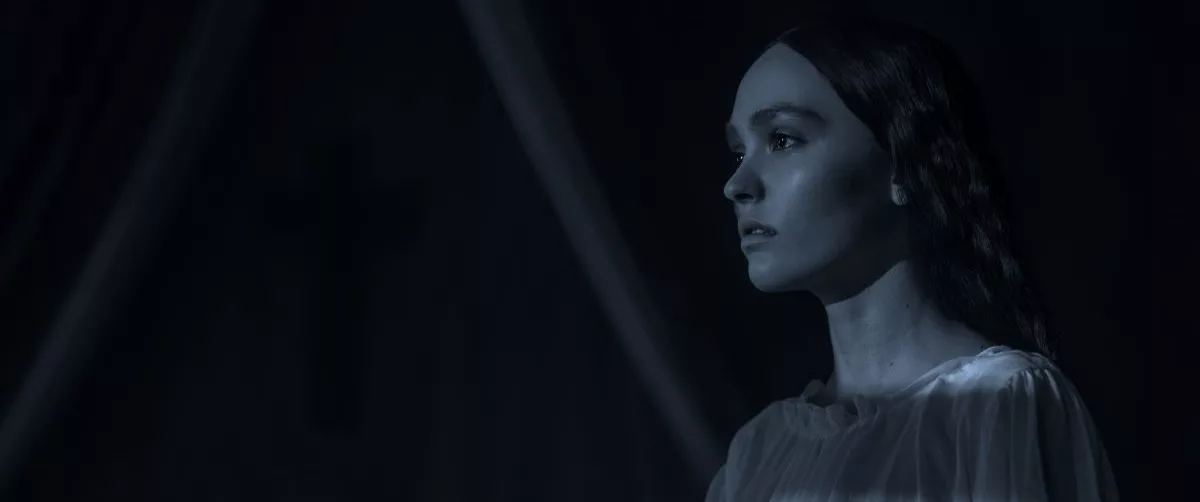
Nosferatu is rated R by the Motion Picture Rating (MPA) for bloody violent content, graphic nudity and some sexual content.
“Nosferatu” is an experience that lingers in the bones: cryptic, beautiful, unnerving in a way that feels almost sacred. Eggers, the singular visionary behind The Witch, The Lighthouse, and The Northman, is one of the rare directors capable of leaving his modern sensibilities at the door. There are no winking metaphors here, no clever analogies to soothe our contemporary ears just the uncanny rendered as tangible reality. In Eggers’ world, witches are real, curses have teeth, prophecies strike true, and a vampire isn’t merely a creature of folklore but a force capable of bending reality itself through sheer, unadulterated malice.
Recommended: The Running Man (2025) Parents Guide
Watching Eggers’ Nosferatu, you get the sense that the story might be narrated by the vampire or perhaps by one of his haunted victims. A low, almost bodily rumble hums constantly through the soundtrack, a moaning vibration that makes the air itself seem alive. The camera glides, drifts, and hovers through castle corridors, into rooms where sleepers writhe in the grip of terror, over landscapes that are both vividly real and strangely miniature, as if someone had built a model world only to cast it in shadow. When a giant silhouette falls across 19th-century German and Eastern European vistas, it is at once painterly and palpable, threatening yet mesmerizing.
Eggers’ film draws from multiple sources. The original 1924 silent film, Nosferatu: A Symphony of Horror, is the most obvious influence, yet there is also Bram Stoker’s Dracula and Tod Browning’s 1932 adaptation. And then, unexpectedly, Francis Ford Coppola’s 1992 Bram Stoker’s Dracula a film that is almost a genre unto itself, silent-film homage fused with Japanese sci-fi aesthetics makes a curious cameo in Eggers’ imagination. What Eggers seems to have borrowed is Coppola’s obsessive, trans-temporal romance: the stalker-like devotion of Nosferatu, here Count Orlok (Bill Skarsgård), to Ellen Hutter (Lily-Rose Depp), the young socialite whose waking and sleeping thoughts he invades with escalating insistence. Robert Calhoun, author and podcaster, posits that Coppola may have drawn this from The Mummy; Eggers, in turn, reanimates it with a slow, inevitable dread.
Recommended: Trap House (2025) Parents Guide
The third point of this twisted narrative triangle is Thomas Hutter, Ellen’s husband, played by a beguilingly naive Nicolas Hoult, making his second foray into Bram Stoker territory after Renfield. He sets out from England with pragmatic ambitions buy a castle, satisfy his London-based employer, improve his family’s fortunes but instead becomes ensnared in Orlok’s obsessive orbit. Meanwhile, Willem Dafoe, in a poker-faced yet quietly magnetic turn, embodies Professor Albin Eberhart Von Franz, the Van Helsing figure. He exudes the quiet authority of a man who understands horrors that others cannot even articulate, trapped in a world unprepared for the scale of the evil he confronts.
Eggers’ meticulous immersion in folklore and history is evident on every frame. This is a Nosferatu shaped not by previous films, but by research and reverence for the source material. The vampire’s essence its grotesque, predatory core emerges not just in his human-facing form but in the very way he moves, breathes, and asserts his presence. What we see on screen is a monstrous mammal with a hint of humanity, a vision that feels simultaneously alien and horrifyingly tangible.
Also Read: The Things You Kill (2025) Parents Guide
Skarsgård’s Nosferatu is unlike any incarnation before him. Far from the familiar fanged, taloned specter of Murnau’s original, this version resembles a malevolent Nutcracker come to life, the color of almost-decayed flesh, utterly dead yet undeniably alive. His voice a deep, rumbling timbre, drenched in self-absorption and melancholy seems to emanate from nowhere and everywhere at once, an auditory embodiment of dread. Skarsgård may have been typecast in horror since It, but here he channels something timeless, becoming, in essence, a 21st-century Lon Chaney: a performer who physically and psychologically disappears into character, leaving the audience with a presence that is disturbingly, inescapably real. You don’t watch a performance you inhale it, feel it, recoil and marvel in equal measure. The rot, the decay, the unrelenting malevolence: it is tangible.
Lily-Rose Depp offers a counterpoint to Skarsgård’s corporeal horror, and she does so with astonishing subtlety. She is less prosthetic, more kinetic: limbs twisting, body shivering, every motion a conduit for Nosferatu’s invasive evil. The contortions, reportedly achieved without visual effects, are themselves a kind of physical poetry and one hopes she has a chiropractor on speed dial. Ultimately, it is her story as much as anyone’s; she sees, feels, and responds to forces that no one else can comprehend.
You May Also Read: Jay Kelly (2025) Parents Guide
Eggers’ films are always immersive, and Nosferatu is no exception. There is no standing outside the period, no ironic distance, no modern sensibility smirking at the “primitive” beliefs of the 19th century. The director makes it feel as though Sigmund Freud and Carl Jung never existed, and that the abundance of images and symbols are accidental byproducts of lived experience, not conscious research imposed upon the narrative.
Beyond the terror, the film functions as a subtle history lesson. It conveys more effectively than any vampire movie before it the deep-seated dread that “civilized” English audiences of Stoker’s era felt toward the unknown expanses of Eastern Europe: its fairy-tale forests, its massive wolves, its people as inscrutable “Other.” Gothic and horror fiction overlapped so completely during this era that it is hard to separate the foreign lover from the secretive destroyer, the romantic from the threatening. Eggers captures that ambivalence beautifully: a world where curiosity and fear are inseparable companions.
Technically, the film is staggering. Wind, rain, darkness they all seem to serve Nosferatu’s will. The monster’s malevolence feels capable of bending the very mechanics of the movie: the frame quivers, the images shudder, the air seems electrically charged. The modern techniques used to make the film give it a tactile authenticity, yet it carries the aura of an artifact from another century, like a cursed tablet discovered in a tomb. Watching it, I was transported back to childhood memories of The Exorcist, the sense of witnessing a documentary of evil so potent it seemed dangerous simply to behold. That feeling the dread that the screen itself might be tainted is alive again in Eggers’ work.
Detailed Content Breakdown for Parents
Violence & Intensity: High. The film features very graphic vampire attacks, throat‑biting, gushing blood, plague deaths, body horror, rats, a decayed corpse, nightmarish sequences of people writhing and being consumed. Kids‑in‑Mind rates the violence/gore at 8/10. If your child is disturbed by blood, mutilation, or relentless dread, this is not light viewing.
Language: Moderate to mild profanity and insults; few instances of strong curse words. More pervasive is the tone of menace, occult language, and religious exclamations (e.g., “for Heaven’s sake,” “what the Devil”).
Sexual Content / Nudity: Significant. There are scenes of nudity (female and male), sexualized feeding (vampire biting a woman’s chest), passionate kissing, bodily exposure in nightmares, and strong erotic undertones interwoven with violence. This is clearly adult territory.
Drugs, Alcohol & Smoking: Minimal but present. Some alcohol consumption and smoking/pipes appear. These are not a major focus.
Parental Concerns
The gore and body horror are intense and graphic; younger or sensitive children are likely to be very unsettled.
The combination of sexuality and violence (especially vampire bite scenes) may be disturbing and borderline erotic in tone.
The horror is unrelenting and atmospheric there are few respite moments, which means sustained tension.
Not appropriate for children or most younger teens; even older teens should be cautious this film sits firmly in adult territory.
Released on December 25, 2024

Stephanie Heitman is a seasoned journalist and author dedicated to helping parents navigate the world of Hollywood entertainment through thoughtful, family-oriented film reviews. With over a decade of experience in writing and a passion for fostering safe, enriching viewing experiences, Stephanie launched Parentguiding.com to provide parents with the insights they need to make informed choices for their families.