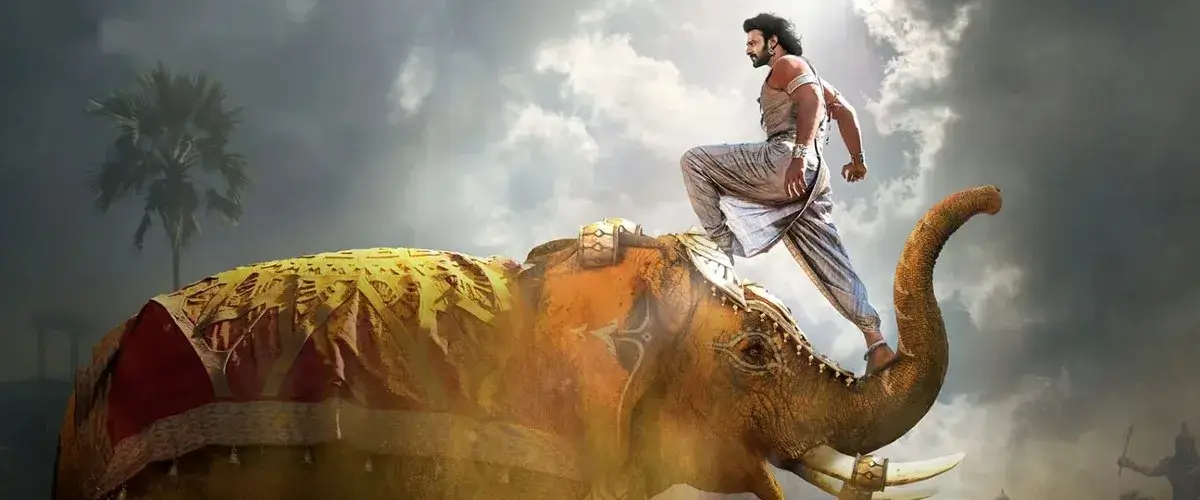
Less isn’t always more. Sometimes less is just… less. That’s the lesson of Baahubali: The Epic, the newly remastered, re-edited version of the two-part fantasy saga that first catapulted S.S. Rajamouli (RRR) to international stardom. This version compresses Baahubali: The Beginning and Baahubali 2: The Conclusion into one long feature, cutting more than eighty minutes from the combined five-hour story. On the surface, that might sound like a smart trade a chance to revisit Rajamouli’s grand, larger-than-life world on the big screen without committing your entire afternoon. But once you settle into it, you begin to feel what’s missing. The film still has its sweep and spectacle, but its heartbeat has been muffled.
Recommended: Batman: Revolution 2025 Parents Guide
The second half, drawn mostly from The Conclusion, still holds up beautifully. The rhythm is intact; the grandeur remains. But the connective tissue those smaller, vital scenes that gave the saga its emotional weight has been shaved away. Amarendra Baahubali (Prabhas), that noble ruler whose death becomes legend, now feels more like an outline than a man of myth and flesh. The story’s frame a tale told across generations, with his son Mahendra (also Prabhas) taking up the mantle to avenge his father is almost forgotten until much later, when the film remembers to loop back. By then, something fundamental has been lost: the slow burn of legacy, the sense of how one generation’s virtues echo into the next.
Most of what’s gone comes from The Beginning, which showed us what Mahendra inherited his curiosity, his moral compass, his restless compassion. Those qualities were once grounded in his relationship with his adoptive mother Sanga (Rohini), the steady leader of the Amburi tribe, and his encounters with Avanthika (Tamannaah Bhatia), the rebellious warrior who pulls him toward his destiny. Some of that remains, but much of the world that shaped these people the friendships, the lessons, the quiet human moments is missing.
And no one suffers more from this compression than Kattappa (Sathyaraj), the loyal general whose choices define both father and son. Without a few key scenes, his motivations wobble. You sense gaps emotional gaps, logical ones. That beautiful conceit from Queen Sivagami (Ramya Krishna), the imperious matriarch who rules with both wisdom and pride “Only when the future king steps outside the palace walls can he understand the trials of his people” used to resonate like a moral bell. Now it feels like a line from a story we only half remember.
The Baahubali films were never just fantasy adventures. They were meditations on leadership, morality, and the burden of power wrapped in myth, yes, but driven by deeply human concerns. Amarendra’s strength wasn’t just his sword arm; it was his compassion. Without the quieter passages that revealed that, we’re left mostly with the grandeur the towering battles, the breathtaking sets, the camera sweeping across kingdoms. It’s all still there, still magnificent. But like an epic poem missing a few stanzas, the music feels off-key.
To compress both films into a single “epic” is like turning a double album into a greatest-hits CD. You still get the highlights, but not the journey. Baahubali: The Epic isn’t a bad film — far from it. It’s glorious to look at, a feast of color and motion and conviction. But you can feel Rajamouli clipping his own wings, tightening his vision for a post-RRR audience that perhaps expects slicker pacing and less emotional digression. The irony is that Baahubali’s original appeal lay in its excess — its willingness to sprawl, to breathe, to let majesty coexist with playfulness.
It’s true that many came to Baahubali because of its astonishing battle scenes those sequences still rank among the most exciting ever staged in modern cinema, drawing inspiration from The Lord of the Rings and Braveheart, yet grounded in something distinctly Indian. But the films endured because they weren’t afraid of melodrama. Rajamouli has a gift for earnestness the ability to stage a love scene or a royal argument with complete, unapologetic sincerity.
You might, for instance, remember (and perhaps wince at) the early scene in which Mahendra “romances” Avanthika by giving her a surprise makeover. Even in its awkwardness, it had a point: both father and son are innocents, guided more by instinct than understanding. The scene drew a line between them men shaped by their hearts, for better and worse.
By streamlining Amarendra’s story, the film loses that warm undercurrent of camaraderie. Take Kattappa again: in the original, there’s a small, lovely moment where Amarendra insists he eat from the same plate, defying caste rules. It’s a gesture that says more about the man than any speech could — and it later ripples forward when Amarendra’s queen, Devasena (Anushka Shetty), asks Kattappa to hold their newborn first. Those connections made the film breathe. Without them, we see the plot but feel less of the pulse.
Even the minor characters lose their footing. Devasena’s hapless brother-in-law, Prince Varma (Subbaraju), once provided a light comic contrast his bungled attempt to split a tree stump mirrored Amarendra’s effortless grace. Cutting his earlier scenes makes him less a person and more a punchline.
Still, once Baahubali: The Epic gets past its surgical opening and eases into its second half, the grandeur returns. After the intermission, the film begins to find itself again that stately rhythm, that operatic confidence. You remember why Rajamouli became a global name. He knows how to fill the screen with movement and emotion, how to make heroism feel both cosmic and intimate. By then, you can settle in, surrender to the spectacle, and let the film wash over you as it always could.
In the end, this new version doesn’t redefine Baahubali; it reframes it. It’s a reminder that Rajamouli’s art thrives on abundance on the belief that too much, done with sincerity, can still be just right. Baahubali: The Epic is magnificent but diminished, a masterwork wearing a smaller crown. Watching it, I found myself longing for the unruly generosity of the original the moments that made the kingdom feel not just grand, but alive.
Detailed Content Breakdown for Parents
Violence & Intensity: The film includes frequent large-scale battle scenes, sword-fights, duels, and scenes of death, injury, and war. Though not grotesquely graphic (i.e., it does not linger on gore or extreme mutilation), the intensity is high and sustained. For example, characters fight in large armies, there are betrayals, executions and rescue/escape sequences.
Language: The language is moderate. There are no heavy curses or explicit slurs widely reported. The tone is dramatic, and some lines may be delivered in a heightened, epic style rather than natural colloquial speech. According to the IMDb parents guide the rating for “Profanity” is mild.
Sexual Content / Nudity: There is very little nudity, and any romantic material is mild. No explicit sex. One critic notes a makeover scene (in the original films) that might be awkward for younger viewers, but in this version much of that has been trimmed. Still, the implication of romantic interest is present.
Drugs, Alcohol & Smoking: Minimal to none. No major plot-point is drug or alcohol abuse. I found no credible reports of significant depiction of smoking or drug use in this version.
Parental Concerns
- The violence is more intense than many typical family-films; younger children may find some scenes distressing or confusing.
- The film runs very long (around 3 hours 44 minutes) – attention spans may be challenged.
- Although trimmed, there remain scenes of romance that may be awkward or culturally dated in how they present gender roles. Some critics point out that the depiction of female characters still caters to the male gaze.
- The political/court intrigue may require older viewers to follow how characters shift allegiances and betray one another.
- Not yet clearly available on streaming platforms (for home viewing) at time of writing watching in a theatre might be a big time commitment.
Best suited for ages 13 and up (teens and older) with a parent/guardian for discussion.

Stephanie Heitman is a seasoned journalist and author dedicated to helping parents navigate the world of Hollywood entertainment through thoughtful, family-oriented film reviews. With over a decade of experience in writing and a passion for fostering safe, enriching viewing experiences, Stephanie launched Parentguiding.com to provide parents with the insights they need to make informed choices for their families.