Downton Abbey: The Grand Finale is Rated PG by Motion Picture Rating (MPA) for suggestive material, smoking and some thematic elements.
The rise of the “eat the rich” mood in recent years makes “Downton Abbey”’s continued presence in cinemas feel oddly out of step. Julian Fellowes has always been unabashedly fond of his aristocrats upstairs arguably more so than the servants downstairs. Yet the saga has always been about decline: the fading of the British aristocracy as the modern world encroached. That makes it strangely timely, maybe even essential, in our current moment. With today’s real-life wealthy clinging desperately to power instead of stepping aside, perhaps the Granthams are the perfect fictional aristocrats to model another path. Fellowes certainly presents them as such in this “Grand Finale,” where, at last, the household is forced to reckon with the end of its golden era. True to form, they face it with elegance setting out, intentionally or not, a hopeful roadmap for the privileged classes of today.
We begin in the 1930s, where the Crawleys are fully immersed in the London season—attending plays, parties, and mingling with high society. That glitter dims quickly when Lady Mary’s (Michelle Dockery) divorce scandal makes the papers, sending polite society into a tizzy. To make matters worse, the family’s finances are in freefall, and the fate of their London townhouse hangs in the balance. Across the Atlantic, Cora’s (Elizabeth McGovern) brother Harold (Paul Giamatti) arrives with his business partner Gus Sambrook (Alessandro Nivola), who’s eager to rope the Crawleys into his schemes. Meanwhile, back home, the county fair looms once more, and Isobel (Penelope Wilton) clashes with the crusty Sir Hector Moreland (Simon Russell Beale) over modern reforms, dragging Carson (Jim Carter) and Daisy (Sophie McShera) into the fray.
As always with “Downton,” the stakes are more genteel than dire. The county fair subplot, hinging on something as obvious as providing a space for lost children, feels designed for an easy victory over a grumbling traditionalist. Mary’s social struggles following her divorce may sting, but given her history and our hindsight she’ll bounce back, as always. Only Sambrook’s shady dealings provide any real tension, and even that is resolved with familiar, almost breezy neatness. But that’s part of the charm: “Downton” has always thrived on trivial aristocratic problems, solved with wit, warmth, and the occasional servant’s clever intervention. Fellowes’s knack for a sharp, unexpected one-liner still lands beautifully, keeping the audience smiling even when the drama is feather-light.
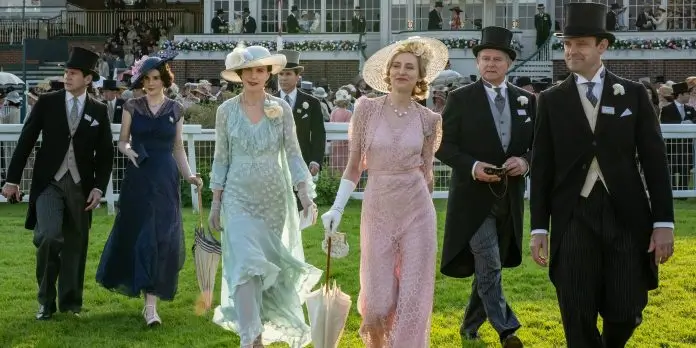
What truly keeps the franchise enchanting, though, is its immaculate craft. The sets and costumes remain jaw-droppingly beautiful, with London interiors adding fresh textures to the visual palette. Seeing the private lives of Carson & Mrs. Hughes and Anna & Mr. Bates beyond the halls of Downton adds welcome intimacy. Costume designer Anna Robbins surpasses herself whether with sumptuous evening gowns or the breathtaking Ascot ensembles, she signals the changing times through fashion, even if the Crawleys themselves lag behind.
And then, of course, there’s Lord Grantham. One of the series’ longest-running frustrations has been Robert’s (Hugh Bonneville) inability or unwillingness to cede control of the estate to Mary. Time and again, Fellowes stalled their progress, trapping both characters in endless repetition. Here, finally, Robert is allowed space to reflect, to accept his waning role in both family and society. The effect is moving, and pointed. In an age when older generations refuse to hand over the reins, Robert’s bittersweet surrender lands as both a personal triumph and a cultural lesson. The Crawleys have always been portrayed as benevolent guardians of wealth, and here, Fellowes drives the point home: if even Robert can recognize when it’s time to step aside, what excuse do today’s power-hoarders have?
“The Grand Finale” succeeds not just as a gently persuasive social parable but also as a heartfelt farewell to the franchise. The ensemble remains as lovable as ever, and it stings just as much to say goodbye now as it did when the series ended nearly ten years ago. Fellowes ensures that almost every character nearly twenty strong gets a grace note to close their arc, while the dialogue sparkles with a little extra polish. The cast rises to the occasion, clearly aware that this is the last bow, and even the performers saddled with weaker material manage to shine. Kevin Doyle’s long-suffering Molesley, for instance, somehow preserves his dignity through sheer commitment. Newcomers fit in seamlessly too, particularly Beale’s deliciously pompous Sir Hector and Arty Froushan’s delightfully sharp Noël Coward.
Closing a television series is one thing; ending it again on the big screen is another challenge entirely. With Simon Curtis returning to direct, balancing grandeur with pace, Fellowes pulls it off. The ending may not surprise anyone who’s been along since the first series, but that’s the point. “Downton Abbey” has always been a high-class soap dressed in period finery a reassuring blend of cliché and charm, comfort food for the soul. And while “The Grand Finale” rarely pushes itself beyond that formula, its last act finds a tender, hopeful resonance that feels almost radical today. To walk out of the theater genuinely believing in a brighter, kinder future well, that’s more than pleasant escapism. That’s a small miracle. Long live “Downton Abbey,” indeed.
Content Considerations:
Mature Themes: The film addresses complex issues such as divorce, financial instability, and the shifting roles of women in society. These themes are explored with sensitivity but may prompt thoughtful discussions among older children and teens.
Romantic Elements: There are several romantic subplots, including a portrayal of a same-sex relationship. While these are handled with respect and subtlety, parents may wish to consider the appropriateness for younger viewers.
Mild Language: The dialogue includes occasional mild language and period-specific expressions. These are infrequent and unlikely to be offensive to most audiences.
Smoking and Drinking: Characters are occasionally depicted smoking and drinking, consistent with the historical setting. These instances are not glorified but are present as part of the period’s social norms.
Suitability for Children:
Given its PG rating, the film is generally suitable for children aged 10 and above. Younger viewers may find some of the thematic content challenging or less engaging. However, for families familiar with the series, the film provides a satisfying and emotionally resonant conclusion.
Final Thoughts:
Downton Abbey: The Grand Finale is a beautifully crafted film that offers a thoughtful exploration of change, legacy, and the complexities of family life. While it contains elements that may require parental discretion, it also provides an opportunity for meaningful conversations about history, society, and personal values.
Highly Recommended:
The Long Walk 2025 Parents Guide
The Threesome (2025) Parents Guide
The Conjuring: Last Rites 2025 Parents Guide
Love, Brooklyn (2025) Parents Guide

Stephanie Heitman is a seasoned journalist and author dedicated to helping parents navigate the world of Hollywood entertainment through thoughtful, family-oriented film reviews. With over a decade of experience in writing and a passion for fostering safe, enriching viewing experiences, Stephanie launched Parentguiding.com to provide parents with the insights they need to make informed choices for their families.