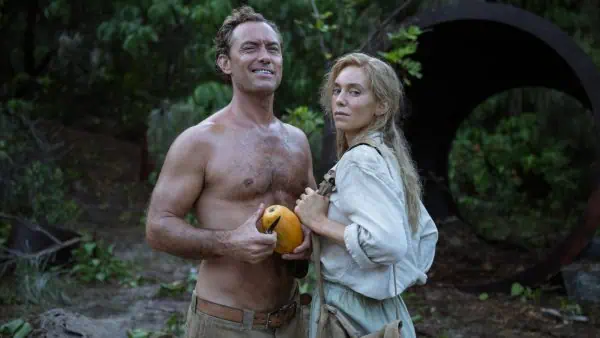
Eden is Rated R by Motion Picture Rating (MPA) for some strong violence, sexual content, graphic nudity and language.
Eden 2025 – Movie Review
Humanity, it seems, just can’t resist ruining its own best intentions. Eden dramatizes the real-life experiment of a German philosopher who, as fascism swelled in 1929, fled civilization to carve out a utopia on the Galápagos island of Floreana. His manifesto for a new way of living was still unfinished, but that didn’t stop him from dragging his lover into the wilderness with promises of a better world. Naturally, it all unravels when others needier, jealous, and far less ascetic invade his supposed sanctuary.
With Jude Law, Ana de Armas, Vanessa Kirby, Daniel Brühl, and Sydney Sweeney in the ensemble, this could have been a biting inversion of The White Lotus not pampered vacationers at a luxury resort, but beautiful people trapped on a brutal island with little fresh water and even less comfort. Instead, under Ron Howard’s heavy-handed and graceless direction, the film lurches between moments of genuine intrigue and stretches of overwrought melodrama.
To his credit, Howard has never shied away from reinventing himself. Across nearly five decades, he’s ping-ponged between broad comedies (Grand Theft Auto, 1977), prestige Oscar plays (A Beautiful Mind, 2001), and limp franchise fodder (the Dan Brown adaptations). In recent years, he’s leaned heavily on fact-based dramas, crafting work that’s accessible but rarely challenging. That’s the crux of the problem here: Eden demands a filmmaker willing to dive headfirst into the ugliest corners of human nature, and Howard, ever the optimist, simply doesn’t have that darkness in him. Noah Pink’s script (he also wrote Tetris, 2023) insists that “hell is other people,” but Howard’s instincts are to soften, reassure, and seek silver linings. He’s fundamentally miscast behind the camera.
And it’s a shame, because the story is rife with unsettling modern echoes. Dr. Friedrich Ritter (Law) flees Germany with the bleak conviction that history is doomed to repeat itself “Democracy, fascism, war. Repeat.” His companion, Dore Strauch (Kirby), who suffers from multiple sclerosis, follows him into exile while he drafts what he believes will be a philosophy capable of saving humankind. For Ritter, the meaning of life boils down to pain, which begets truth, which in turn leads to salvation. Of course, the German press, entranced by the romanticism of his escapade, publicizes his letters, inadvertently inspiring others to follow. Soon, Heinz Wittmer (Brühl), a weary veteran of the Great War, arrives with his much younger wife Margaret (Sweeney) and his ailing son Harry, hoping the island’s climate will ease Harry’s tuberculosis. Ill-prepared but stubborn, the Wittmers prove surprisingly resilient.
Then comes the real disruption: the Baroness Eloise Bosquet de Wagner Wehrhorn (de Armas), a brazen opportunist bent on transforming Floreana into her own exclusive resort. Flanked by her lovers and hangers-on, she crashes through the fragile equilibrium like a wrecking ball. Where Ritter demonstrates grim resolve he even had all his teeth removed to ward off infection the Baroness drains drinking water for a casual swim and later resorts to stealing food when her own supplies run dry. As a character, she’s both detestable and magnetic, a portrait of decadent excess hiding behind aristocratic entitlement. At one point, she proclaims herself “the embodiment of perfection,” though she’s more like a black hole, consuming everyone and everything around her.
Visually, Howard can’t seem to find his footing. Sweeping drone shots clash with claustrophobic close-ups, while gratuitous nudity and sex scenes feel more like an attempt to seem “adult” than an organic extension of the story. The performances are equally uneven. Law, Kirby, and Brühl turn in strong, grounded work, while Toby Wallace is convincingly menacing as the Baroness’s enforcer. De Armas is excellent at weaponizing charm into something corrosive, though the film noticeably sags once her character exits. The real weak link is Sweeney, miscast as the film’s moral anchor. Her performance veers into unintentional comedy, her accent wandering between continents, her modern energy clashing against the period. Saddled with her in the closing stretch, the movie loses what little dramatic momentum it had.
When Howard and editor Matt Villa run out of ideas, they resort to animal cutaways iguanas and seabirds attacking each other, a blunt metaphor for Darwinian survival. But the script can’t decide what it wants to say. Is it about Ritter’s cycle of political collapse? About man’s arrogance toward nature? About survival of the fittest? The result is a scattershot critique of human vanity and greed, never honed into a cohesive vision. Only in the epilogue, with the revelation that the Wittmers’ perseverance led to the still-operating Wittmer Lodge, does the film land on something resembling meaning: survival comes from cooperation with nature, not conquest over it.
But Howard never digs into that idea. He’s too fixated on conflict, too hesitant to embrace the moral ugliness the story demands. Eden could have been a savage, timely parable. Instead, it’s a strangely hollow survival drama handsome on the surface, but unwilling to wrestle with the darker truths simmering beneath.
Eden 2024 Parents Guide
Violence: The island is less Eden and more “Lord of the Flies with better cheekbones.” People smack each other around, steal food like seagulls at a beach picnic, and generally behave as though “civilization” was a rumor they once heard. Blades come out. Tempers flare. There’s blood, though not Chainsaw Massacre levels more “I really regret leaving Germany for this.” Also, Ron Howard, in his infinite wisdom, keeps cutting to animals eating each other as if we wouldn’t get the Darwin metaphor. Yes Ron, nature is red in tooth and claw. Thanks for the biology lesson.
Language: Everyone curses, though the film’s real obscenity is Sydney Sweeney’s accent, which ping-pongs between continents like a drunken backpacker. You’ll hear the usual four-letter suspects, deployed in fits of rage and desperation, but nothing so shocking you haven’t already heard from your uncle after three bourbons.
Sexual Content: There’s nudity plenty of it. But don’t expect eroticism so much as Ron Howard desperately whispering, “See, I can do adult material too!” Actors disrobe, writhe, and perform obligatory island trysts, but it’s less sexy and more like watching beautiful people try to remember if coconuts count as lube. Ana de Armas slinks through her role with villainous glam, but even she can’t save these scenes from feeling like clumsy attempts at “serious cinema.”
Substance Use/Drugs: Nobody’s passing joints around the campfire this isn’t Beach Bum. Instead, the intoxicant of choice is plain old human ego, which everyone gulps down like seawater. The Baroness guzzles self-importance. Ritter snacks on pain and philosophy. Meanwhile, the rest are just high on delusion. Actual booze or drugs? Not much to report. Just a steady drip-feed of hubris until the whole social experiment collapses like a bad Airbnb weekend.

Stephanie Heitman is a seasoned journalist and author dedicated to helping parents navigate the world of Hollywood entertainment through thoughtful, family-oriented film reviews. With over a decade of experience in writing and a passion for fostering safe, enriching viewing experiences, Stephanie launched Parentguiding.com to provide parents with the insights they need to make informed choices for their families.