There’s something electric about coming back to Strange New Worlds. You feel it the moment the Enterprise glides back onto the screen—that mix of wonder, tension, and a big beating heart that’s always made the best Star Trek resonate. And with Season 3, that feeling returns in full force… most of the time.
After a nail-biting Gorn cliffhanger in Season 2, expectations were sky-high. Would the show double down on grit and stakes? Would it keep its genre-hopping energy alive without losing focus? The answer is… mostly yes. Season 3 isn’t flawless—there are tonal swings that don’t always stick the landing—but it’s confident, entertaining, and emotionally sincere in a way that few sci-fi shows dare to be.
The Story & What It Tries to Say
The season kicks off with “Hegemony, Part II,” and it wastes no time diving headfirst into chaos. Captain Pike (Anson Mount) is torn between orders and conscience, risking everything to rescue his crew from the terrifying grip of the Gorn—a species that’s been reimagined here not as rubber-suited monsters but as cold, calculating predators. The rescue mission is tight, visceral, and full of old-school Trek ingenuity, with one standout sequence involving an artificial solar flare to manipulate the Gorn’s biology. It’s pulpy sci-fi brilliance.
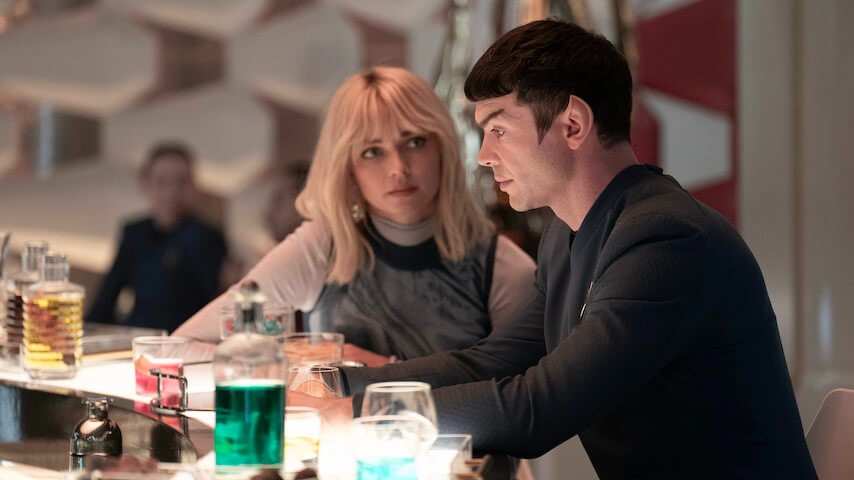
Then, in classic Strange New Worlds fashion, the series does a 180 and gives us “Wedding Bell Blues,” an episode that’s basically a romantic holodeck fever dream featuring Spock (Ethan Peck), a possible marriage proposal, and the return of the gleefully chaotic Trelane (played with scene-stealing delight by Rhys Darby). It’s weird. It’s theatrical. It’s… sort of beautiful, actually.
And that’s the joy of this season: it bounces between genres like a starship hopping across nebulae. Noir mysteries, psychological horror, comedic romps, high-stakes political thrillers—each episode feels like a new flavor, yet the characters remain the emotional throughline holding it all together.
But underneath the genre play, there are meaningful themes being explored. Spock continues to wrestle with identity and love, especially as his relationship with Chapel (Jess Bush) reaches a breaking point. Pike’s leadership is repeatedly tested—not just through external threats but internal doubts. Can he remain the beacon his crew needs while still honoring his own humanity?
If there’s one unifying thread, it’s the idea of balance: logic vs. emotion, duty vs. desire, and personal fear vs. collective hope. It doesn’t always articulate its message as cleanly as it wants to—but it always tries. And that effort, that reaching for meaning, makes it feel deeply human.
Performances & Characters
Let’s talk about this cast. What a gift.
Anson Mount continues to bring something rare to the role of Captain Pike: a softness that doesn’t undercut authority. His Pike is commanding, yes—but also kind, deeply empathetic, and visibly wounded by the costs of leadership. It’s a performance that anchors the entire show.
Ethan Peck’s Spock gets some of his most layered material yet. There’s a vulnerability just under his Vulcan surface that Peck handles with incredible nuance, especially during his unraveling relationship with Chapel. You can feel the heartbreak radiating beneath his reserved exterior.
Jess Bush, too, gets a lot to chew on this season, and she runs with it. Her version of Chapel is smart, fiery, and emotionally raw in all the right ways. She’s not just Spock’s romantic interest—she’s a person with her own ambitions, doubts, and inner battles.
Melissa Navia finally gets a moment in the spotlight as Ortegas, and it’s overdue. Her wit and charm have always made her stand out, but this season gives her actual depth and growth. Christina Chong’s La’An continues to be one of the most compelling characters—tough but never one-note. And Martin Quinn, the new Scotty, slips into the ensemble like he’s always been there. He brings just the right mix of charm and chaos.
The chemistry between this ensemble? Off the charts. Whether they’re exchanging banter on the bridge or grappling with loss and regret in quieter moments, the emotional fabric of this crew feels lived-in and real.
Direction, Visuals & Pacing
Visually, Strange New Worlds has never looked better. The production design hits that sweet spot between retro and futuristic—it honors Trek’s roots while still feeling slick and modern. The color palette is rich, especially in episodes like “Through the Lens of Time,” where cinematography practically tells a story of its own.
Some of the standout visual moments: the eerie interiors of Gorn hives, the sweeping views of alien worlds drenched in saturated neon light, and the holodeck sequences that gleefully jump into different aesthetics without apology. Directors like Jonathan Frakes lend the season a cinematic flair that elevates even its more whimsical entries.
Pacing-wise, it’s a bit of a mixed bag. The episodic structure remains a double-edged sword. On the one hand, it allows each episode to feel like its own mini-movie—complete with unique tone and stakes. On the other, it occasionally diffuses momentum, especially when you’re craving resolution on overarching plot threads.
But even when an episode misfires tonally, it rarely drags. There’s an energy here—a confidence in the storytelling—that makes it easy to forgive a few detours along the way.
Star Trek: Strange New Worlds Season 3 Parents Guide
Rating & Overview
This season is rated TV‑PG, which is broad—but here’s the reality check: Strange New Worlds is generally safe for tweens and up, though a few episodes might give younger children pause.
Violence & Scary Moments
Content: The season continues the franchise’s tradition of episodic adventures—aliens, spaceship battles, even a creepy horror episode involving an away mission gone wrong. Expect a couple of tense scenes (including abduction, occasional sudden threats, and bloodless but suspenseful moments)
Language: Generally limited to mild profanity (think: “damn,” maybe “hell”). There’s no heavy swearing. Think of it as classic space-invader PG dialogue.
Romance & Relationships: A mild to moderate presence across episodes. We’ve got a Spock-centric triangle, Bruce “rom-com” vibes, and some flirtation sprinkled in.
Substance Use: Alcohol: Mild—maybe a toast in Ten-Forward or a celebratory glass, but nothing excessive.
Final Thoughts & Recommendation
At its best, Star Trek: Strange New Worlds – Season 3 reminds us why this franchise has endured for decades. It’s imaginative, character-driven, and unafraid to be heartfelt. It celebrates curiosity, connection, and the messy, beautiful contradictions of being human—or Vulcan, or Andorian, or something else entirely.
Is it perfect? No. Not every genre experiment lands. Not every character gets equal screen time. And sometimes the message gets lost in the metaphor. But when it works—and it often does—it’s magic.
This season is for longtime fans who want to see Star Trek evolve without losing its core ideals. It’s also for newcomers looking for sci-fi that isn’t just about tech and battles, but about people and principles. It doesn’t pander, but it welcomes you in.
Final Score: 8.5/10

Stephanie Heitman is a seasoned journalist and author dedicated to helping parents navigate the world of Hollywood entertainment through thoughtful, family-oriented film reviews. With over a decade of experience in writing and a passion for fostering safe, enriching viewing experiences, Stephanie launched Parentguiding.com to provide parents with the insights they need to make informed choices for their families.