Acres is Rated R by Motion Picture Rating (MPA) for strong bloody violent content and language
40 Acres Review – A Post-Apocalyptic Thriller with Soul, Sorrow, and a Shotgun
Directed by R.T. Thorne, best known for his work in music videos and TV, this Canadian indie feature may fly under the radar, but it delivers a rare kind of genre storytelling: intimate, layered, and deeply tied to cultural memory. Starring Danielle Deadwyler, Michael Greyeyes, and newcomer Kataem O’Connor, 40 Acres isn’t just about surviving the end it’s about what comes after, when you’re still carrying centuries of trauma, responsibility, and maybe just maybe hope.
The Story & What It Tries to Say
The story follows Hailey Freeman (Deadwyler), a once-soldier who now rules over a fiercely self-sufficient farm in rural Canada with her partner Galen (Greyeyes) and their blended family. It’s been 14 years since a fungal plague swept across the planet, wiping out animal life and crumbling the world as we knew it. Civilization, as far as we can tell, collapsed. There are no governments. No systems. Just the land, the scars, and whoever managed to survive it.
The Freeman family has turned their ancestral land into a stronghold. Barbed wire. Guns. Drills. This is not a commune it’s a fortress. The kids are homeschooled in combat and farming. There’s no electricity, no outside contact. The farm itself becomes almost a character: lush, fertile, and sacred in a world that’s otherwise dead.
But when Emanuel, the teenage son (O’Connor), sneaks past the perimeter and meets Dawn, a mysterious outsider, everything shifts. Dawn represents something the Freemans have been avoiding for over a decade: the unknown, the other, and the terrifying possibility of connection or contamination.
At its heart, 40 Acres is about legacy and land about the promises made to Black and Indigenous communities, broken and buried, and the trauma that still haunts those histories. The title alone is a loaded reference to “forty acres and a mule,” that long-denied restitution after slavery. And here we are, generations later, with descendants trying to protect a piece of land they earned, but never stopped having to fight for.
It’s also about control vs. freedom especially in a post-apocalyptic context. Is Hailey protecting her family or controlling them? Is fear of the world justified, or does it become its own kind of tyranny? These are big, messy questions, and the movie sits in that discomfort instead of trying to solve it neatly.
Performances & Characters
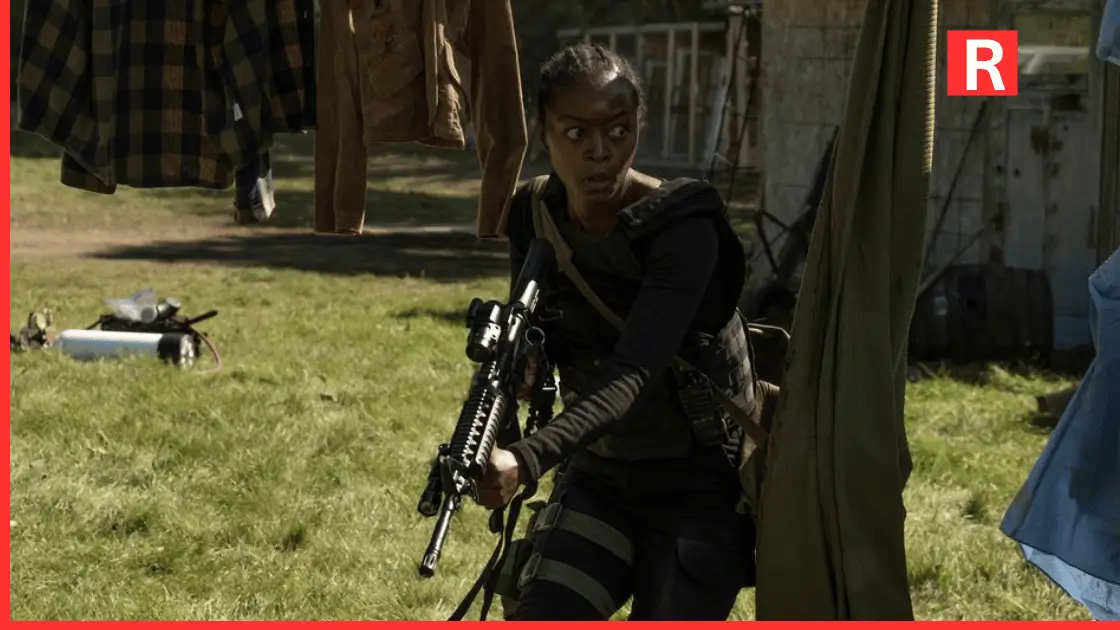
Let’s talk about Danielle Deadwyler first. If you thought she was powerful in Till, wait until you see her here. As Hailey, she’s not a stereotypical “tough mom” trope. She’s complex wounded, resourceful, terrifying at times, but also deeply loving. There’s a constant flicker behind her eyes, like she’s never not calculating threats. You believe she’s the kind of woman who’s made peace with killing to protect what’s hers and you ache for what that’s cost her.
Michael Greyeyes, as Galen, brings an essential calm to the film. He’s the counterbalance to Hailey’s edge. Where she sees danger, he sees possibilities. Their chemistry feels lived-in like a real couple who’ve shared unspoken grief for years and built something fragile out of the ashes.
Kataem O’Connor, as Emanuel, is the film’s emotional hinge. He’s a kid who’s never known the world before the collapse, and that curiosity burns inside him. O’Connor brings a softness and sincerity that plays beautifully against Deadwyler’s steely resolve. His scenes with Dawn are tentative, vulnerable, and a bit tragic like watching someone learn to dream in a place where dreaming is dangerous.
Dawn herself is an enigma, but a necessary one. She’s not just a plot device she’s the embodiment of everything the family fears, but also everything they’ve lost: trust, connection, and the potential for something beyond survival.
Direction, Visuals & Pacing
Director R.T. Thorne makes some bold choices here. There’s no heavy exposition. No clunky worldbuilding. We’re just there, on the farm, learning by watching. And that works in the film’s favor it feels lived-in, not explained to death. He clearly trusts the audience to keep up.
The cinematography by Jeremy Benning is stripped down but beautiful. The farmland is captured in soft, natural light almost serene during the day, but eerily isolated at night. And when violence erupts (and it does), it’s jarring and brutal in a way that feels real, not stylized.
There’s one action sequence around the midpoint that genuinely shocked me. Not just because of the violence, but because of the way it was shot. It’s quick, chaotic, and emotional. You don’t come away from it cheering. You come away rattled.
Now, full honesty: the pacing may test some viewers. This is not a fast movie. It builds. It broods. The first half is deliberately slow, and if you’re expecting a high-octane apocalypse thriller, you may grow impatient. But the tension simmering under the surface pays off—especially if you’re willing to sit in the film’s emotional discomfort.
40 Acres (2025) Parents Guide
Violence & Gore: There are close-up sequences of hand-to-hand combat, including axe strikes to the head and machete wounds that are realistically bloody. We see impact, aftermath, and sometimes the emotional fallout.
A few scenes involve point-blank gunfire, especially during home invasions and sieges. The camera doesn’t look away.
One moment involves hanging bodies, used as a threat. It’s disturbing, even though it’s not overly gory in itself more the implication than the detail.
Some intense fight scenes unfold in low light or flashlight glow, which amps up the tension in a very visceral, claustrophobic way.
Language: As with most R-rated dramas rooted in realism, the language is strong and consistent. Characters use words like “fk” and “st” fairly regularly, usually in high-stakes moments. There’s no comedic or casual swearing—it’s frustration, fear, and panic talking.
If you’re not fond of profanity or if your teen is still navigating boundaries around adult language, this might be a consideration. But it doesn’t feel gratuitous—it’s situational and authentic.
Sexual Content: There’s no nudity or romance here but there is a brief and somewhat awkward masturbation scene involving a teen boy and a drawing of a nude woman. It’s not graphic, but it’s very clear what’s happening.
That moment, while fleeting, may catch some parents off guard. It’s not meant to be titillating or shocking it’s more a glimpse into the emotional confusion and isolation this kid is going through. Still, you might want to skip past that scene if you’re watching with teens.
No other sexual content is shown, referenced, or explored.
Substance Use: There’s very little here in terms of drug or alcohol use. You may catch a drink or two in passing, but there’s no smoking, no drugs, and no substance-driven behavior. In a world where every breath might be your last, numbing out isn’t really part of the picture.
Final Thoughts & Recommendation
40 Acres isn’t trying to be the next Mad Max. It’s not chasing spectacle. It’s chasing truth—about land, family, grief, and what it means to protect a legacy in a world that’s already ended once before. It’s not flashy, but it is ferocious—in its quiet moments, its bursts of rage, and especially in its sense of place and purpose.
This is for the patient viewer. For fans of The Road, Leave the World Behind, or The Last of Us, who want a little more soul with their survival. It’s for people who appreciate character-driven drama that just happens to be set at the end of the world.
And most of all, it’s for people who know that the scariest part of an apocalypse isn’t the collapse—it’s what you’ll do to protect what’s left.
Director: R.T. Thorne
Writers: R.T. Thorne, Glenn Taylor, and Lora Campbell
Stars: Danielle Deadwyler, Kataem O’Connor, and Michael Greyeyes
Rating: 8/10
Release date: July 2, 2025 (United States)
Country of origin: Canada
Highly Recommended:
Best New Movies & Shows Coming to Netflix (July 2025)
Jurassic World: Rebirth 2025 Parents Guide

Stephanie Heitman is a seasoned journalist and author dedicated to helping parents navigate the world of Hollywood entertainment through thoughtful, family-oriented film reviews. With over a decade of experience in writing and a passion for fostering safe, enriching viewing experiences, Stephanie launched Parentguiding.com to provide parents with the insights they need to make informed choices for their families.