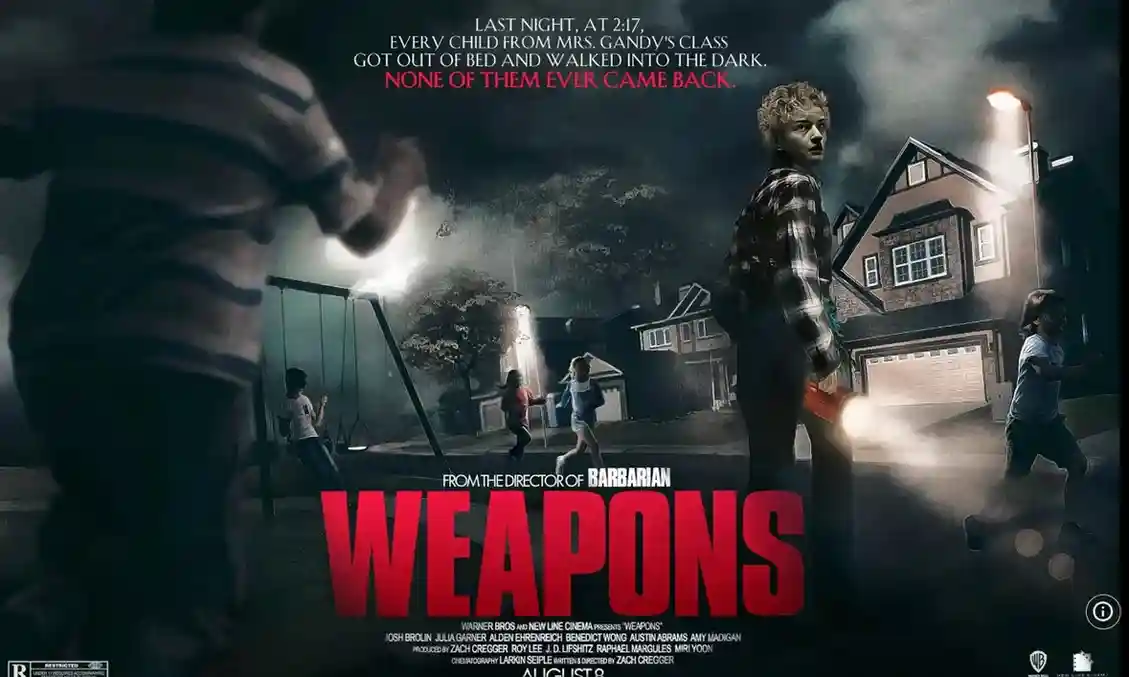
Weapons is Rated R by Motion Picture Rating (MPA) for strong bloody violence and grisly images, language throughout, some sexual content and drug use.
The Story & What It Tries to Say
The story follows a quiet, ordinary American town that’s suddenly and violently ripped out of its routine when something unthinkable happens: seventeen elementary school children vanish in the dead of night. No break-ins, no screams, no alarms they’re just gone. One child remains: a boy named Alex, sitting silently in the classroom, unable or perhaps unwilling to say what happened.
That image one child sitting in an empty classroom surrounded by vanished classmates feels like the kind of thing that haunts your dreams. And it sets the tone for what Weapons really is: not just a horror film, but a multi-layered mystery told through interlocking chapters, each from a different character’s perspective. It’s a structure that asks you to lean in and piece together not just what happened, but why it matters.
We begin with Justine Gandy (Julia Garner), a teacher who walks into her classroom that morning and finds the nightmare waiting. Her story is a slow burn of grief, confusion, and guilt. She’s not just reeling from the event she’s questioning her own sense of safety and purpose. Then there’s Archer Graff (Josh Brolin), the father of one of the missing children. He’s rugged, stoic, and slowly unraveling. His pain is different not intellectual like Justine’s, but primal. And then we meet Paul (Alden Ehrenreich), a police officer with a complicated past and an even more complicated connection to Justine. His chapter hints at buried secrets and the kind of trauma that doesn’t make headlines but quietly destroys lives.
Each chapter deepens the mystery and shifts our understanding of what’s going on. At first, you think this is about missing kids. Then it becomes about a community on the verge of collapse. Then it becomes something else entirely something eerie, metaphysical, and unsettling in a way that goes far beyond the realm of true crime.
There’s a scene wordless, chilling where children are shown reenacting a very specific and haunting pose: arms outstretched, frozen mid-run, like ghosts caught between worlds. It’s an echo of the infamous “Napalm Girl” photo, and it says more than any dialogue ever could. Cregger is playing with iconography, memory, and trauma, and how we process horror as a society.
As the film progresses, it becomes clear that Weapons isn’t about solving a mystery. It’s about sitting with one. It’s about the ache of not knowing. About grief that lingers without resolution. About the stories we tell ourselves to survive tragedy and the darker truths we ignore to feel safe.
There are echoes of Magnolia in the structure, Hereditary in the mood, and Barbarian in the way it toys with your expectations. But Weapons isn’t trying to be anything else. It’s carving out its own space, taking the risks most horror films wouldn’t dare to take.
What’s it really about? At its core, Weapons is a meditation on collective trauma. Not just the trauma of a single incident, but the way communities bury things, distort things, turn grief into spectacle or silence. It’s about how people break differently some inwardly, others in dangerous, external ways. And yes, there’s horror here, but it’s not just in the supernatural suggestion of what happened to those kids. The real horror is how the adults process it. How they don’t process it. How people weaponize pain when they don’t know what else to do with it.
Does the film succeed in what it’s trying to say? That depends on what you bring to it. If you’re looking for clean answers or a conventional resolution, you might walk away frustrated. But if you’re open to sitting in the ambiguity to feeling the discomfort and letting the questions linger then Weapons absolutely lands. It’s haunting because it doesn’t wrap things up. It stays with you because it dares to leave you with the echoes.
Highly Recommended:
Performances & Characters
Julia Garner grounds the film with emotional weight: her portrayal of Justine is raw and tremoring with loss. Brolin’s Archer balances vulnerability and steely grief as a father unraveling. Ehrenreich as Paul brings quiet tension his chemistry with Garner feels lived-in, though some critics noted that dynamic treads familiar ground. Amy Madigan delivers a surprising and memorable supporting turn. The standout is little Cary Christopher as Alex the lone child and Benedict Wong’s small but chilling appearances add real eeriness to the ensemble.
Some arcs (especially Garner/Ehrenreich’s) feel underserviced or overly familiar but still, this cast sells the blend of sorrow and dread exceptionally well.
Direction, Visuals & Pacing
Zach Cregger’s direction feels confident and eerily poised. Reminiscent of elevated arthouse horror, his camera moves glacially tracking characters, cutting to reveal hidden dread and the chapter structure keeps tension taut yet human.
Larkin Seiple’s cinematography captures both oppressive suburban daylight and ghostly twilight moods with finesse. The pace is deliberate occasionally frustrating when cutting away from reveals but that structure offers breathing room, even moments of absurd levity to reset before the next blow.
The editing by Joe Murphy and score (Ryan & Hays Holladay, plus Cregger himself) maintain a tight, immersive rhythm. Visuals like children moving in trance-like poses (arms outstretched an homage to the infamous “Napalm Girl” photo) send chills and linger long after the credits.
Weapons 2025 Parents Guide
Violence & Gore: including tense physical confrontations, injuries, and visceral imagery linked to the missing children that won’t look away. The horror can feel relentless and emotionally grating it’s not for the squeamish. The tone is grim, oppressive, intimate designed to unsettle.
Language: Characters often under duress drop multiple expletives, including words you wouldn’t expect rough language, unfiltered and intentional.
Sexual Content: While it’s not the film’s focus, there are brief sexual themes and innuendo, more present as tension than romance. Nudity is minimal and implied in scenes that feel uncomfortable or emotionally fraught rather than affectionate or erotic.
Substance Use / Drugs: At least one character (Austin Abrams’s Anthony) is shown doing drugs depicted as part of his downward arc. It’s not glamorized; it comes across as raw and depressing, part of the broader chaos in the story.
Is It Suitable for Teens?
Honestly not really. The film is emotionally intense and deals with subject matter lost children, grief, fragmented minds that is deeply unsettling. Even older teens may find the visuals and tone overwhelming. Unless your teen is mature, experienced with gritty adult horror, and prepared for trauma‑based storytelling, this one is better left to adults.
Final Thought
Weapons is a bold, artistically ambitious horror film but it’s also a heavy, intense journey. If you’re looking for high‑concern visuals, strong language, adult tension, and emotional horror grounded in grief rather than monsters, it’s worth knowing exactly what you’re walking into.
This is not a film for young viewers, nor for casual horror fans it’s crafted for adults ready to sit in the chill of uncertainty.
Rating: 9 / 10.
Release date: August 8, 2025 (United States)

Stephanie Heitman is a seasoned journalist and author dedicated to helping parents navigate the world of Hollywood entertainment through thoughtful, family-oriented film reviews. With over a decade of experience in writing and a passion for fostering safe, enriching viewing experiences, Stephanie launched Parentguiding.com to provide parents with the insights they need to make informed choices for their families.