Train Dreams Rated PG-13 by Motion Picture Rating (MPA) for some violence and sexuality.
Train Dreams (2025) — Review
Ever stopped to think about the marks we leave behind not the big, showy ones, but the quiet, human kind? Clint Bentley’s Train Dreams is a film built entirely out of those marks. It’s a story about work, guilt, love, and the slow passage of time, but more than that, it’s about how even an ordinary life can carry mythic weight when seen through memory’s soft light.
Adapted from Denis Johnson’s novella, Train Dreams isn’t a sweeping epic so much as a haunting echo of one. Bentley, who co-wrote the film with Greg Kwedar (Sing Sing), roots his story in the American West at the turn of the 20th century a place and time when the railroad wasn’t just technology; it was destiny. The train, in Bentley’s hands, becomes a symbol of progress and destruction at once: it connects people while cutting through the land that sustains them.
Highly Recommended: Peter Hujar’s Day Parents Guide
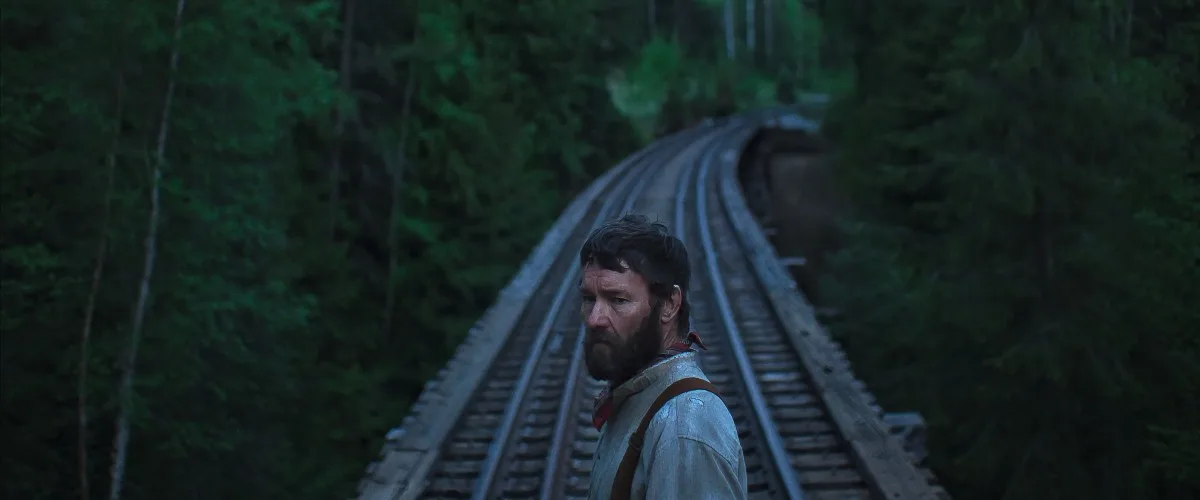
At the film’s heart is Robert Grainier, played with aching restraint by Joel Edgerton in what may be the most quietly powerful performance of his career. Robert is a man of few words, a laborer who spends his days cutting down trees, hammering in tracks, and building bridges across impossible terrain. His job keeps him away from home for long stretches, and his soul seems bound to the rhythm of the trains he helps set in motion always moving, never resting.
Early on, we witness a scene that will shadow him forever: a violent act against a Chinese immigrant, and Robert’s failure to intervene. It’s a moment of cowardice that metastasizes into lifelong guilt, a burden that becomes the spine of his story. Will Patton’s narration, deep and weary, carries Robert’s unspoken thoughts, and the film immediately finds its rhythm somewhere between confession and dream. Patton doesn’t just narrate; he remembers. It’s the sound of time itself, whispering.
The early sections of Train Dreams unfold like distant recollections you can almost smell the smoke from the workers’ fires, hear the creak of boots against damp soil. These men are ghosts of an emerging nation, carving a world that’s swallowing them whole. Among them is William H. Macy, in a brief but unforgettable role as an explosives expert a man who treats danger like an old friend. He’s in the movie for mere minutes, but Macy makes every line feel like a story in itself.
Recommended: Put Your Soul on Your Hand and Walk Parents Guide
And then, like sunlight breaking through fog, Robert meets Gladys (Felicity Jones). She’s kind, playful, and full of life, and together they build something resembling peace a riverside home mapped out with rocks and hope. These scenes are breathtaking, glowing with the kind of visual poetry that recalls Terrence Malick’s Days of Heaven. You feel the warmth of their love, the simplicity of two people imagining a future together. When tragedy strikes as it inevitably does in a story like this it feels less like a plot twist and more like a force of nature, something fated and unstoppable.
From that point on, the film becomes a meditation on solitude. Robert drifts through the rest of his life like a ghost among the living, haunted by what he’s lost and what he failed to do. Yet Bentley never paints him as tragic in the conventional sense. There’s dignity in Robert’s silence, in his endurance. We come to understand him not through grand speeches but through the smallest gestures a glance, a pause, the way he runs his hand along a tree he might once have cut down.
Cinematographer Adolpho Veloso (Jockey) captures all this with a painter’s precision. The landscapes feel both vast and intimate nature as memory, the sky as both home and witness. Every shot breathes, often lingering a moment longer than you expect, as if unwilling to let go. And Bryce Dessner’s score, gentle and mournful, weaves through the images like a current beneath the surface. His music doesn’t tell you what to feel it simply listens alongside you.
What makes Train Dreams remarkable is its restraint. Bentley trusts silence, trusts stillness. He understands that sometimes the most profound things in life are the ones we can’t articulate. That’s what makes Edgerton’s performance so striking it’s not about transformation but accumulation. Every loss, every memory, every mile of track built or burned away leaves its mark on his face. You don’t watch him act; you watch him age into understanding.
There’s a moment late in the film simple, almost throwaway when Kerry Condon’s character tells Robert, “The dead tree is as important as the living one.” It’s one of those lines that quietly reframes everything before it. That’s the film in a sentence: a recognition that death, decay, and memory aren’t the end of life’s story, but part of it. The past doesn’t disappear; it roots itself into the soil beneath our feet.
By the time the credits roll, Train Dreams doesn’t feel like something you’ve just watched it feels like something you’ve lived through. Bentley’s storytelling walks the same line as his protagonist: between poetry and pain, history and myth.
If you come to it expecting a fast-moving drama, you might grow restless; Train Dreams moves at the pace of recollection, not momentum. But for those willing to surrender to its rhythm, it’s one of the most beautiful films of the year a hymn for forgotten workers, for lost families, for anyone who’s ever stood still long enough to listen to the wind and wonder who came before.
In the end, it reminds us that every life no matter how small, how unremarkable leaves its own track behind.
Parents Guiding & Content Rating
Violence & Intensity: There are brief scenes of violence related to early 20th-century labor life including an off-screen murder and an accident involving a worksite explosion. None are lingered on or stylized, but they feel emotionally raw. The death of a child (handled with restraint and implied rather than shown) gives the story its emotional center. The tone is more sorrowful than shocking, but sensitive kids may find certain moments distressing.
Language: Very mild overall. A few period-accurate curses (“hell,” “damn,” “bastard”) and some rough, worksite banter between men, but nothing harsh or excessive. No slurs or explicit profanity.
Sexual Content / Nudity: There’s a brief, tender love scene between Robert and his wife, Gladys (Felicity Jones), depicted with emotional intimacy rather than explicitness. Partial nudity is suggested but not shown clearly. The focus is on affection and connection, not eroticism.
Drugs, Alcohol & Smoking: Characters drink whiskey occasionally after long days of work, and smoking is shown throughout, as expected for the historical setting. These moments feel authentic to the period and are never glamorized.
Scary or Disturbing Scenes: Some sequences may feel unsettling for kids or preteens notably the grief scenes after a tragic loss and a few moments where Robert hallucinates or dreams about his past. These aren’t horror-style scares, but the mood can be heavy and somber. The idea of isolation and death hangs over much of the story, though it’s presented with empathy rather than darkness.
Positive Messages / Role Models: Train Dreams is about resilience, humility, and the quiet heroism of ordinary people. Robert isn’t a man of grand gestures he’s someone who endures, learns, and keeps moving forward. The film gently reminds viewers that life’s meaning isn’t in achievements but in the connections we forge and the memories we leave behind. There’s also a strong theme of respect for nature and the passage of time how progress can both create and destroy.
Parental Concerns: Parents should know that the film’s pace is very slow and its themes can feel heavy. It’s not designed to entertain children or even most younger teens it’s more meditative, filled with silence, voiceover, and visual storytelling. The depiction of grief, death, and guilt may be too intense for sensitive audiences, even though it’s handled with delicacy. Nothing is inappropriate; it’s simply emotionally deep.
Filed from the Toronto International Film Festival, September 12. “Train Dreams” opens theatrically November 7, 2025, and arrives on Netflix November 21.

Stephanie Heitman is a seasoned journalist and author dedicated to helping parents navigate the world of Hollywood entertainment through thoughtful, family-oriented film reviews. With over a decade of experience in writing and a passion for fostering safe, enriching viewing experiences, Stephanie launched Parentguiding.com to provide parents with the insights they need to make informed choices for their families.