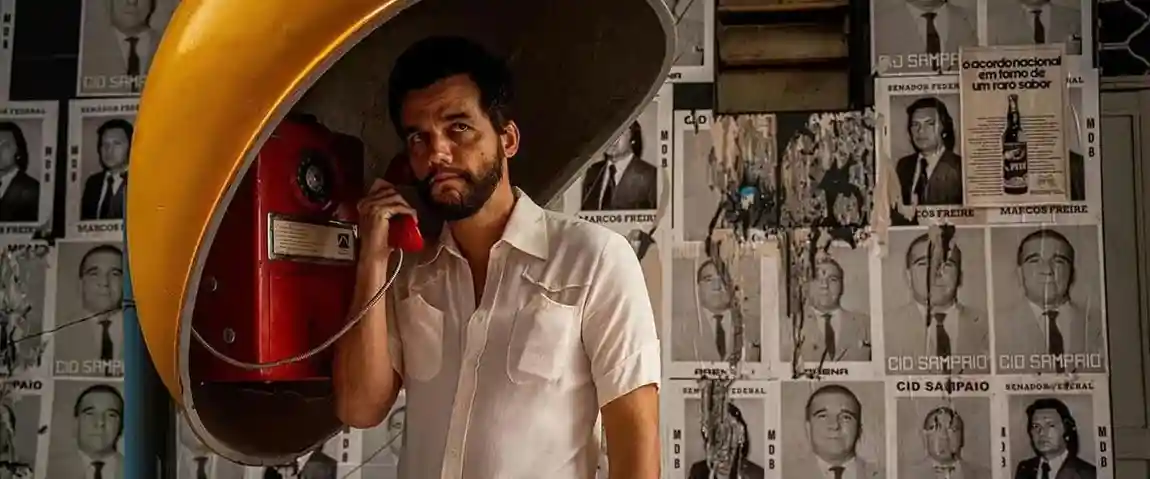
The Secret Agent is Rated R by Motion Picture Rating (MPA) for strong bloody violence, sexual content, language, and some full nudity. Recommended Age Range: Best suited for: Teens 16+ and adults.
Once in a great while, a film comes along that doesn’t feel constructed so much as siphoned directly out of someone’s subconscious. It carries a singular temperament, a confident visual identity, and an internal pulse that refuses to march in step with anyone else’s expectations. It won’t spoon-feed you its intentions you have to lean toward it, let it envelop you. That’s the magic of The Secret Agent, written and directed by Kleber Mendonça Filho (“Aquarius,” “Bacurau”).
Set in Brazil in 1977 a point dead-center in the nation’s 21-year military dictatorship The Secret Agent operates simultaneously as drama, satire, mellow-burn spy thriller, and atmospheric time capsule, embroidered with expressionist and surreal touches you simply have to accept as they drift across the screen. Wagner Moura plays Marcelo, a lanky, bearded man radiating quiet melancholy. He rolls into Recife, capital of Pernambuco, in a sunshine-yellow Volkswagen Beetle. The film pointedly withholds why he’s here. It’ll be ages before we’re even allowed to guess. Dialogue becomes a puzzle of implication and half-truth: Marcelo and nearly everyone around him tiptoe around direct statements, as if invisible ears populate every shadow.
Highly Recommended: Devil: The British Secret Agent 2023 Parents Guide
Death is omnipresent. Some killings are state-sanctioned executions aimed at supposed political opponents; others are the byproducts of everyday urban violence. And often the categories blur. Hired assassins drift freely between these unsettling worlds they’ll kill anyone for the right price, whether the client is a government ministry, a business with secrets, or just a vengeful nobody then reward themselves with a decent meal and a good night’s sleep. Much of the film investigates how ordinary people normalize living in such a reality and figure out how to slide through it without being crushed.
Marcelo’s introduction unfolds in a prologue so pristine in its construction that you could lift it out and present it as a standalone short. During Carnival, on Recife’s outskirts, he pulls into a rundown gas station. Close by lies a corpse, partly shielded under a piece of cardboard, buzzing with flies. The image channels Kafka’s bureaucratic nightmares, Julio Cortázar’s surreal existential puzzles, and the cutting absurdity of Buñuel. When a group of mangy dogs wanders over to sniff the body, it feels entirely plausible almost expected that one might trot off with a severed limb.
The attendant tells Marcelo the dead man had tried to make off with a few cans of motor oil the previous night and was blown apart by the night clerk. Two policemen arrive, but the body receives no more attention from them than a piece of litter. Instead, one officer zeroes in on Marcelo’s Beetle, inspecting it with obsessive zeal in search of a technical violation. Inevitably, he solicits a “donation” to the “Policeman’s Carnival Fund” in lieu of issuing a fine cash only, of course. When Marcelo finally gets back on the road, the film floats in Chicago’s “If You Leave Me Now,” one of many soundtrack choices that should feel jarring but instead pry open Marcelo’s serene exterior, letting contradictory emotions seep through.
Highly Recommended: The Beast in Me (2025) Parents Guide
Everything that follows builds outward from that opening movement, maintaining an eerie calm even as it catalogues corruption, brutality, and apathy. Truth means nothing in this world; suffering is background noise. Whatever Marcelo’s mission is, it’s instantly clear that he must remain constantly attuned to danger. Even visiting his young son, Fernando (the irresistibly sweet Enzio Nunes) who lives in Recife with Marcelo’s former in-laws is an unnecessary hazard. But he’s a father before he’s anything else, and he can’t keep away.
Every character Marcelo encounters is drawn with such crisp specificity that each could anchor their own film. His local contact, the 77-year-old Dona Sebastiana (Tânia Maria), is a tiny woman with a raspy, weathered voice, introduced striding down an alley with a cigarette dangling from her fingers. Meanwhile, the hitmen assigned to eliminate Marcelo Agusto (Roney Villela), aging and cantankerous, and Bobbi (Gabriel Leone), his overeager, inquisitive young partner fall naturally into a prickly father-son dynamic even before we learn their backstories.
Eventually, Bobbi and Agusto rope in another killer for assistance: Vilmar (Kaiony Venâncio), a gaunt, haunted-looking man with hollow eyes and a posture shaped by deprivation. Venâncio enters the film late yet leaves a ferocious mark. His Vilmar is sharp, cunningly self-protective, and hopelessly bound to the work he needs the cash, but he also can’t refuse a job without wounding his fragile sense of pride. He’d fit seamlessly into one of those grimy, sun-blasted westerns where every character carries a tarnished conscience.
Upstairs from Dona Sebastiana lives Claudia (Hermila Guedes), a gorgeous single mother who developed a quiet fascination with Marcelo thanks to the old woman’s stories. Her fling with Marcelo is refreshingly grown-up: casual, sensuous, very much of the 1970s no grand declarations, just two adults seeking warmth in a cold era. And like many threads in the film, their relationship circles themes of missing parents and children. Some have vanished naturally, others violently, others by choice. Marcelo’s own mother disappeared long ago, prompting his visits to a government ID office where he searches dusty records for clues. Marcelo is also a widower. His line of work makes raising Fernando himself a lethal option, so the boy remains with his maternal grandparents. The scenes between father and son are devastating in their plain, unforced tenderness especially when Fernando asks when his mother is coming home. (Chicago’s lyrics echo in the background: “If you leave me now, you take away the biggest part of me.”)
Some mixed reviews have dismissed The Secret Agent as scattered or indulgent, singling out its stranger digressions particularly the subplot involving a murder victim’s leg discovered inside a tiger shark. Two other criminals, Arlindo (Italo Martins) and Sergio (Igor de Araújo), painstakingly wrap the severed leg like a holiday roast and toss it back into the sea, only for it to return via stop-motion animation and terrorize men cruising a public park. The point isn’t literal realism; we’re meant to absorb the imagery as metaphor just as the rotting limb reawakens, the authoritarian state functions like a hidden predator, surfacing only to devour. Young Fernando’s obsession with Jaws still screening in Brazilian theaters in 1977 threads neatly into this dream logic. The film’s surreal veins are rooted in lived truth, even when they wander into the uncanny.
For my money, this is one of the year’s most striking achievements utterly singular, mesmerizingly constructed. I’ve watched it three times, something I almost never do with new releases given the avalanche of films vying for attention. Each viewing drew me deeper, hit harder. The final minutes elevate the entire work including Moura’s extraordinary performance into a realm that feels mythic. If you’re willing to surrender to its fluid, drifting storytelling, The Secret Agent will carry you to cinematic territories most films never dare approach.
Detailed Content Breakdown for Parents:
Violence & Intensity: The film depicts frequent, realistic killings by both state agents and street criminals. Some deaths are gruesome; one subplot includes a severed leg, stop-motion horror, and darkly surreal violence. Overall, the tone is tense and unsettling, though the violence is often stylized rather than purely graphic.
Language: Moderate profanity is present, with occasional strong language. The dialogue carries an intense, serious tone; no explicit racial or sexual slurs dominate, but the conversations reflect a morally complex world.
Sexual Content / Nudity: There are brief sexual scenes, portrayed in a casual, 1970s adult manner no explicit pornography, but nudity and sexual activity are implied or lightly shown. Relationships are realistic and mature, including adult intimacy without idealization.
Drugs, Alcohol & Smoking: Characters are occasionally seen smoking and drinking alcohol. Drug use is suggested in passing but is not central to the story.
Parental Concerns: Persistent tension and surreal, unsettling imagery could be frightening to younger viewers.The film’s deliberate pacing and complex narrative may challenge less mature audiences.Mature themes include political oppression, murder, moral ambiguity, and absent or struggling parents.
The Secret Agent first premiered on the festival circuit, making its debut at the Cannes Film Festival on May 18, 2025. It rolled out in select international markets later in the year, opening in Brazil and Germany on November 6, 2025, followed by a French release on December 17, 2025. In the United States, the film saw a staggered limited release, starting in New York on November 26, 2025, and in Los Angeles on December 5, 2025.

Matthew Creith is a movie and TV critic based in Denver, Colorado. He’s a member of the Critics Choice Association and GALECA: The Society of LGBTQ Entertainment Critics. He can be found on Twitter: @matthew_creith or Instagram: matineewithmatt. He graduated with a BA in Media, Theory and Criticism from California State University, Northridge. Since then, he’s covered a wide range of movies and TV shows, as well as film festivals like SXSW and TIFF.