The Running Man is Rated R by Motion Picture Rating (MPA) for strong violence, some gore, and language.
Edgar Wright’s “The Running Man” his ferocious, funny, and faintly despairing take on Stephen King’s dystopian novel hits the ground in a full sprint and barely pauses to breathe. The movie moves like it’s being chased by its own premise. That propulsive energy is its greatest trick: a relentless forward motion that powers past any nitpicky doubts about plausibility. It’s the kind of film that keeps you too wired to question its worldview too deeply at least until the adrenaline fades. And maybe that’s for the best. For all its grime and bite, this new version doesn’t dig much deeper into the story’s dark heart than the 1987 Arnold Schwarzenegger cult favorite did. It’s nastier, yes, and certainly meaner, but not necessarily wiser. The longer you sit with it, the more its seams start to show.
Also Read: Trap House (2025) Parents Guide
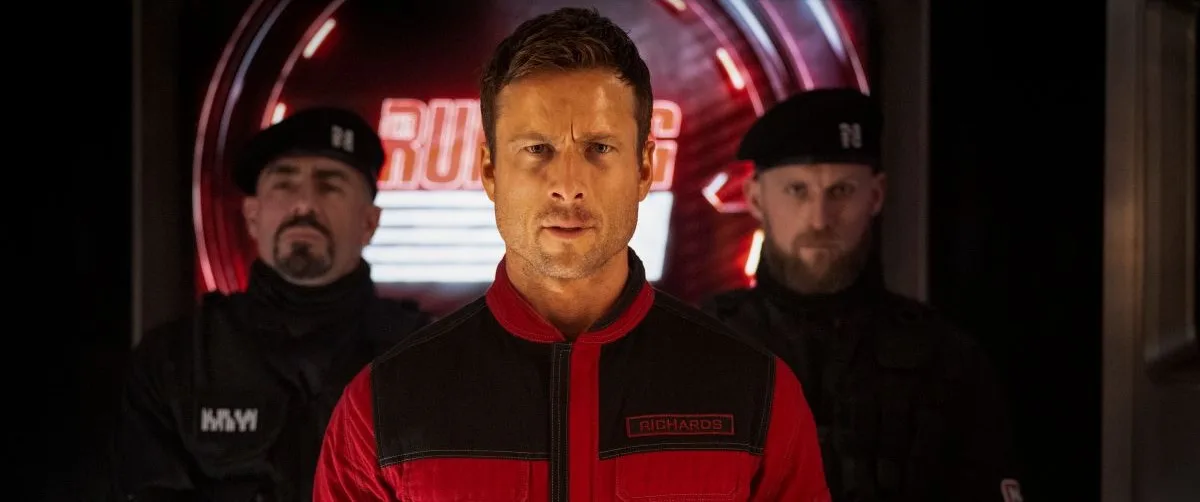
Glen Powell plays Ben Richards with a wiry, smoldering intensity the kind of man who’s always a few seconds away from boiling over. He lives with his wife Sheila (Jayme Lawson, steady and sympathetic) and their sick baby in an apartment that feels barely larger than a parking space. Every corner of their existence is haunted by scarcity. Sheila’s job at what’s either a strip club or a brothel Wright leaves that detail murky on purpose barely keeps them afloat, and she’s being pushed toward “extra favors” to make rent. Ben, meanwhile, can’t hold a job to save his life. He keeps getting fired for backtalk and outbursts, the kind that come from a man who refuses to swallow one more ounce of humiliation.
He’s not a criminal, though he’ll soon be painted as one. He’s an ordinary man clinging to a moral compass in a world that’s forgotten what “north” means. His anger burns hot, but it’s righteous he lashes out not at random, but on behalf of those already being crushed by a system that’s turned cruelty into policy. Democracy, here, has curdled into a corporate dictatorship, a land run by the ruthless and the rich. Ben is furious, and who can blame him? His waking hours are full of indignation, and his dreams, apparently, offer no relief. (The Schwarzenegger version turned Ben into a wronged military man, which gave that film a cartoon nobility. Powell’s Ben is closer to the bone less superman, more everyman at the end of his rope.)
Highly Recommending: The Things You Kill (2025) Parents Guide
With nothing left to lose and a sick child to save, Ben does what desperate people do in dystopias: he signs up for television. The show that could save his family is one he promised never to touch The Running Man, a grotesque ratings juggernaut where contestants, or “Runners,” try to stay alive for thirty days while assassins, or “Hunters,” track them down in public. It’s hosted by Bobby T (Colman Domingo, exuding oily charm), a kind of game-show peacock with murder in his smile. The game is fixed, of course. No one’s ever won. Drone cameras hover like vultures while civilians use an app to snitch for cash. It’s not far-fetched; it’s a few clicks away from the real world.
Dan Killian (Josh Brolin), the show’s producer and resident Mephistopheles, sees something in Ben something combustible. He wants him as the next sacrificial lamb who thinks he can beat the system. To shape the narrative, Killian’s team brands Ben a welfare leech and a deadbeat dad, a man so lazy and ungrateful he’s killing his own child through neglect. Bobby T whips up the mob with a line that lands like a punch: “He bit the hand that fed him, because that’s what dogs do!” The smear campaign works too well; Sheila and the baby have to be hidden away from the baying crowd. Wright makes these moments sting with their eerie familiarity you can feel how easily this sort of outrage would trend.
Recommended: Death by Lightning Parents Guide
Ben, though, refuses to play along. Instead, he finds an underground network of helpers outlaws, hackers, and idealists who haven’t given up on decency. There’s a weary gunrunner (William H. Macy), a truth-telling podcaster (Daniel Ezra), and a gadgeteer played by Michael Cera, whose quiet pain over his father’s death adds a surprising pang of humanity. They’re all small lights flickering in the dark, and you wish the movie lingered on them a little longer.
That’s the paradox of Edgar Wright. As a filmmaker, he’s an impeccable craftsman, a precision stylist who believes every cut, every sound cue, every movement should matter. The Running Man showcases all his favorite toys: whip-fast montages straight out of Hot Fuzz, an eclectic soundtrack curated by Kirsten Lane, and razor-edged editing from Paul Machliss, whose name suits his job perfectly. It’s thrilling, propulsive cinema. And yet, this time, you leave wishing Wright had pumped the brakes. The side characters so vivid in their brief moments deserve space to breathe. When Cera’s character faces a choice between survival and vengeance, you can almost feel the movie racing past an emotional peak it doesn’t have time to explore.
Ben himself could use that same generosity. He’s written as a snarky, blue-collar antihero—half Bruce Willis in Die Hard, half guy muttering under his breath in a grocery line. His anger is funny, until it isn’t; his sarcasm sharp, until it starts to dull. Powell’s got charisma and grit, but the character’s too narrowly drawn to sustain the movie’s moral weight. Schwarzenegger, with his mythic screen presence, could sell this kind of role on sheer force. Powell has the talent, but not yet the gravity. You can sense him pushing to make Ben iconic, but the film’s speed keeps dragging him back to the surface.
Where the 1987 film was all soundstages and neon junkyards, Wright and co-writer Michael Bacall ground their version in something eerily recognizable: a world only slightly exaggerated from ours. The promise of American abundance has turned to a cheap mirage, visible but unreachable. Everyone works themselves to death for less and less, clinging to the fantasy that effort still means reward. The rich float above it all, their cynicism so complete it almost reads as wisdom. One of the film’s most heartbreaking lines comes when Ben remembers the day his daughter first tasted ice cream “when our number came up for the park.” In that moment, the dystopia feels less like science fiction than next week’s news.
The movie’s politics are blunt but sincere. Wright wants to champion labor rights, universal healthcare, fair housing, and the moral necessity of standing up to corporate power. Some sequences echo the satirical ferocity of RoboCop or Starship Troopers those fake commercials and propaganda reels that make you laugh and wince in the same breath. You sense Wright reaching for that mix of horror and hilarity, where entertainment becomes its own indictment.
And yet, for all its flash and purpose, The Running Man feels a bit too calibrated for the zeitgeist. It’s so eager to say something important that it forgets to let the message evolve naturally from the story. Its vision of humanity an ignorant mob baying for blood, punctuated by a few noble resisters tilts toward despair. We’re told that Ben’s defiance inspires the masses, but we never quite feel it. The revolution seems more like a TV subplot than a genuine awakening. Wright is too sharp a filmmaker to believe in easy catharsis, but not cynical enough to make hopelessness his point. The result hovers somewhere in between.
You May Also Read: Jay Kelly (2025) Parents Guide
By the end, you can sense the film’s struggle with its own reflection. It wants to mock the culture of spectacle while being one of its flashiest examples. It wants to topple the machine but also keep the lights on. If it didn’t aim so high if it were content to be a wild, kinetic action movie these contradictions might not matter. But it does, and they do. When the credits roll, The Running Man feels like a dazzling act of rebellion swallowed whole by the system it set out to expose. You admire the audacity. You just wish it could’ve escaped.
Detailed Content Breakdown for Parents:
Violence & Intensity: The movie features frequent, intense action sequences: armed hunts, chases, explosions, some blood and injury. Contestants are aggressively pursued; scenes often show realistic fear, peril and violence. It doesn’t shy away from the brutality of its game-show premise. According to parental guides, “strong violence, some gore” is mentioned.
Language: The film includes rough profanity strong language is noted in the MPAA descriptor. Slurs or hateful speech are not prominently flagged in reviews, but the intensity suggests coarse dialogue is frequent.
Sexual Content / Nudity: There is no major nudity flagged in the parental guide. Some implied or suggested adult themes (e.g., the wife’s difficult job, possibly seedy surroundings) but no explicit sexual scenes highlighted in major reviews.
Drugs, Alcohol & Smoking:
While the world is morally degraded, major drug-use or heavy alcohol consumption aren’t central to the plot in the flagged notes. Parents should still be aware of adult settings (night club/strip-club type atmosphere) and possible drinking.
Parental Concerns:
- The level of violence and the premise (game show of survival) are intense — younger children may be overwhelmed.
- Themes of economic despair, exploitation, and night-club/strip-club hints may require parent discussion.
- Some of the action may be relentless; pacing means there are few restful moments.
- The film’s message is darker than typical “hero saves the day” fare it may leave viewers with uneasy feelings rather than a fully comforting resolution.
Recommended Age Range:
Given the intensity, violence, and adult themes, this film is most suitable for teens 15 and up (in many cases 16+). Younger teens may handle it with parental guidance, but it is not appropriate for pre-teens.

Stephanie Heitman is a seasoned journalist and author dedicated to helping parents navigate the world of Hollywood entertainment through thoughtful, family-oriented film reviews. With over a decade of experience in writing and a passion for fostering safe, enriching viewing experiences, Stephanie launched Parentguiding.com to provide parents with the insights they need to make informed choices for their families.