
I’ve spent years believing that almost any good movie is diminished when you watch it at home. Even the merely decent ones usually feel like they’d bloom on a bigger screen with real surround sound. And the bad movies? There’s at least a faint, petty comfort in knowing you didn’t waste the effort of driving to a theater. But every once in a while, a film arrives that seems built for the living room not in a dismissive way, but in the way certain paperback thrillers feel perfect for a long flight. Netflix’s The Rip is exactly that kind of movie.
It’s a film powered less by plot mechanics than by atmosphere. These are movies that don’t use genre to tell a story so much as use story to conjure the sensation of a genre. Everything the performances, the lighting, the pacing, the dialogue rhythms is engineered to evoke the memory of watching a certain type of familiar, slightly worn-in thriller.
The pleasure isn’t in tracking every narrative beat or dissecting character psychology. It’s in surrendering to the mood, letting the movie’s current take you wherever it’s headed, and enjoying the ride for what it is.
Although The Rip is technically inspired by real events, Joe Carnahan a filmmaker who has long been fascinated by tough-guy codes and volatile masculinity in films like Narc, The Grey, and Boss Level isn’t really adapting history here. He’s riffing on the idea of the “cop thriller” itself. The results are uneven but often satisfying. The film reaches for more intelligence than it fully achieves, and it never quite becomes as nerve-shredding as it wants to be. Yet thanks to shrewd casting, thick atmosphere, and a sly awareness of its own occasional silliness, it lands exactly where a streaming thriller should: as a movie that’s easy to sink into and hard to actively dislike. It’s not an event. It’s a hang.

The premise, though, is introduced in a somewhat awkward fashion. The film opens with the murder of Jackie Velez (Lina Esco), a Miami police captain whose last phone conversation suggests she’s been dancing dangerously close to secrets someone desperately wants buried. Her death leaves Lieutenant Dane Dumars (Matt Damon) suddenly in charge of their special narcotics unit. He presents himself as determined to find who killed her, but the situation is poisoned from the start. Jackie had made enemies everywhere criminals, rivals, possibly even colleagues. Worse, a wave of corruption scandals has already forced the department to dissolve an entire violent crime unit. Internal Affairs and the FBI are circling now, watching every move. One wrong step and Dane’s team could be wiped out next.
Then comes the opportunity that changes everything. Dane receives an anonymous text pointing him toward what’s supposed to be a cartel stash house. Instead of following protocol, he convinces his entire squad to check it out unofficially, off the clock. Along for the ride are Detective Mike Ro (Steven Yeun), Detective Numa Baptiste (Teyana Taylor), Detective Lolo Salazar (Catalina Sandino Moreno), and Detective Sergeant JD Byrne (Ben Affleck) Dane’s closest friend and, not incidentally, the man who had been secretly involved with Jackie in a way everyone pretended not to notice.
From the moment they step inside the house, something feels off. The place belongs to a young woman named Desi (Sasha Calle), and it’s a chaotic suburban wreck, not the fortified drug den they expected. But tucked away in the attic wall is a fortune: at least $20 million in cash. A score like that is never just money; it’s a fuse already burning. Whether the cash belongs to a cartel or to the rumored ring of dirty cops who’ve been hitting stash houses for their own profit, someone will come looking for it. Meanwhile, Dane’s jittery behavior and his resistance to doing anything by the book start to unsettle the group. Trust, once assumed, becomes a fragile thing. You can feel the room temperature drop as suspicion creeps in.
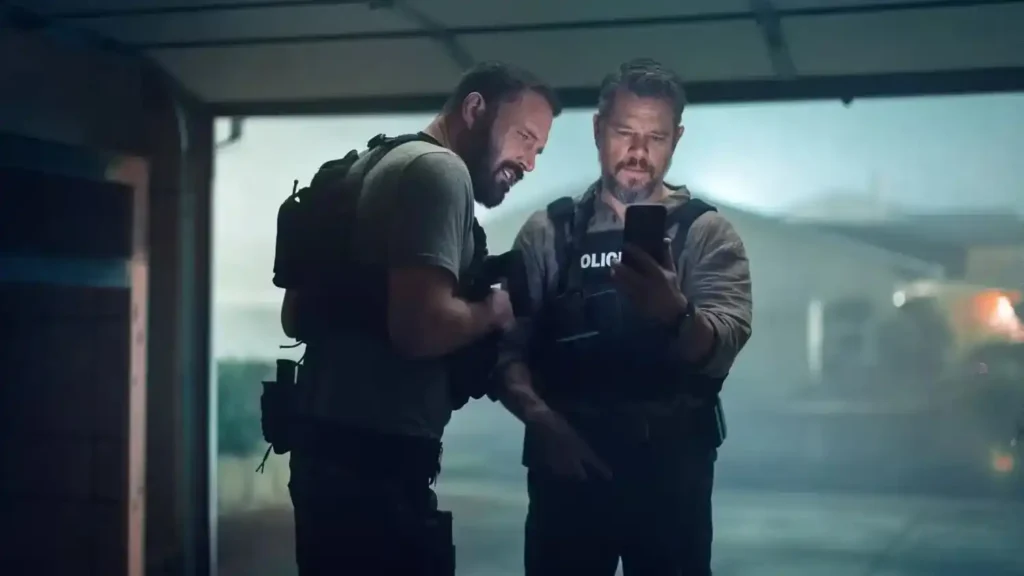
It’s a strong setup, yet the film doesn’t unfold the way you might expect. Carnahan and his script feed us far more backstory than the narrative actually needs before the team ever arrives at the house. The result is that Dane’s true agenda never really feels mysterious, even though the movie keeps insisting that it is. There’s a strange artificiality to this tension a sense that we’re being asked to lean forward when the film has already shown its hand. And yet, oddly, this hollowness becomes part of the movie’s odd charm. The Rip often feels like it’s play-acting as a tense, twist-laden thriller. It’s not the real thing, and it knows it. But the sincerity of the imitation becomes endearing in its own way, like watching a talented cover band absolutely commit to the song.
That self-awareness pays off especially in how the film handles Matt Damon and Ben Affleck. The marketing leans heavily on their real-life history, and Carnahan cleverly incorporates that baggage into the texture of the movie. Their characters’ bond mirrors what audiences already project onto the actors themselves. There’s not a lot of depth written into either role, despite the film’s occasional attempts to gesture toward it. Instead, the emotional stakes live in the performances we recognize: Affleck’s wounded expression when JD begins to believe Dane has betrayed him, Damon’s strained vulnerability when JD accuses him of wanting the money for himself. Carnahan, to his credit, understands that this is the real engine of the film and frames it accordingly.
The casting across the board does heavy lifting. Steven Yeun, Teyana Taylor, Catalina Sandino Moreno, and Sasha Calle all bring specificity and charisma to roles that could easily have felt like placeholders on the page. Kyle Chandler shows up as a scruffy, lived-in DEA agent, instantly giving the film a shot of credibility. Scott Adkins appears as JD’s FBI-agent brother, and his presence adds just enough genre muscle to keep things lively. What’s striking is how rarely the film feels dull, even in scenes that probably would have gone flat with less magnetic actors. You can sense how much the performers are compensating for the script’s thin spots, and somehow that effort becomes part of the pleasure.
There’s a version of this movie you can practically see it hovering behind the one we got where the writing is sharper, the tension more carefully calibrated, the moral ambiguity more genuinely thorny. In that alternate cut, The Rip might have been a great thriller instead of a merely solid one. But taken on its own terms, tuned to its wavelength, it works. It’s absorbing without being demanding, familiar without being cynical, and entertaining without pretending to be more than it is. For a low-key night at home, that’s not a compromise. That’s exactly the point.
The Rip Parent Guide
Violence & Intensity: Violence in The Rip is present but not wall-to-wall. It arrives in sharp, unsettling bursts rather than constant action. The opening murder sets the tone: grim, serious, and emotionally heavy. Later scenes involve threats, gunfire, physical confrontations, and moments of real tension as characters turn on one another. There’s blood, but the film isn’t obsessed with gore. What lingers more than the imagery is the atmosphere the unease, the distrust, the sense that things could explode at any second. Sensitive viewers may find the psychological intensity just as impactful as the physical violence.
Language (Profanity, Slurs, Tone): The language is relentless. This is a story about cops under pressure, and they speak like it. Expect frequent use of strong profanity, including repeated uses of the F-word, along with other harsh insults and aggressive exchanges. The tone of the dialogue is often bitter, sarcastic, and emotionally raw. It’s not playful swearing; it’s the sound of people cracking under stress. If you’re sensitive to constant coarse language, it’s hard not to notice how pervasive it is.
Sexual Content / Nudity: Sexual content is limited and mostly implied rather than shown. The film references an affair between two characters, which carries emotional weight in the story, but there are no explicit sex scenes. Any nudity, if present at all, is brief and non-sexual. The emphasis here is on relationships, betrayal, and emotional fallout, not erotic content.
Drugs, Alcohol & Smoking: Given the narcotics-unit setting, drugs are central to the story thematically. Characters discuss drug trafficking, cartel operations, and illegal substances frequently. However, the film doesn’t glamorize drug use, and onscreen consumption is minimal. Alcohol appears in casual settings, consistent with adult characters decompressing under stress. Smoking may appear occasionally. The tone is grounded and grim, not celebratory.
Age Recommendations: This is firmly an adult-oriented film. While there’s nothing here that’s unusually extreme for an R-rated crime thriller, the combination of heavy language, mature themes, moral ambiguity, and sustained tension makes it best suited for ages 17 and up. Mature older teens might handle the content, but this isn’t a movie designed with younger viewers in mind and it doesn’t soften its edges to accommodate them.
Highly Recommended:

Stephanie Heitman is a seasoned journalist and author dedicated to helping parents navigate the world of Hollywood entertainment through thoughtful, family-oriented film reviews. With over a decade of experience in writing and a passion for fostering safe, enriching viewing experiences, Stephanie launched Parentguiding.com to provide parents with the insights they need to make informed choices for their families.