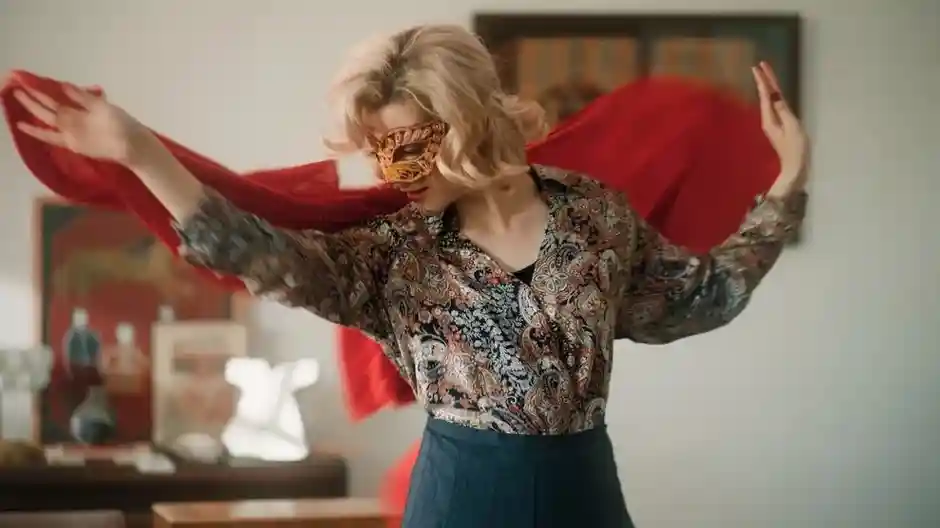
In times of uncertainty, life has a way of feeling ordinary right up until the moment it doesn’t. That quiet, unnerving pivot is the emotional spine of “The Friend’s House is Here,” a film that follows a circle of young artists in Tehran’s underground scene as they move through days fueled by art, conversation, flirtation, and idealism until that fragile normality fractures. What begins as a portrait of creative youth slowly reveals itself as something more precarious, more political, more urgent. And at the heart of Maryam Ataei and Hossein Keshavarz’s film told with the kind of lived-in sensitivity that suggests deep familiarity with these worlds is a quietly radical proposition: that solidarity between women, the simple act of protecting one another’s dreams, might be the most powerful form of resistance available. Without that, the film seems to ask, what is left to live for?
The opening moments are deliberately disorienting. We’re dropped midstream into an interactive theater performance, with no contextual handholding, no guideposts. For a while, you’re left to flounder, to piece together meaning from fragments of dialogue and gesture. Then, slowly, the camera retreats, widening its gaze to reveal the audience encircling the performers. What we thought was reality resolves into performance. The shift is subtle, but it matters: it establishes the film’s fascination with perception, with the thin and unstable line between what is acted and what is lived. From there, the film eases into a gathering of the cast at a party. They drink, smoke, tease one another. Conversations wander from art to philosophy, from playful to earnest. It all feels loose, spontaneous, gently intoxicating. You can almost relax into it. Almost.
Highly Recommended: The Big Fake (2026) Parents Guide
The title, of course, is a deliberate answer to Abbas Kiarostami’s “Where Is the Friend’s House?” and the dialogue with Iranian cinematic history feels intentional rather than ornamental. Where Kiarostami traced a child’s moral journey through simplicity and repetition, Ataei and Keshavarz construct their film out of long takes and drifting conversations that accumulate meaning gradually, like sediment. Scene by scene, a portrait forms: not only of a generation on the cusp of transformation, but of a country trembling with pressures that rarely announce themselves directly. The narrative centers on Pari (Mahshad Bahraminejad), who leads an underground improvisational theater troupe, and her best friend and roommate Hana (Hana Mana), a performer who records herself dancing freely, joyfully in front of Tehran’s iconic landmarks.
Their dynamic is instantly recognizable, painfully human. Pari is cautious, pragmatic, always scanning the horizon for danger. Hana is impulsive, luminous, unwilling to shrink herself for safety’s sake. The stakes of that difference are devastatingly real: women dancing in public, especially without a hijab, is forbidden, and the consequences can be severe. What begins as friendly concern gradually reveals itself as deeper dread. The opening performance, we come to understand, was not an abstract experiment but an embodiment of Pari’s private terror—that one day Hana’s visibility, her refusal to hide, will cost her everything.
When the film’s tonal shift arrives, it does so with the force of something both inevitable and shocking. For the first hour, Ataei and Keshavarz allow us to settle into the rhythms of intimacy: the casual warmth of shared apartments, the affectionate bickering, the texture of everyday life. And then, almost without warning, the ground gives way. A man approaches Pari claiming to be a fan; Bahraminejad’s face registers, in real time, the slow recognition that he is not who he says he is, that he represents the Ministry of Culture. The fear that blooms across her features is devastating because it’s so contained. Later, when Hana returns home to find their apartment torn apart and Pari missing, Mana’s expression hardens into something else entirely: grief, fury, resolve. You don’t need exposition. You feel it.
What’s remarkable is how carefully the film seeds its dread. Early details might seem incidental, even mundane. During one rehearsal, members of the troupe complain about exhaustion. It isn’t because they were out late partying; it’s because they couldn’t sleep through the sound of explosions from a nighttime bombing. The line is delivered almost casually, as though this were simply another annoyance of daily life. In the same scene, someone jokes about how evacuating the city during the June War felt like a vacation, how people in rural areas treated him kindly out of pity. The joke lands with a bitter aftertaste. These aren’t digressions; they are quiet reminders that violence and instability are not interruptions here they are the background noise of existence.
Gradually, the truth becomes impossible to ignore: nothing is fine. Not really. And yet, leaving is not an option. There is no easy escape, no legal pathway out. So the characters wake up, go to work, keep performing normalcy because they must. Pari’s job at an art gallery becomes another site of quiet humiliation. She overhears a patron warn her supervisor about employing underground artists, calling them criminals. Pari stands perfectly still, hands folded, pretending not to hear. It’s a small moment, but it burns. The performance of compliance becomes its own kind of theater.
Highly Recommended: In Cold Light (2025) Parents Guide
The film’s power deepens when you realize how closely its fiction brushes against reality. Bahraminejad is not just an actress playing an underground artist; she is a founding member of a real improvisational troupe, many of whom appear in the film as versions of themselves. Hana Mana wasn’t discovered through conventional casting channels her real-life social media videos, as risky as the ones her character posts, drew the filmmakers’ attention. The entire production was shot covertly, exposing Ataei, Keshavarz, and their collaborators to genuine danger. And if the circumstances within the film feel dire, the reality beyond it has only grown more so, as filmmakers like Jafar Panahi have publicly testified in recent years. That knowledge doesn’t overwhelm the film, but it does haunt it, like an unspoken presence in every frame.
And yet and this is perhaps the film’s greatest achievement “The Friend’s House is Here” does not leave you in despair. For all its clear-eyed depiction of repression and loss, the lingering emotional residue is tenderness. There is a gentleness here, a belief in the sustaining power of connection. Pari and Hana argue with the intimacy of sisters, wound each other with familiarity, forgive with equal depth. The sacrifices they make quiet, risky, profoundly personal become the film’s moral core. Watching them, it’s hard not to feel that Ataei and Keshavarz are offering something more than critique. They’re offering a vision of endurance. Of care as survival. Of friendship as a form of defiance.
It’s a modest film on the surface, built from conversations and glances rather than spectacle. But it lingers because it understands something essential: that cinema, like friendship, can be a shelter. Not a permanent one. Not an invincible one. But sometimes, for the length of a film, for the length of a shared life, enough.
The Friend’s House Is Here (2026) Parents Guide
MPA Rating: Not rated by the Motion Picture Association (MPA)
Violence & Intensity: There is no graphic violence, but the film carries a steady undercurrent of tension. References to bombings, surveillance, political repression, and state intimidation are woven into everyday conversations. An apartment is shown ransacked. A character disappears. These moments are not shown exploitatively, but they are emotionally unsettling. The fear is psychological rather than physical and that can be just as intense. You feel the danger more than you see it.
Language: The dialogue is largely naturalistic and conversational. There may be occasional mild profanity, but nothing excessive or aggressive. The tone is intimate, reflective, sometimes tense. No hate speech or slurs are central to the film’s language.
Sexual Content / Nudity: There is no explicit sexual content. Characters flirt and share close friendships. Emotional intimacy is far more present than physical intimacy. No nudity.
Drugs, Alcohol & Smoking: Characters are shown drinking alcohol and smoking cigarettes at social gatherings. This is portrayed realistically rather than glamorously, as part of the underground artistic lifestyle. No hard drug use.
Age Recommendations: Because of its themes rather than its visuals, this film is best suited for: Ages 15+ (mature teens and adults)

Stephanie Heitman is a seasoned journalist and author dedicated to helping parents navigate the world of Hollywood entertainment through thoughtful, family-oriented film reviews. With over a decade of experience in writing and a passion for fostering safe, enriching viewing experiences, Stephanie launched Parentguiding.com to provide parents with the insights they need to make informed choices for their families.