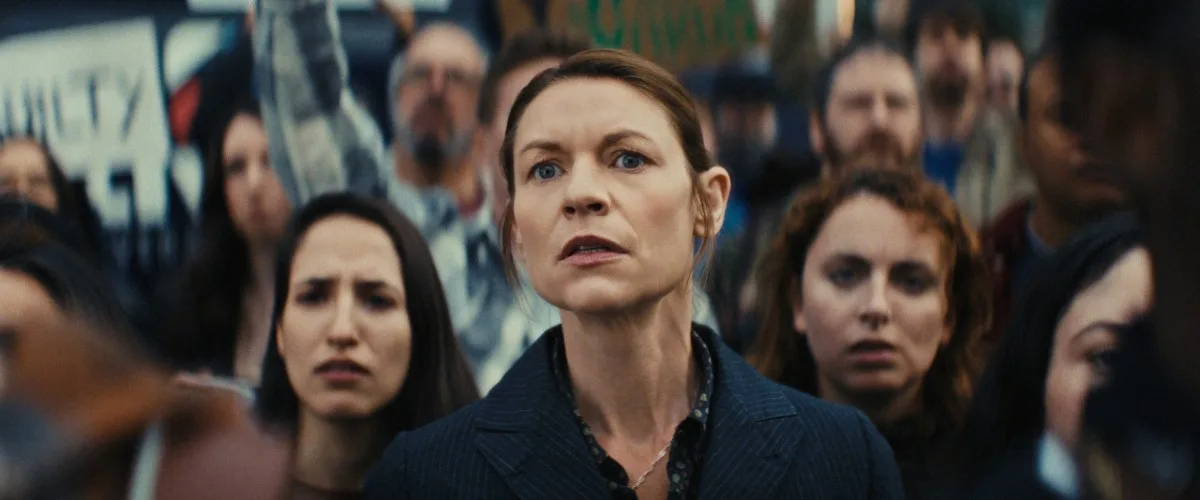
The Beast in Me is rated TV-MA by Motion Picture Rating (MPA) for mature audiences. This series is best suited for older teens (16+) and adults.
The Beast in Me Review
It’s a rare pleasure these days to encounter a television series where every creative department seems to be rowing in the same direction. More often than not, a show boasting superb acting is sabotaged by clunky dialogue, or a beautifully lit production gets dragged down by limp editing. But every once in a while, all the gears lock neatly into place starting with the writing and the director, cinematographer, and editors have the confidence to step back and let the performers take command. That’s exactly the kind of alignment “The Beast in Me,” Netflix’s new limited series led by Matthew Rhys and Claire Danes, manages to achieve. If you share my somewhat morbid tastes, you might wish the show pushed further into its own darkness, but even so, in an eight-episode landscape clogged with mediocrity, this is a cut above.
Highly Recommended: Playdate (2025) Parents Guide
The premise, with its blend of family rot and privileged paranoia, feels like a hybrid of Succession and All Good Things. Nile Jarvis played by Rhys, who at this point might as well be the Peter O’Toole of American television is a billionaire heir relocating to a heavily wooded pocket of Oyster Bay with his second wife, Nina (Brittany Snow). His reputation is already clouded by suspicion surrounding the disappearance of his first wife, Madison. Living next door is Danes’s Aggie Wiggs, a novelist whose dilapidated home mirrors the emotional wreckage left by the death of her young son in a car crash. Her marriage to Shelley (Natalie Morales) collapsed under the weight of that loss, leaving Aggie to stew in grief, bitterness, and near-total isolation.
Their first encounter is what you might call a “meet-brute”: not cute, not charming a collision of two prickly temperaments. Aggie rejects Nile’s attempt to secure an easement for a jogging path through the communal woods, and their egos immediately lock horns. Nile’s manipulation is silky and smiling; Aggie’s resentment burns closer to the surface. Director Antonio Campos, whose work on The Staircase showcased his talent for psychological framing, stages this introduction with an astute sense of power imbalance, establishing their triangular dynamic with Nina watching closely from the sidelines. Cinematographer Lyle Vincent stretches the visual space by shooting into corners, giving the wooded neighborhood a faintly haunted, hollowed-out quality. And the editing team Philip Carr Neel, Ralph Jean-Pierre, Shelby Siegel, and Kane Platt cuts with a perceptive rhythm, often isolating Rhys and Danes in separate frames to emphasize how fundamentally at odds these two souls are.
Also Read: Left-Handed Girl Parents Guide
Aggie’s fascination with Nile’s notoriety soon becomes the spark for an irresistible and faintly reckless deal. Nile suggests she drop her current manuscript (a study of the unlikely rapport between Ruth Bader Ginsburg and Antonin Scalia) and instead write his story. A chance to reclaim his public image. A chance, perhaps, to reveal who he really is. Or who he wants people to believe he is. Aggie accepts, partly for professional reasons, partly because poking around a possible murder jolts her out of her emotional stupor. Tom Hiddleston once said that great acting is like a tennis rally, the energy bouncing back and forth between scene partners. Watching Rhys and Danes here, you understand precisely what he meant.
Danes remains one of the most expressive screen actors working today; her face can collapse in grief or flare with righteous fury in the span of a breath. She can communicate whole paragraphs with the slightest tremor of her chin. Rhys, meanwhile, has spent the last several years embodying misanthropes with reluctant hearts Perry Mason, Towards Zero which makes it especially thrilling to watch him inhabit someone who might, or might not, be capable of killing his wife. He glides between charm, menace, and vulnerability with a disconcerting ease, radiating a kind of toxic magnetism that invites your sympathy even as your gut warns you to keep your distance. And yes, his pelvis-driven shimmy to Talking Heads may be one of the most unexpectedly seductive moments TV will offer this year. Casting directors Julie Tucker and Kim Krakauer deserve serious applause.
Related articles: The Carpenter’s Son Parents Guide
And who, you might wonder, fills the Logan Roy-shaped vacuum? Naturally, it’s Jonathan Banks. He plays Martin Jarvis, the domineering patriarch and real estate titan who clings to his empire with talons sharpened by decades of ruthlessness. A Manhattan development subplot which folds in a bit of political snark, especially given mayor-elect Zohran Mamdani’s recent shockwave of a win allows Banks and Rhys to square off in scenes that are pure pleasure. Nile may intimidate nearly everyone in his orbit, but his father is the one man who has him genuinely rattled. Banks has that rare ability to project the same essential presence while shapeshifting into wildly different characters: close your eyes and he’s Buzz Hickey lecturing students in Community; open them and he’s a cashmere-swaddled tyrant devouring adversaries for breakfast.
The supporting cast more than holds its own. Snow, who had little to work with in the chaotic swirl of Hunting Wives, finally gets a role that allows her to show her emotional nuance as Nina, a woman navigating the minefield of her marriage with secrets she isn’t ready to voice. Julia Ann Emery, as Martin’s second wife Lila (picture Betsy Kettleman married to Mike Ehrmantrout), appears only sparingly yet manages to steal scenes with a single glance. And Hettienne Park, whose standout turns in The Outsider and The Last of Us proved she’s long overdue for meatier roles, delivers a gripping performance as FBI Agent Erika Breton, her presence both steadying and quietly nerve-racking.
With so many elements firing Loren Weeks’s immaculate production design (honestly, no show this year will out-decorate it in the wallpaper department); the eerie, propulsive score from Sara Barone, Sean Callery, and Tim Callobre; the writers who pace the twists with the confidence of novelists rather than showrunners desperate for cliffhangers you might wonder why the series doesn’t quite earn a perfect four stars.
The answer requires no spoilers. From its very title, “The Beast in Me” gestures toward the idea that grief, when left to calcify into boundless rage, can turn almost anyone toward monstrous impulses. Rhys and Danes do remarkable work embodying two profoundly damaged people, each broken in a different register. Still, the show stops just shy of fully interrogating the murky territory between good and evil. A bit more risk, a touch more moral ambiguity, might have pushed the story into more unsettling and more memorable territory. After all, few of us live at the extremes; most of our choices are forged in the in-between.
But that’s a minor complaint. As November rolls in, do yourself a favor: put down your phone, ignore the laundry you’ve been meaning to fold, and savor this rare treat of a series.
Content Breakdown for Parents
Violence & Intensity: A few sudden physical confrontations, Flashbacks of a fatal car crash (emotional but not gory), Moments of implied domestic tension. Psychological manipulation throughout, which may be more disturbing than physical violence
Language: Frequent use of f-bombs, Occasional heated insults, Some emotionally charged arguments where the tone is more cutting than the actual words.
Sexual Content / Nudity: Brief intimate scenes, tastefully shot but clearly adult, Partial nudity (nothing explicit), Sensual dancing / flirtation that carries emotional weight rather than shock value.
Drugs, Alcohol & Smoking: Characters drink wine or whiskey during tense conversations, A few instances of stress drinking, no hard drug use shown, Occasional smoking in moody, noir-style framing.
Parental Concerns
Parents may want to be aware of:
Heavy emotional themes (death of a child, marital collapse)
- Psychological manipulation and gaslighting
- Ambiguous morality characters are complicated, not clear-cut role models
- A lingering, sometimes oppressive sense of dread

Stephanie Heitman is a seasoned journalist and author dedicated to helping parents navigate the world of Hollywood entertainment through thoughtful, family-oriented film reviews. With over a decade of experience in writing and a passion for fostering safe, enriching viewing experiences, Stephanie launched Parentguiding.com to provide parents with the insights they need to make informed choices for their families.